


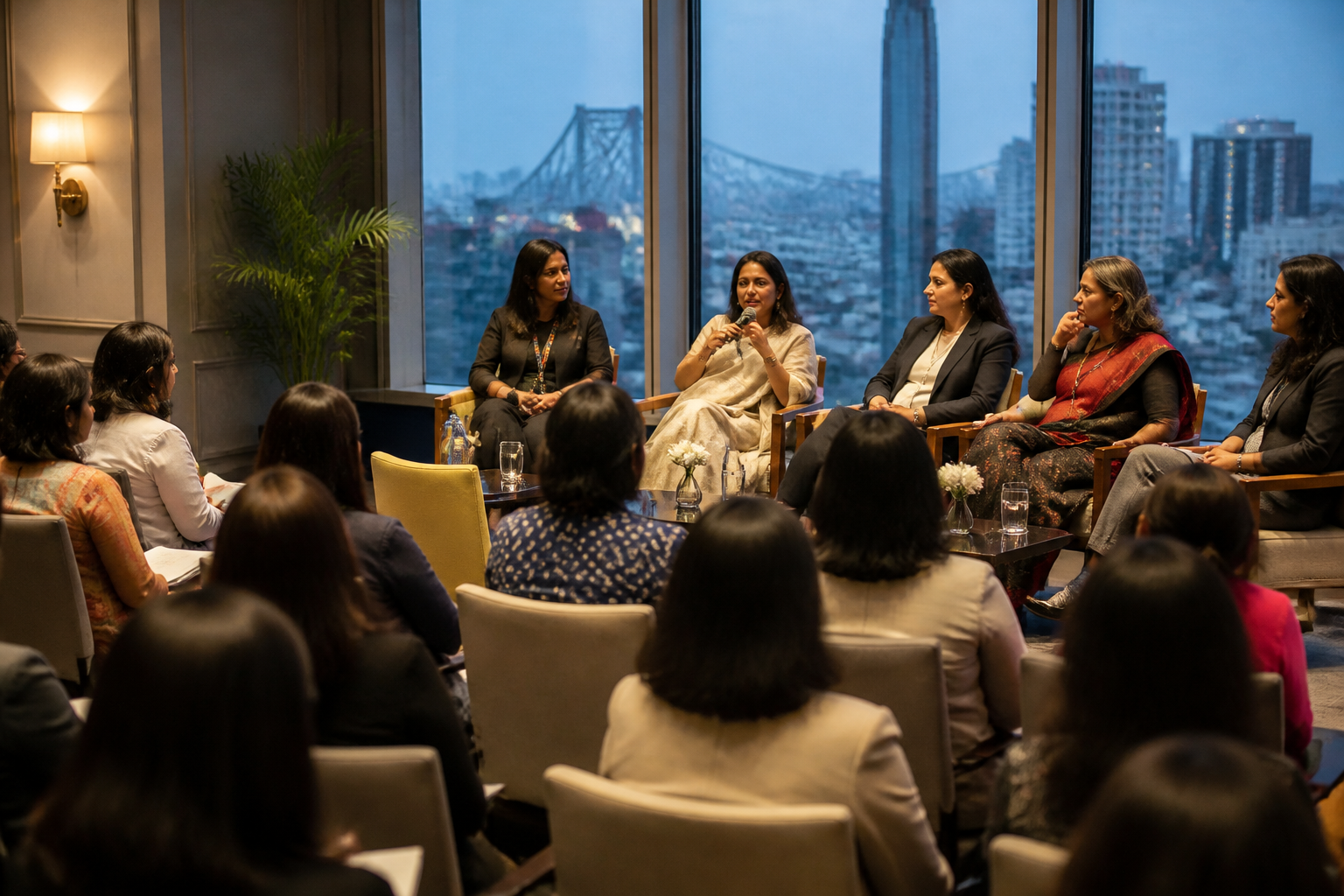
A new return-to-work playbook for small and mid-sized businesses places a difficult workforce problem in sharper focus: women who leave employment for childcare, health, education or other reasons often face institutional barriers when they try to return. Unveiled at a symposium in Kolkata, the guide developed by the diversity, equity and inclusion task force of the Bengal chapter of the Confederation of Indian Industry’s Indian Women Network sets out a framework for recruiting, onboarding and retaining women after career breaks.
The initiative matters beyond the individual hiring decision. It treats workforce re-entry as an organisational and labour-market question rather than solely as a personal challenge for women. That shift is particularly relevant for MSMEs, which were central to the playbook’s intended audience and to the discussions at the symposium. The event brought together corporate leaders, human resource professionals, entrepreneurs and women who had returned to work after career breaks.
The playbook’s central proposition is that employers need a structured pathway for people whose professional histories do not follow a continuous line. A career break can result from responsibilities or circumstances outside a person’s control, but recruitment systems may still read the gap as a negative signal. The guide therefore focuses on three linked stages: recruitment, onboarding and retention. Taken together, those stages suggest that hiring a returning professional is not enough. The workplace must also provide a workable route back into the organisation and the role.
The evidence cited at the symposium shows how the first barrier can emerge before a candidate reaches an interview. The playbook cites research indicating that a candidate with a career break is 24 percentage points less likely to be called back than an otherwise identical candidate without a break. That figure, as presented in the source report, points to a screening problem. The disadvantage is created at the point where employers assess a résumé, before a candidate’s current skills, experience or suitability can be discussed.
This distinction is important for MSMEs. A business may need skilled employees but still lose potential talent through recruitment filters that treat a gap as evidence of diminished capability. The return-to-work playbook attempts to connect those two sides of the problem: women seeking to re-enter employment and smaller businesses seeking access to talent. Its approach is not presented as a single hiring campaign, but as a step-by-step framework for making the pathway more accessible and sustainable.
The symposium also framed the issue through the relationship between caregiving and the economy. Swagata Guha Mustafi, chairperson of CII IWN West Bengal, said that losing women’s talent to caregiving at home was “not merely a personal loss — it is a loss to the national economy”. She argued that identifying fragmented roles and mapping them against the talent needs of MSMEs could allow women to re-enter the workforce while helping businesses access skilled talent for performance and growth.
That argument places caregiving within the design of employment systems. A career break is often discussed as an interruption in an individual’s résumé. The playbook, as described at the event, instead raises a question about whether employers have designed roles and processes that can accommodate varied career paths. Its reference to fragmented roles is significant because it suggests that the available work itself may need to be mapped more carefully against the skills returning professionals can offer.
The institutional setting also matters. The guide was developed by the DEI task force of CII’s Indian Women Network Bengal chapter, giving the initiative an industry-body platform rather than leaving the issue to isolated employer programmes. The event linked the experiences of large organisations with the practical challenges facing MSMEs. That connection is necessary because the systems, resources and human-resource capacity available to a large company cannot automatically be assumed to exist in a smaller business.
A fireside conversation featured Radhika Singh Banerjee, chief of talent management and employee experience at Tata Steel, and Navneet Damani, vice-president of human resources at ITC Limited. Moderated by Vishnupriya Sengupta, senior director at PwC India, the discussion focused on making return-to-work pathways accessible, supporting returning professionals and developing sustainable approaches. The emphasis on sustainability is relevant because re-entry is not complete when an offer letter is issued; the employee must also be able to remain in the role.
The event’s panel brought together participants from healthcare, technology, publishing, consulting, recruitment and industry. Its members included Roli Verma of Narayana Health, Anindita Mukherjee of the Cognitive AI Institute, Priyadarshini Basu of The Paperclip, Priyanka Singh of Click 1 Consulting Services, Anirvan Mukherjee of NMD Placement Consultancy and Swati Smita of Essel Mining and Industries. Asha Pillai, CFO of Shell Recharge, moderated the session.
The range of organisations represented at the panel indicates that the problem is not confined to one occupation or one sector, although the supplied report does not establish how the barriers differ between them. What the discussion does establish is that return-to-work questions are being considered across human resources, recruitment, entrepreneurship and operating businesses. That makes the playbook a mechanism for translating a broad DEI objective into employer-facing processes.
For cities, the issue is also a question of how urban economies use available skills. The event took place in Kolkata, but the source material does not provide city-level employment data or quantify the number of women affected in the region. It does, however, show how a city-based industry network is attempting to address a labour-market gap through guidance directed at businesses. The urban relevance lies in that institutional relationship: employers, professional networks and returning workers must connect through systems that make re-entry visible and workable.
The guide’s focus on MSMEs is especially important to its proposed model. The source report describes these firms as facing practical challenges in making return-to-work pathways accessible and sustainable. It does not provide details of the playbook’s individual steps, implementation costs, participating companies or measurable targets. Those gaps limit what can be concluded about its likely reach. The immediate significance is therefore the framework’s direction, not evidence of outcomes that have yet been reported.
This distinction should remain central as the initiative develops. A published guide can identify recruitment, onboarding and retention as linked concerns, but its impact will depend on how employers apply those principles. The available account does not say whether the participating MSMEs have adopted the playbook, how many returning women they intend to recruit or what monitoring system will be used. Those are the next institutional questions for any assessment of the initiative.
The 24-percentage-point callback gap cited in the playbook provides a clear measure of the problem at the screening stage. But the source does not provide the underlying study’s sample, geography, occupations or methodology. It should therefore be read as evidence cited by the playbook rather than as a complete measure of women’s workforce re-entry in Kolkata or India. More data would be needed to understand how the gap changes by sector, length of career break, qualification or type of role.
Even with those limits, the playbook identifies a structural sequence. First, a career break can reduce the likelihood of receiving a callback. Second, a returning candidate may require a more deliberate onboarding pathway. Third, retention must be treated as part of the process rather than as a separate human-resource concern. The value of the framework is its attempt to connect these stages instead of treating recruitment as the only point at which an employer can intervene.
The policy landscape described in the source is industry-led. The initiative comes from CII IWN’s Bengal chapter and is directed towards MSMEs, while the symposium brought in corporate and professional expertise. No government scheme, statutory mandate, public funding arrangement or regulatory requirement is identified in the supplied material. That means the playbook’s immediate model is one of institutional coordination and employer guidance rather than formal public policy.
That model can help create a common language around returning professionals, but it also leaves questions about scale and accountability. The source does not state whether the guide will be adopted through a formal commitment by participating businesses or whether its recommendations will be reviewed against employment outcomes. Nor does it establish whether women who attend or use the programme will receive placement support. These details will determine whether the initiative remains a discussion platform or becomes an operational labour-market intervention.
The wider urban question is how cities and their businesses respond when employment systems are built around uninterrupted careers. The symposium’s focus on childcare, health, education and other reasons for career breaks shows that professional participation can be interrupted by responsibilities and circumstances beyond a narrow workplace timeline. If recruitment systems treat those interruptions as permanent disqualification, businesses may exclude experienced people while continuing to report difficulty accessing suitable talent.
The playbook does not, on the evidence supplied, prove that its framework has already changed hiring outcomes. It does provide a structured response to a documented barrier and brings MSMEs into a conversation that is often associated with larger employers. The key developments to monitor are the guide’s implementation, the number and type of businesses that adopt it, the pathways offered to returning women and whether employers report changes in callbacks, onboarding and retention.
For now, the Kolkata symposium has made one institutional point clear: bringing women back to work cannot be reduced to asking individual candidates to explain a career gap. It also requires employers to examine how they identify talent, structure roles and support re-entry. The playbook’s significance will ultimately be measured not by its launch, but by whether those processes become more open to women returning after a break.
