


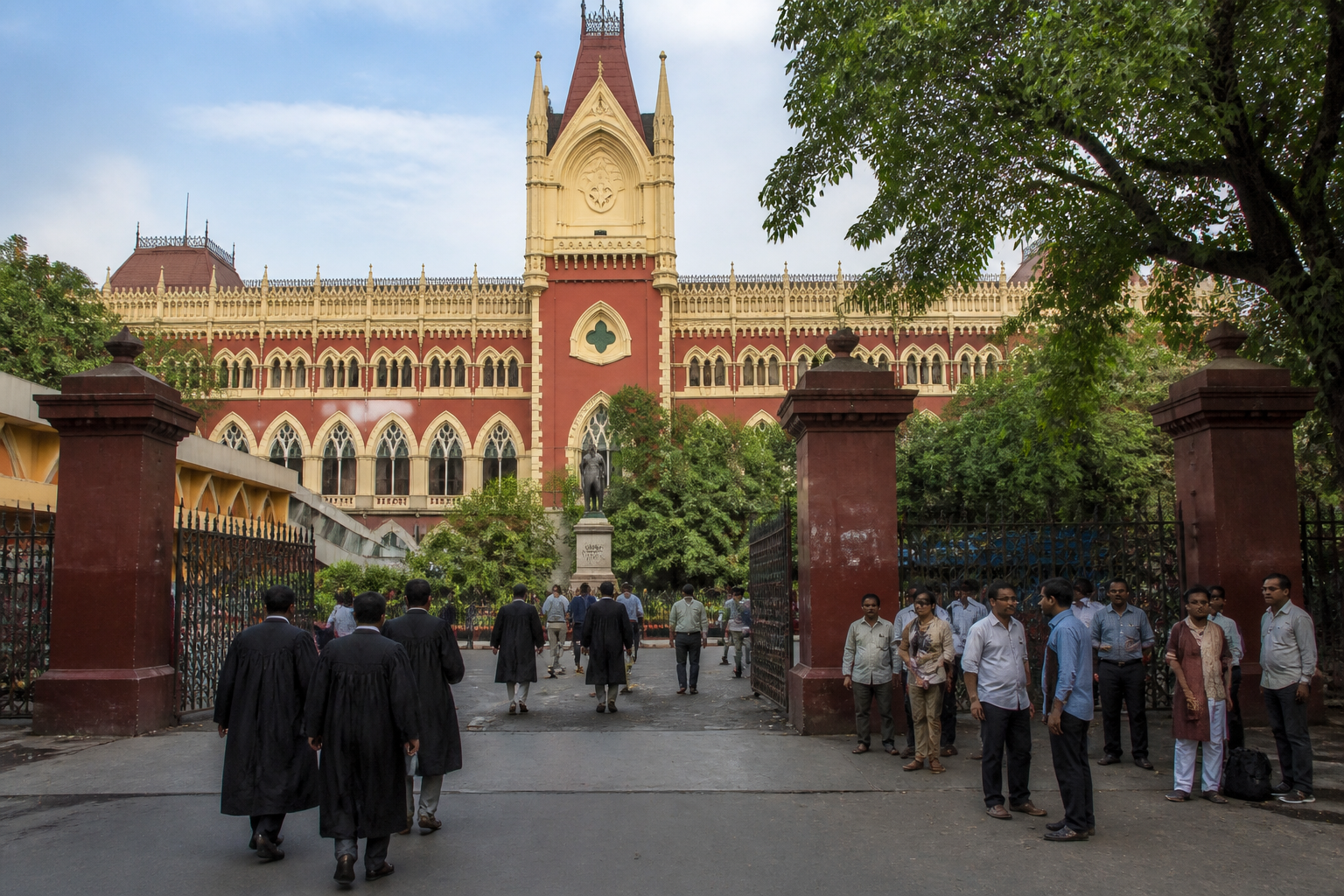
The Calcutta High Court has warned lawyers that public interest litigations filed without sufficient supporting documents could attract heavy penalties, with Chief Justice R.V. Ghuge calling such petitions a waste of the court’s time.
Justice Ghuge made the remarks on Wednesday while hearing a batch of PILs. A division bench headed by the chief justice usually hears public interest litigation cases in the high court.
“These petitions are being filed without furnishing sufficient documents. This is simply a waste of the court’s time,” Justice Ghuge said, according to a report by Telegraph India.
The chief justice also advised lawyers handling PILs to strengthen their legal groundwork and read more before approaching the court. “Such counsel will be forced to spend time in libraries,” he said.
The bench warned that it could impose “heavy penalties” on lawyers who file PILs without merit. The remarks place the focus on the evidentiary and legal preparation required before seeking judicial intervention in matters presented as issues of public interest.
A PIL allows citizens or groups to approach a court over matters affecting the wider public, including issues involving people who may not otherwise be able to seek judicial intervention. In urban matters, such petitions have often been used to challenge administrative decisions, raise environmental concerns and seek action on civic and public infrastructure.
In Kolkata, a PIL resulted in the shifting of the book fair out of the Maidan in 2007. In the same year, the high court prohibited the use of fuels other than LPG and open-fire ovens within a three-kilometre radius of the Victoria Memorial, with the stated aim of protecting the marble monument from environmental degradation.
Other landmark judgments arising from PILs have involved the protection of slum dwellers, alleged misappropriation of government funds and civic infrastructure. Such cases have made public interest litigation an important channel for scrutiny of decisions affecting urban land, public spaces, environmental conditions and access to basic services.
The Supreme Court and high courts have developed public interest jurisprudence through interventions concerning environmental protection, governance and fundamental rights. At the same time, the Supreme Court has repeatedly stressed that PILs must be used to pursue genuine public interest rather than private or publicity-driven objectives.
In May, Supreme Court Justice B.V. Nagarathna said PILs were intended to “bring social justice within the reach of the common man”. She also observed that the mechanism had, in some cases, become “private”, “publicity”, “paisa” and even “political” interest litigation.
The Calcutta High Court’s latest warning comes as a reminder that petitions affecting public administration and urban life must be supported by relevant documents and a clear legal basis. The court’s next steps will depend on the PILs being heard by the division bench and on whether the threatened penalties are imposed in specific cases.
