


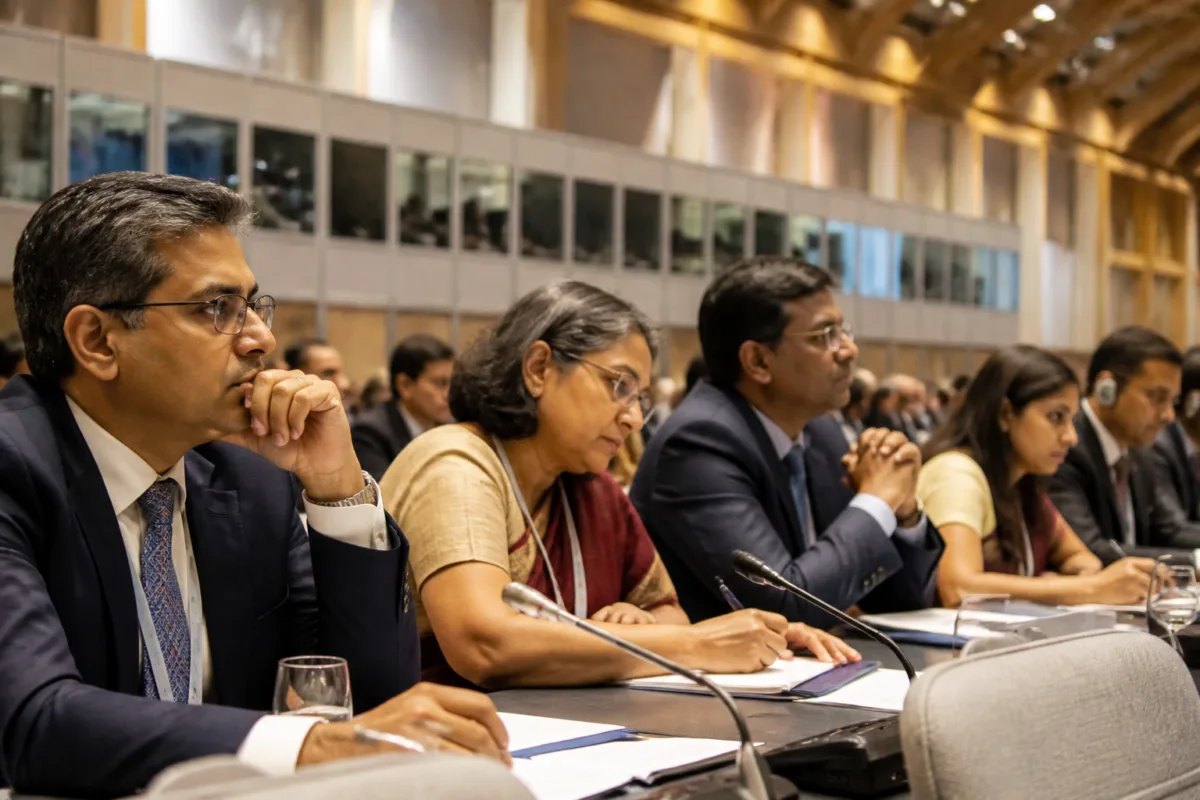
India has brought historical responsibility for greenhouse-gas emissions back to the centre of climate negotiations at COP31, linking the issue to climate finance, adaptation and the development rights of developing countries.
In its national statement at the conference in Antalya, Türkiye, Environment, Forest and Climate Change Minister Bhupender Yadav urged the presidency to apply equity, climate justice and the principle of Common but Differentiated Responsibilities and Respective Capabilities (CBDR-RC), which is part of the United Nations climate framework.
The statement also called for the remaining global carbon budget to be treated as non-negotiable, for the Global Stocktake to remain an instrument that informs countries rather than imposes obligations on them, and for the Just Transition Mechanism to be anchored in equity. India further opposed unilateral trade measures that could penalise developing countries in the name of climate action.
The position directly relates to the European Union’s Carbon Border Adjustment Mechanism, which applies a carbon cost to certain imported goods based on their emissions. For countries seeking to expand manufacturing and improve living standards, such measures have become part of a broader dispute over who should bear the economic costs of decarbonisation.
Historical responsibility is based on the argument that countries that industrialised earlier, largely through extensive fossil-fuel use over the past two centuries, bear a greater responsibility for addressing climate change and supporting developing countries through finance and other means. The principle was central to the Kyoto Protocol, under which binding emissions-reduction targets applied primarily to developed countries.
The Paris Agreement adopted a different structure. It requires all countries, including India, to act through their respective climate commitments while recognising different national circumstances and capabilities. India’s latest intervention seeks to sharpen the distinction between universal participation in climate action and the unequal historical contribution to accumulated greenhouse-gas emissions.
Yadav said developing countries should not be forced to choose between climate action and legitimate development needs, including decent living standards, healthcare and education. The statement described equitable access to the remaining carbon budget as non-negotiable.
According to the report, India had raised historical responsibility at earlier conferences, including while representing the Like-Minded Developing Countries group at COP29 and in a joint BASIC and LMDC statement at COP30. It had also referred to the issue at COP27. The latest statement, however, placed greater emphasis on the link between past emissions, present climate impacts and financial obligations.
The debate is particularly relevant to adaptation finance. Developing countries require resources to respond to climate impacts while continuing to expand essential services and infrastructure. The source report identifies a continuing gap between the resources needed for adaptation and the finance being made available, affecting countries such as India as well as least-developed nations.
An Indian negotiator, speaking anonymously, said developed countries were resisting commitments on climate finance, especially adaptation finance, despite the issue being included on the agenda. The negotiator alleged that questions about the time frame and volume of funding were being used to delay progress. This remains an attributed claim rather than an independently established outcome of the negotiations.
Xolisa Ngwadla, special adviser to the chair of the Africa Group of Negotiators on Climate Change, also said developed countries were retreating from earlier commitments. He referred to the COP30 agreement in Belém, which set an ambition of reaching at least US$120 billion in adaptation finance annually by 2035.
The dispute therefore concerns more than the size of a financial pledge. It also concerns whether climate negotiations will produce resources that reach countries and communities facing immediate adaptation needs. India’s national statement said the success of COP31 should be measured by implementation, resources reaching those who need them and the scaling up of proven solutions.
India has also sought to present itself as both a developing country with low per-capita emissions and a participant in climate action. A senior Indian negotiator cited in the report said India accounts for about 17 per cent of the world’s population but only 4–5 per cent of cumulative global emissions. Yadav said India’s next Nationally Determined Contribution was aligned with the goal of a sustainable Viksit Bharat by 2047.
At the same time, India had earlier declined to join an electrification pledge promoted by the COP31 presidency. That decision, together with its renewed emphasis on historical responsibility, indicates the continuing tension between global calls for faster climate action and national positions on development, technology and finance.
For India, the unresolved question is how international commitments will translate into dependable finance and implementation capacity. Without agreement on adaptation funding, the burden of responding to climate risks remains concentrated in countries that argue they contributed less to the historical stock of emissions. The negotiations at Antalya are consequently testing not only the ambition of climate action, but also the fairness and delivery of the system intended to support it.

