


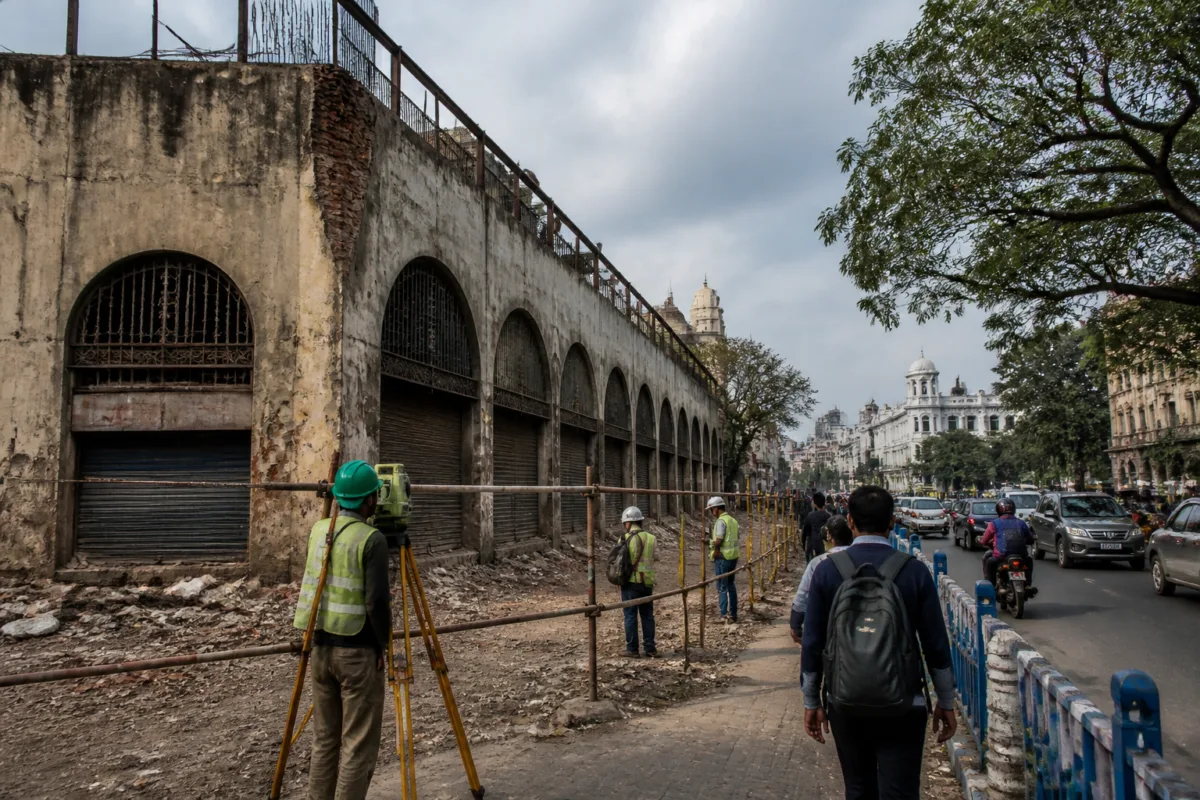
The Esplanade Metro station has moved closer to construction after all 528 traders at Kolkata’s old Maidan Market relocated to a new structure, but the project still shows how urban infrastructure can remain stalled when land, heritage-era commercial activity, defence control and traffic management overlap in one location. Demolition of the old Dr BC Roy Market is expected to begin in the first week of December, while physical construction of the station is planned for March or April, according to senior railway and Metro officials quoted by the Times of India.
The immediate event is the clearance of the old market building, which is no longer operational and has been locked after traders shifted out. The relocation removes one of the most visible obstacles to construction at Esplanade. Yet it does not complete the approval chain. Railway officials said additional defence land is still required, and discussions with the Ministry of Defence are continuing. The Indian Army is the custodian of Kolkata Maidan, meaning construction activity in the area requires its approval.
This makes the Esplanade station more than a construction-site problem. It is a case study in how major transport projects are assembled from permissions controlled by different institutions. Railways and Metro authorities are responsible for delivering the line, the executing agency is Rail Vikas Nigam Ltd, the contractor is Larsen and Toubro, defence authorities control relevant land, market traders occupy the affected commercial premises, and traffic authorities will have to manage changes on Dufferin Road. The station cannot move from design to excavation through the action of one agency alone.
The project’s history underlines the cost of that fragmentation. The plan to shift Maidan Market was first proposed more than three-and-a-half years ago. A Press Information Bureau release issued in March said that temporary shifting of the 528 unauthorised shops on defence land was required for construction of the Esplanade Metro station. According to the release, the proposal for a no-objection certificate for the temporary shifting of the market was submitted in February 2022.
The delay was therefore not caused simply by the physical presence of a market building. It involved the legal and administrative status of the stalls, the ownership and custodianship of the land, the relocation of traders and the need to create a replacement facility before the old structure could be cleared. The relocation has now happened, but the handover is not entirely complete. Kishore Manglani, secretary of the stall owners’ association, told the Times of India that traders still retain the keys to the individual stalls and the old market, while some amenities promised in the new market have yet to be delivered.
That detail is important because urban infrastructure projects often treat relocation as a binary event: either occupants are present or they have moved. On the ground, handover is usually a process involving access, services, documentation, compensation or replacement premises. In the Maidan Market case, traders have shifted to the new structure, but the unresolved amenities and retained keys indicate that the social and administrative closure of the relocation is still incomplete. The report also says RVNL has been cooperating with the traders, suggesting that continuing coordination remains necessary even after physical evacuation.
The next stage brings another layer of complexity. Railway officials said some work must be completed between demolition of the old market and the start of station construction. The Esplanade Tram Depot has to be shifted, and vehicular traffic on Dufferin Road must be diverted. This means the construction schedule depends not only on taking down the old market but also on reorganising nearby transport and public-utility functions before excavation begins.
The proposed timeline reflects that sequence. RVNL officials have promised to start physical construction of the station by April 2027, while a senior Metro Railway official said the Esplanade station is expected to be ready by December 2030. Between those milestones lie demolition, site preparation, the tram-depot shift, traffic diversion and the completion of outstanding land approvals. The supplied report does not establish whether each of these steps has a finalised schedule, making them important implementation points to monitor.
Esplanade is also significant because it sits at the centre of Kolkata’s transport geography. The location connects a major commercial district with the Maidan, tram infrastructure, road traffic and the city’s existing and planned rail networks. A station here is consequently not an isolated addition to the Purple Line. Its construction affects how the surrounding public realm is used during the works and how commuters, traders and motorists move through one of the city’s most central areas.
The Purple Line itself remains only partly operational. The 7.7-kilometre stretch between Joka and Majerhat is currently in service, while the planned line is 26.8 kilometres long and is intended to end at Eden Gardens. The gap between the operational section and the full planned alignment shows why the Esplanade station matters to the line’s eventual continuity. At the same time, the available information does not establish when the entire corridor will be completed or how the station’s December 2030 target relates to the opening of the rest of the route.
The project’s institutional structure adds another accountability question. RVNL is the executing agency, and Larsen and Toubro is the private contractor building the Purple Line. The contractor’s inspection of the old market building indicates that preparation for demolition has begun, but inspection is not the same as completion of statutory clearances or site possession. The railway and Metro authorities will therefore have to convert the announced sequence into verifiable milestones: formal handover of the market, demolition, defence-land approval, tram-depot relocation, traffic management and construction commencement.
For citizens, the most immediate impact is likely to arise from the construction arrangements rather than from the eventual station opening. The planned diversion of traffic on Dufferin Road will affect road users, while the shift of the tram depot could alter local operations and access. The source material does not provide details of the proposed diversion route, duration, traffic plan or impact on tram services. Those gaps matter because construction disruption is often experienced locally well before the benefits of a new station become available.
The Maidan Market episode also shows why project timelines should be read as conditional rather than automatic. The December demolition plan is linked to trader relocation, but keys and promised amenities remain issues. The March-April construction expectation is linked to several preparatory works and continuing discussions over defence land. The December 2030 completion target is an official projection, not evidence that all intervening permissions and site requirements have already been secured.
The central lesson is that the Purple Line’s progress depends on coordination capacity as much as on engineering capacity. A station can be designed, contracted and publicly scheduled, yet remain blocked until a market is relocated, a land-owning institution grants approval, a transport facility is shifted and road space is reorganised. In Esplanade, the visible structure being demolished is only one part of the project’s delivery chain.
What is now established is that all 528 market traders have relocated to the new facility, the old market is no longer functioning, demolition is expected in early December, and physical station construction has been promised for March or April, with completion targeted for December 2030. What remains to be demonstrated is whether the remaining land approval, key handover, amenities, tram-depot relocation and traffic-diversion arrangements can be completed in sequence. Those milestones will determine whether Esplanade becomes the next step in Purple Line expansion or another example of Kolkata’s infrastructure being delayed by unresolved urban coordination.

