


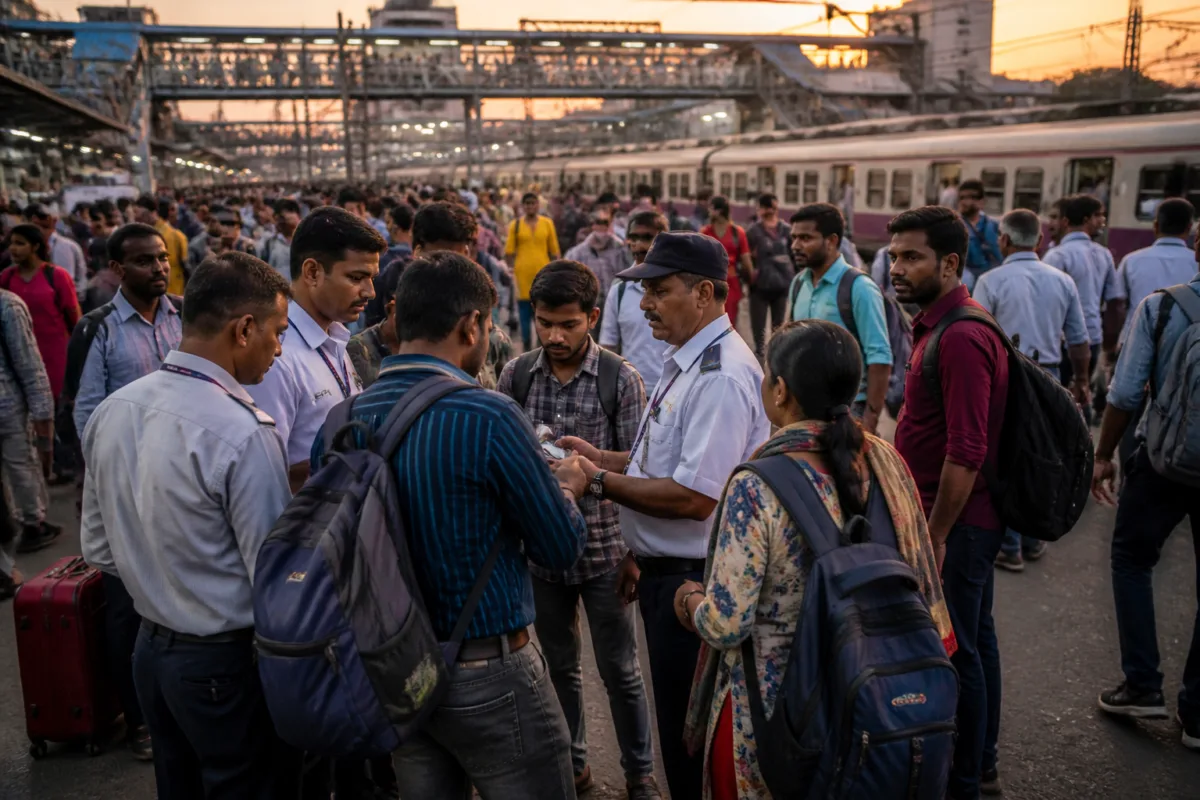
Western Railway’s record recovery of Rs 8.23 crore during its 15-day Diwali enforcement drive offers more than a measure of railway vigilance. It provides a rare numerical view of how intense festive demand, crowded trains and weak compliance can combine to put pressure on Mumbai’s already heavily used rail system. Between October 31 and November 14, the Mumbai Central Division detected 94,919 cases of ticketless or irregular travel during ‘Operation Deep’, according to a Western Railway official quoted by the Times of India.
The campaign covered suburban and long-distance services, with ticket-checking teams deployed at major stations, entry and exit points and heavily patronised routes. Officials said the drive included surprise inspections, onboard checks and coordinated enforcement operations. The reported recovery exceeded the division’s target of Rs 7.65 crore by more than 7.5 per cent and was 53 per cent higher than the Rs 5.36 crore recovered during the corresponding Diwali period in 2025.
These figures do not, by themselves, establish that ticketless travel increased by 53 per cent. They record the amount recovered during an intensified enforcement campaign. The increase may therefore reflect the scale of checking, the number of passengers inspected, the volume of irregularities detected, the value of penalties and fares collected, or a combination of these factors. The supplied report does not provide a comparison of inspection hours, personnel deployed, passenger volumes or the number of trains checked in the two periods.
That distinction matters because railway enforcement numbers are shaped by both passenger behaviour and institutional capacity. A large detection figure can indicate widespread non-compliance, but it can also indicate that an agency has concentrated more staff and more checks in places where violations are likely to be found. Without a denominator—such as the number of passengers checked or the total passenger journeys during the campaign—the recovery figure cannot be converted into a precise rate of ticketless travel.
Even with that limitation, the scale of the operation is significant. Nearly 95,000 cases were recorded in a fortnight across a network serving one of India’s busiest metropolitan regions during one of its most demanding travel periods. Diwali brings higher movement across suburban and intercity rail services, while trains and stations operate under conditions in which boarding, alighting and crowd circulation become more difficult to manage. In that environment, ticket checking is not only a revenue exercise; it is also part of the railway’s attempt to regulate access to limited space.
Western Railway said the campaign was intended to ensure that passengers holding valid tickets could travel without inconvenience caused by unauthorised travellers. The statement points to a broader operational problem: on a crowded railway, an invalid ticket or unauthorised occupation of a reserved coach affects more than the fare that has not been paid. It can alter the distribution of passengers inside a train, increase conflict between travellers and complicate the experience of those who have paid for a specific service.
The report specifically identifies several forms of irregular travel. These include travelling without a valid ticket or pass, travelling beyond the authorised destination and occupying reserved coaches with unreserved tickets. Each reflects a different administrative challenge. The first is a basic fare-compliance issue. The second concerns the difficulty of controlling journeys once passengers are inside a high-volume network. The third concerns the enforcement of service categories, particularly when reserved and unreserved passengers meet during festival congestion.
The institutional response described in the report is correspondingly distributed across the journey. Checks were carried out at stations, at entry and exit points and onboard trains. This is important because no single checkpoint can fully control a large suburban system. Station checks can intercept passengers before boarding or after arrival, while onboard inspections can identify passengers who evade or bypass entry controls. Surprise inspections are intended to reduce the ability of passengers to plan around predictable checking patterns, although the supplied report does not quantify how frequently each method was used.
The recovery also shows why festive periods become focal points for railway enforcement. Demand is concentrated, long-distance trains operate at full capacity and suburban services are crowded. Those conditions increase the financial stakes of fare compliance, but they also make enforcement more difficult. Staff must check passengers without creating additional congestion or delaying train operations. The report does not state whether the campaign caused delays, altered boarding procedures or required additional operational resources.
The comparison with the previous year gives the campaign a clear institutional benchmark. Recovery rose from Rs 5.36 crore during the corresponding Diwali period in 2025 to Rs 8.23 crore in the latest campaign. The Mumbai Central Division had also set a target of Rs 7.65 crore, which it exceeded. Targets can help railway divisions organise enforcement and measure collection performance, but the available account does not explain how the target was calculated or whether it was based on past recovery, expected passenger traffic, staffing levels or another internal method.
That missing information limits what can be inferred from the record. The figures confirm that Western Railway collected more money and detected more irregular-travel cases during the reported drive than during the previous comparison period. They do not show whether the underlying rate of non-compliance rose, fell or remained unchanged. Nor do they show whether passengers changed their behaviour after encountering more frequent checks. Those questions would require data on total ridership, passenger inspections, repeat violations, penalties imposed and the proportion of cases settled through fare recovery.
The story therefore sits at the intersection of revenue protection and passenger management. Railways are public transport systems, but they also operate through detailed rules governing fares, passes, reservations and access to different services. Enforcement is the mechanism through which those rules become visible in everyday travel. During normal periods, non-compliance may be dispersed across the network. During a festival rush, it becomes more consequential because even small breaches occur within a system close to its practical capacity.
The report does not identify the exact number of personnel deployed, the stations with the highest number of violations or the split between suburban and long-distance services. It also does not say how much of the Rs 8.23 crore represented unpaid fares and how much represented penalties. These details would be necessary to assess where the greatest pressure lies and whether enforcement is addressing the main sources of leakage.
For passengers, the immediate implication is that intensive checking is likely to remain part of Western Railway’s response during high-demand periods. Officials said similar drives would continue in the future to promote disciplined travel and improve the passenger experience. That commitment indicates that the operation is being treated as a continuing enforcement model rather than a one-time Diwali exercise.
The larger urban question is how Mumbai’s railways can maintain orderly access when demand surges sharply across a network that serves both daily commuters and seasonal travellers. Operation Deep confirms the scale of the enforcement task and the money involved, but it does not yet explain the causes of irregular travel or measure the effect on crowding and service quality. Future reporting would need those operational indicators to determine whether higher collections translate into better passenger management, or simply more effective detection during peak periods.

