


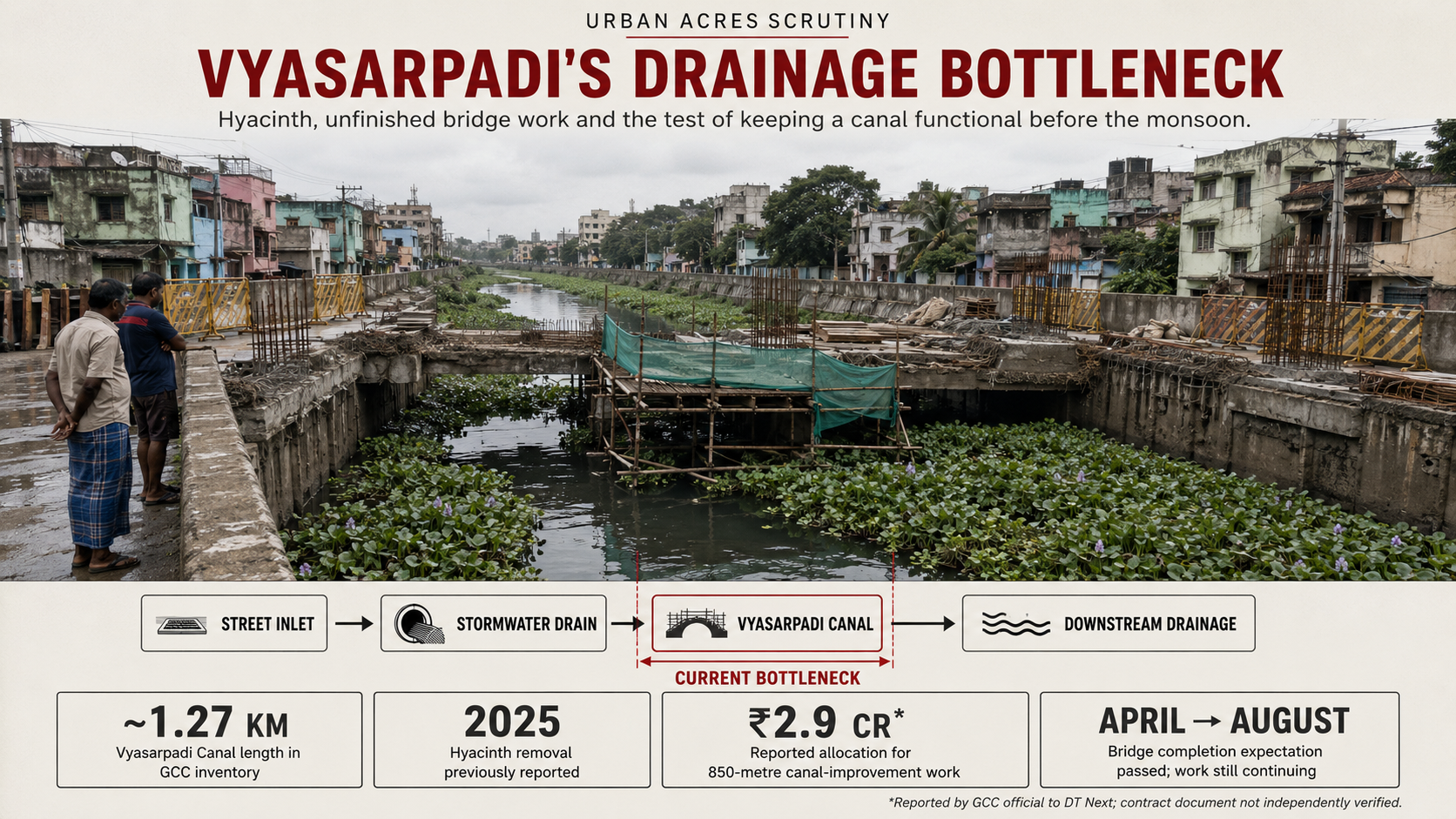
Dense water hyacinth and continuing bridge construction are restricting a drainage corridor in Vyasarpadi’s Shastri Nagar, raising a larger question for Chennai’s flood-preparedness programme: can the city keep its existing canals hydraulically functional while simultaneously rebuilding the infrastructure around them?
Residents along Shastri Nagar First Street say water hyacinth has spread across a substantial portion of Vyasarpadi Canal and that rainwater is stagnating around the locality. Construction at an Anna Salai bridge is also reported to be obstructing parts of the water path. Greater Chennai Corporation has said a robotic excavator has been requested to clear the vegetation.
The immediate intervention is therefore still at the maintenance-response stage. A machine has been requested; completed removal has not yet been established.
But the episode deserves scrutiny because neither canal maintenance nor construction at this location is new.
The canal was being cleared a year ago
In August 2025, GCC was already using a robotic excavator to remove weeds and hyacinth from Vyasarpadi Canal near Dr Ambedkar Arts College. Officials at the time described a broader programme that was to include deepening and desilting the channel, raising its wall and reconstructing a culvert to improve water movement. Completion was then expected by the second week of October.
The recurrence of dense vegetation does not prove those earlier works failed. Water hyacinth can return and canal maintenance is inherently recurrent.
It does, however, change the accountability question.
The relevant measure is no longer simply whether GCC undertook a cleaning operation last year. It is how frequently the canal is inspected and cleared, what service standard governs acceptable obstruction and whether maintenance cycles are adequate ahead of heavy rainfall.
That matters because GCC’s own stormwater department states that it maintains Vyasarpadi Canal and describes canal desilting and hyacinth removal as regular rotational activities.
Residents’ claim of vegetation persisting for about five months therefore deserves reconciliation with the Corporation’s stated maintenance regime.
A flood-mitigation bridge has become part of the drainage problem
The more consequential issue is the unfinished bridge.
In April, residents were already reporting disruption after the Anna Salai bridge in Shastri Nagar was demolished as part of canal-improvement works. GCC then said underground Metro Water and drainage pipelines encountered during excavation had contributed to the delay.
Officials described a project costing around ₹2.9 crore, extending over 850 metres and approximately 70% complete. Bridge reconstruction, they said, was expected within 15 days.
More than four months later, the August 30 report says one side is complete and construction continues on the other. Residents now associate that construction with restricted water movement and local stagnation.
Urban Acres has not located the corresponding work order or revised construction programme, so it cannot establish the contractual completion date, contractor responsibility or whether an authorised extension of time has been granted.
Those documents now matter.
A delay caused by unmapped or unexpectedly encountered utilities is technically plausible. Chennai road and drainage projects routinely operate in crowded rights-of-way containing water, sewer, electricity and telecom infrastructure.
But once the delay extended into another monsoon-preparation cycle, the critical engineering question became whether GCC maintained a temporary hydraulic passage around the worksite.
Flood-mitigation construction cannot be judged solely by eventual completion. Its temporary works must also preserve drainage capacity while construction is underway.
Vyasarpadi Canal is part of a larger drainage system
GCC’s published canal inventory lists Vyasarpadi Canal at roughly 1.27 km and identifies it with the Captain Cotton watershed in Chennai’s northern basin. The Corporation separately lists Captain Cotton Canal, Kodungaiyur Canal, Vyasarpadi Canal and Jawahar Canal among its Zone IV assets.
That distinction is important.
Earlier reporting linked the Anna Salai bridge work to improvements along Captain Cotton Canal, while the latest report identifies the affected waterway as Vyasarpadi Canal.
The two descriptions may reflect interconnected works within the same drainage catchment, but public documents reviewed by Urban Acres do not establish the exact chainage and hydraulic interface.
GCC should publish the project plan rather than leave residents and reporters to reconstruct the drainage network from individual works.
The system has to work from street to outfall
For residents, the drainage system is not a canal-cleaning programme.
It is a chain:
Street inlet → local stormwater drain → collector/trunk system → Vyasarpadi or connected canal → downstream canal → final receiving waterbody
A bottleneck at any interface can limit the performance of upstream investment.
That means measuring only kilometres of stormwater drains constructed or tonnes of vegetation removed is inadequate.
The more useful operational questions are:
- What is the canal’s unobstructed design section?
- How much of that section is presently available?
- Is silt reducing depth?
- Are bridge or temporary construction works reducing effective opening?
- Are garbage and vegetation being intercepted upstream?
- What downstream water level causes backflow or surcharge?
- How long does water remain on Shastri Nagar streets after a defined rainfall event?
Those indicators would show whether the infrastructure is delivering the intended service.
Machine deployment alone will not close the story
GCC has experience and equipment for mechanical canal cleaning. Its official stormwater page specifically describes robotic excavators used for canal desilting and shows them working in the Vyasarpadi area.
A June 2026 procurement also sought a floating hydraulic excavator for 60 days in Zone IV, at a tender value of ₹15.49 lakh. But the published work description identifies Buckingham, Captain Cotton and Linking canals—not Vyasarpadi Canal itself.
The connection, if any, should therefore not be assumed.
More importantly, removing today’s vegetation would restore only one part of the system.
If garbage dumping persists, maintenance intervals are too long, construction constricts flow or a downstream bottleneck remains, vegetation removal becomes a recurring emergency response rather than a dependable drainage-management programme.
What residents should be able to measure next
The proper test comes after the excavator leaves.
GCC should publish a dated before-and-after record for the affected reach showing:
- canal chainage cleared;
- vegetation removed;
- desilting completed;
- effective channel width and depth restored;
- bridge opening available during construction;
- project completion percentage;
- contractor and work-order number;
- original and revised bridge completion dates;
- utility conflicts remaining;
- and street-level waterlogging duration after subsequent rainfall.
That would convert monsoon preparedness from an activity report into a service-performance record.
For Shastri Nagar residents, success is not a photograph of an excavator in a canal.
It is rainwater leaving the neighbourhood without entering homes or remaining stagnant in the streets.
