


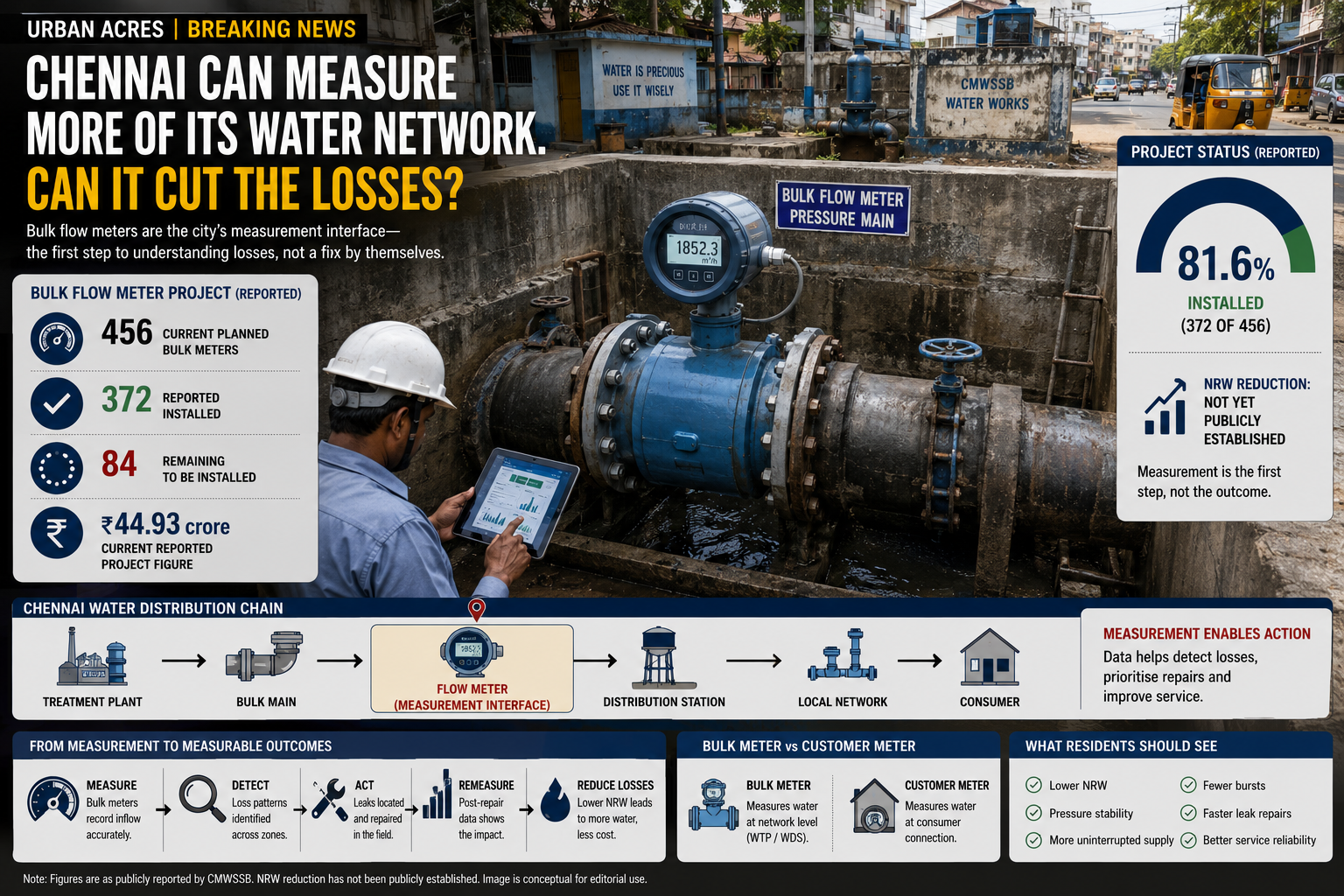
Chennai Metrowater has installed 372 of a currently planned 456 bulk flow meters across the city’s water-supply infrastructure, taking a long-running programme to measure water moving through the network closer to completion.
CMWSSB Managing Director T. Anand inspected installations at the Manapakkam water-distribution station and Ramakrishna Nagar pumping station in Valasaravakkam. Eighty-four meters remain under the present stated programme.
The installation matters. But its significance needs to be stated precisely.
A flow meter does not reduce non-revenue water by itself. It gives the utility the information needed to identify where intervention is required.
That distinction is particularly important in Chennai, where the water utility is simultaneously attempting to strengthen bulk transmission, modernise distribution, expand consumer metering and improve the reliability of service.
A measurement project dating to 2023
The latest development is an implementation milestone, not a newly announced scheme.
Tamil Nadu’s Municipal Administration and Water Supply policy documentation records government administrative approval of ₹43.01 crore for bulk water metering under Singara Chennai 2.0 through a February 2023 government order. The purpose identified in that documentation was to support water audits and assess non-revenue water.
A subsequent procurement sought electromagnetic flow meters with IoT-based data-transfer facilities at CMWSSB’s treatment plants, distribution stations and filling stations, along with comprehensive operation and maintenance.
By May 2025, CMWSSB officials were reported to have said around 70% of the installations were complete. The current 372-meter tally therefore represents further physical progress on that older programme.
Measuring NRW is not the same as reducing it
Non-revenue water is the difference between water entering a distribution system and the volume for which a utility ultimately receives revenue. It can arise from leaking pipes and reservoirs, unauthorised use, meter inaccuracies, billing problems and authorised but unbilled uses.
That makes reliable flow measurement essential.
If CMWSSB knows how much water leaves a treatment facility, how much reaches a distribution station and—eventually—how much legitimate consumption occurs downstream, it can build a water balance and narrow the location of losses.
But the sequence is:
Measure → locate discrepancy → diagnose cause → repair/enforce/correct → measure again.
The latest announcement establishes progress mainly at the first stage.
It does not yet demonstrate a fall in Chennai’s NRW percentage.
Two unresolved changes in the project record
The public record also contains two discrepancies that deserve clarification.
First, the 2023 tender BOQ indexed online referred to 518 full-bore electromagnetic flow meters. The latest CMWSSB communication refers instead to a programme of 456 meters.
That is 62 fewer meters than the earlier tender quantity.
There may be a straightforward technical explanation—sites may have been rationalised, designs may have changed or the final contractual scope may differ from the tender BOQ—but Urban Acres did not find the document explaining that change.
Second, the older policy documentation gives the project’s administrative approval as ₹43.01 crore, while the latest update describes the initiative as costing ₹44.93 crore.
Urban Acres could not determine from the documents reviewed what financial category accounts for the difference.
Neither discrepancy invalidates the project. Both warrant a revised project sheet from CMWSSB stating the final sanctioned scope, contract quantity and cost.
Bulk metering is only one half of the water balance
Chennai is also pursuing a much larger customer-metering programme.
An official Tamil Nadu tender sought procurement, commissioning, communication, billing and long-term operation of one lakh smart water meters under a Hybrid Annuity Model. Procurement records indicate the contract has since moved through award.
This distinction is crucial.
A bulk flow meter can establish how much water enters a part of the system. Consumer meters help establish how much of that water is legitimately consumed and billed.
Without both sides of the equation—or another reliable method for estimating legitimate consumption—NRW estimates remain less precise.
World Bank programme documents for Chennai similarly link operational improvement not merely to meter installation but to a chain of outputs that includes bulk metering, customer metering and quantified NRW reduction. A revised results framework sets an outcome of NRW below 20% in selected subzones, alongside one lakh metered connections.
That is a far stronger performance test than counting devices installed.
Equity depends on what the utility does with the data
CMWSSB also says flow information should help detect unequal distribution between areas. That is plausible: knowing inputs and withdrawals at different nodes can expose unusually low or high flows.
But equity cannot be established from meters alone.
The relevant resident-level metrics are whether different neighbourhoods receive comparable pressure, duration, quality and reliability after accounting for legitimate network constraints and service needs.
ADB’s current Chennai water programme, approved in June 2026, similarly focuses on safe and reliable water services, network modernisation, stronger pressure and O&M performance—not simply additional infrastructure.
The logical next step for CMWSSB is therefore a public water-balance dashboard.
For every monitored distribution zone or subzone, it should show how much water entered, authorised consumption, estimated NRW, leakage interventions, pressure, average supply duration and whether losses fell after repairs.
Only then will residents be able to distinguish a metering programme from a water-loss reduction programme.
