


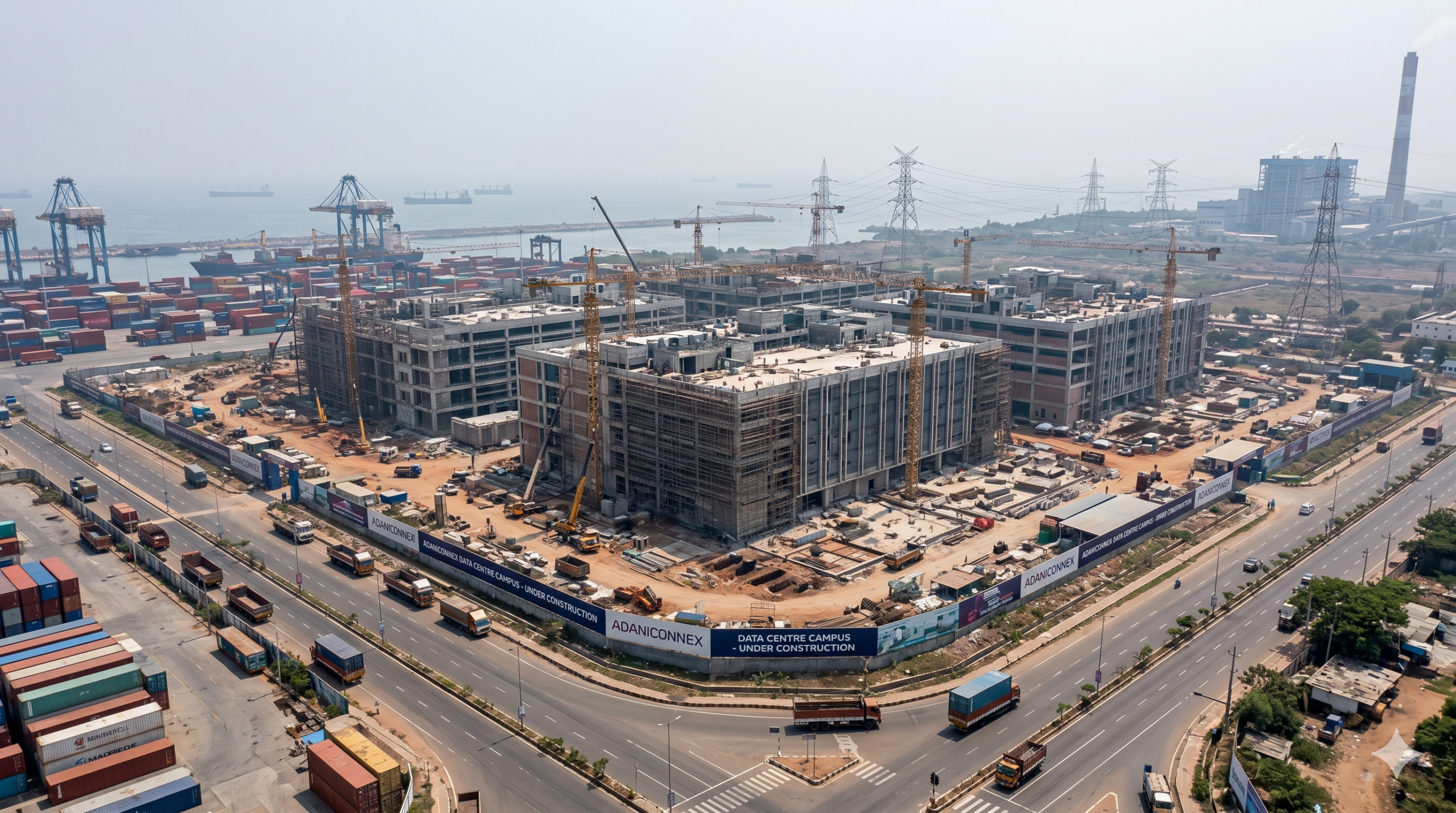
Visakhapatnam’s industrial coast is now being positioned for one of India’s largest digital infrastructure bets, with Adani Group committing $100 billion toward a national AI platform anchored by a nearly 1 gigawatt hyperscale data centre campus planned in the city. The announcement, made during the foundation event for the first phase of the AI facility this week, places Visakhapatnam at the centre of a new category of urban buildout: compute infrastructure on the scale of heavy industry.
Adani officials say the integrated platform will combine AI data centres, clean power systems, transmission networks and digital backbone infrastructure, while technology partner investments led by Google are expected to add another $15 billion to the larger campus ecosystem. Publicly stated capacity figures indicate that nearly 1 GW of server load is being planned at one location — a substantial benchmark in a country whose operational data centre stock currently stands at roughly 1.3 GW.
That number changes the meaning of the project.
This is no longer a standard commercial server park or IT warehouse. A one-gigawatt AI compute zone requires the kind of urban servicing usually associated with ports, aluminium plants or refinery clusters: uninterrupted high-voltage electricity, dedicated fibre corridors, land buffers, water management systems, cooling infrastructure and long-horizon industrial logistics.
Visakhapatnam is being chosen because it can offer that combination.
The city already sits on a deep industrial coastline with transmission access, port adjacency, large land parcels and state backing for technology manufacturing expansion. Andhra Pradesh has spent the past year repositioning Visakhapatnam not just as a maritime city but as an east-coast digital industrial node, and this AI campus now becomes one of the clearest physical expressions of that shift.
The authority priority is visible in the geography itself.
India is now treating AI infrastructure less like software policy and more like strategic utility infrastructure — something that requires dedicated energy, dedicated land and long-term urban planning guarantees. In practical terms, land and power that might once have been reserved for conventional manufacturing or mixed industrial growth are now being assigned to compute-heavy private digital campuses.
That is the central trade-off.
Hyperscale AI growth promises jobs, cloud capacity and lower domestic computing costs, but it also concentrates enormous urban resources into a single private technology ecosystem whose local employment footprint may remain far smaller than its land and electricity footprint.
Visakhapatnam has seen this pattern before in other sectors: ports changed the shoreline, pharma changed the industrial belt, and steel changed freight movement. AI infrastructure is now beginning to change what the next layer of the city gets built for.
What rises on this coast may look like server sheds.
But the power lines, substations and secured land around them will tell the larger story.
