


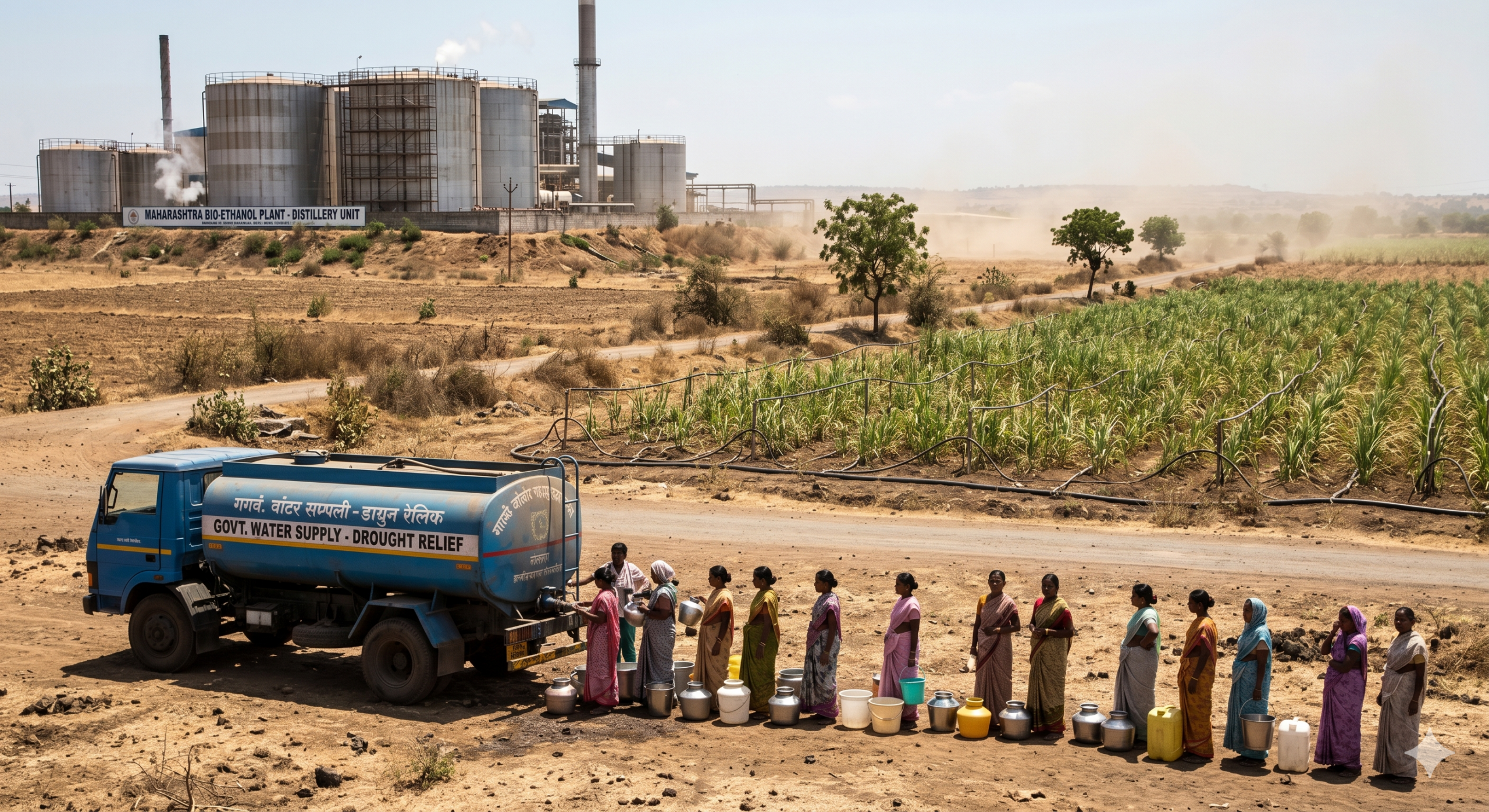
India’s ethanol blending programme is now drawing heavily on the same groundwater systems that several major cities depend on, creating a new resource contradiction between fuel security and urban water resilience. As the Centre sharply raises grain and sugar diversion for ethanol production in 2025-26, water-intensive crops such as rice, maize and sugarcane are increasingly being routed toward distilleries even in states already facing recurring summer tanker dependence.
The scale of water involved is no longer marginal. Government data cited by Food Secretary Sanjeev Chopra shows that producing one litre of ethanol from rice can consume roughly 10,790 litres of water when cultivation and processing demand are counted together. Maize requires around 4,670 litres, while sugarcane requires about 3,630 litres. At the same time, the Union government has raised rice allocation for ethanol from 52 lakh tonnes in 2024-25 to a targeted 90 lakh tonnes in 2025-26.
That means India’s fuel blending push is no longer just an oil import policy. It is now a large-scale water transfer.
Much of this extraction is concentrated in states that already feed nearby urban agglomerations. Maharashtra, one of the country’s largest ethanol-producing belts, is also one of its most drought-prone, with Marathwada and Vidarbha repeatedly dependent on tanker supply even as the state hosts ethanol capacity of nearly 396 crore litres. Uttar Pradesh, Karnataka, Punjab and Haryana — all major feedstock contributors — are similarly tied to stressed aquifers or falling groundwater tables.
The urban consequence sits downstream.
Cities do not receive water only from municipal pipelines; they depend on regional reservoirs, agricultural groundwater balance and interstate river systems that are already under pressure. When crop acreage, irrigation withdrawals and industrial distillation begin scaling for fuel production, that pressure does not stay inside farms. It reduces the resilience of the larger water geography that metropolitan households draw from.
NITI Aayog’s Composite Water Management Index had already warned that 21 Indian cities, including Delhi, Bengaluru and Chennai, face severe groundwater depletion trajectories by 2030. The ethanol programme now adds another industrial claimant to the same shrinking hydrological base.
The authority priority is clear: India is choosing import substitution and cleaner petrol blending targets even if the raw material chain remains highly water consumptive.
That does not make ethanol blending irrational.
But it does make the “green fuel” label incomplete.
A cleaner exhaust pipe does not automatically mean a lighter water footprint.
In many parts of India, the petrol tank may begin saving foreign exchange while the borewell runs deeper.

