


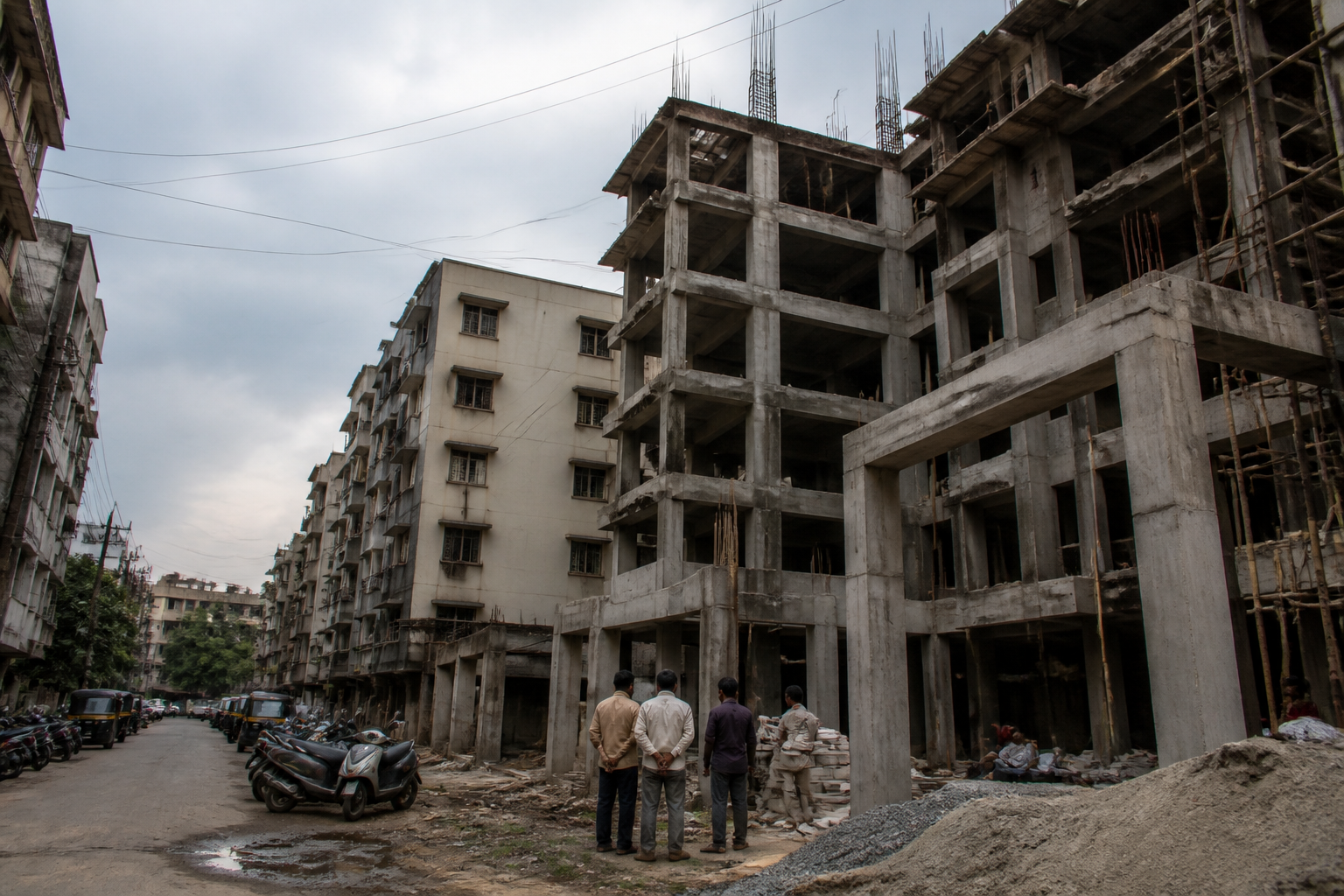
More than 80 redevelopment projects in the Vasai-Virar City Municipal Corporation area have been caught in a dispute over additional floor space index approvals, leaving original residents, homebuyers, developers and lenders facing uncertainty. The immediate political demand is for the stay on construction, occupancy certificates and property registrations to be lifted, but the larger issue is whether citizens should bear the consequences of alleged administrative and technical errors in projects cleared by public authorities.
According to a report by Loksatta, the municipal corporation halted additional construction in projects approved between 2020 and 2025 after a re-examination allegedly found that additional FSI had been sanctioned in violation of rules. The corporation also wrote to district registrars asking them not to register sale documents for houses and shops in the affected projects. The action has placed redevelopment schemes that were already under way in a legally and financially uncertain position.
The reported sequence is important. Original residents are said to have vacated their homes after relying on municipal approvals, sanctioned plans and commencement certificates. Buyers reportedly invested in homes on the strength of those approvals and registrations with the Maharashtra Real Estate Regulatory Authority, or MahaRERA. Nationalised and cooperative banks are also reported to have extended loans for many of the projects. A later municipal review has therefore created consequences across the entire chain, from residents who surrendered existing homes to buyers who committed savings and lenders that financed the transactions.
The report puts the potential financial exposure at more than Rs 1,000 crore for citizens, investors and banks. That figure is attributed to the account presented in the report and is not accompanied in the supplied material by a project-wise municipal statement or an independently published assessment. Even so, the number indicates the scale of the risk being described: a decision affecting construction and registration can freeze not only a building site but also the financial arrangements connected to it.
Redevelopment approvals are not a single transaction between a builder and a resident. They involve municipal planning departments, building permissions, commencement certificates, occupancy certification, registration authorities, lenders, residents’ associations and buyers. Each approval is expected to reduce uncertainty for the next participant. When a municipal body later questions the basis on which additional development rights were granted, that chain becomes unstable. The Vasai-Virar case shows how a planning dispute can quickly become a housing-security and financial-protection issue.
The immediate difficulty is that a blanket stoppage, if applied across more than 80 projects, may treat projects with different facts in the same manner. The report says the corporation identified alleged rule violations during a re-check, but the supplied material does not provide project-wise details, the precise rules involved, the extent of excess construction in each case or the number of affected households. It also does not establish whether every project has the same technical deficiency. Those details matter because a project with a correctable calculation or documentation issue raises a different question from one involving construction that cannot legally be retained.
BJP MLA Rajan Naik met Chief Minister Devendra Fadnavis at the Mantralaya and sought immediate relief from the restrictions. Naik has argued that residents should not suffer for administrative and technical errors. His proposal, as reported, is for a special committee led by senior Urban Development Department officials to review every project separately. He has also sought an opportunity to regularise technical discrepancies through premium payments or the adjustment of transferable development rights, while calling for separate action against officials, architects and developers found responsible for violations.
That proposal places two different questions on the same administrative table. The first is how to protect residents and purchasers who relied on official permissions. The second is how to establish accountability if additional FSI was wrongly approved or used. A system that resolves the first question by overlooking unauthorised construction could weaken planning controls. A system that enforces the second without distinguishing between responsible actors and people who relied on official documents could deepen the harm to residents and buyers. The supplied report records the MLA’s demand for separate action, but it does not state whether the state government has accepted it or whether a committee has been formally constituted.
The registration restriction adds another layer of uncertainty. Registration is not the same as planning approval, but blocking document registration can prevent transactions from being completed and can leave buyers unable to establish or transfer their interests through the ordinary property system. For purchasers who have already paid or borrowed, the uncertainty may extend beyond possession to loan servicing, resale and the legal status of their purchase. The article reports these risks, but does not provide the number of blocked registrations, the value of individual loans or the official legal basis for the district registrar’s instruction.
The episode also highlights the limits of approval-based confidence in urban housing markets. Residents and purchasers commonly depend on a sequence of official documents because they cannot independently reconstruct every planning calculation behind a project. When approvals are later reopened, the public question is not only whether a rule was breached. It is also whether the approval process gave affected people a reasonable basis to act, and what remedy is available when that basis is withdrawn.
For Vasai-Virar, the dispute is particularly significant because redevelopment changes the relationship between existing residents and the expanding property market. Original residents may exchange older homes for promised replacement units, while new purchasers enter the project at later stages. A construction stoppage can therefore affect people with different legal and financial positions inside the same building. The report does not provide a detailed breakdown of these groups, but its reference to original residents, buyers and banks shows why a project-level review would be more informative than a single city-wide label.
The reported demand for a senior-level committee reflects a governance problem as much as a construction dispute. The municipal corporation is reported to have found irregularities in approvals issued during a five-year period, while political representatives are seeking a review and interim relief from the resulting restrictions. Until the authorities publish the basis of the re-examination, the affected projects cannot be assessed consistently from the information available. A transparent review would need to clarify the approval granted, the alleged violation, the current construction status and the remedy proposed for each project. The supplied report does not say whether such a public project-wise record exists.
The evidence currently confirms three things: more than 80 projects are reported to be affected; the municipal corporation has halted additional construction and sought restrictions on registration; and an MLA has asked the chief minister for a project-by-project review, possible regularisation of technical discrepancies and separate accountability for those responsible. It does not yet establish the final legal status of the projects, whether the alleged violations are uniform, or whether the requested committee and remedies have been approved. Those are the developments that will determine whether the dispute becomes a managed correction of planning records or a prolonged housing and financial crisis for Vasai-Virar residents.
