


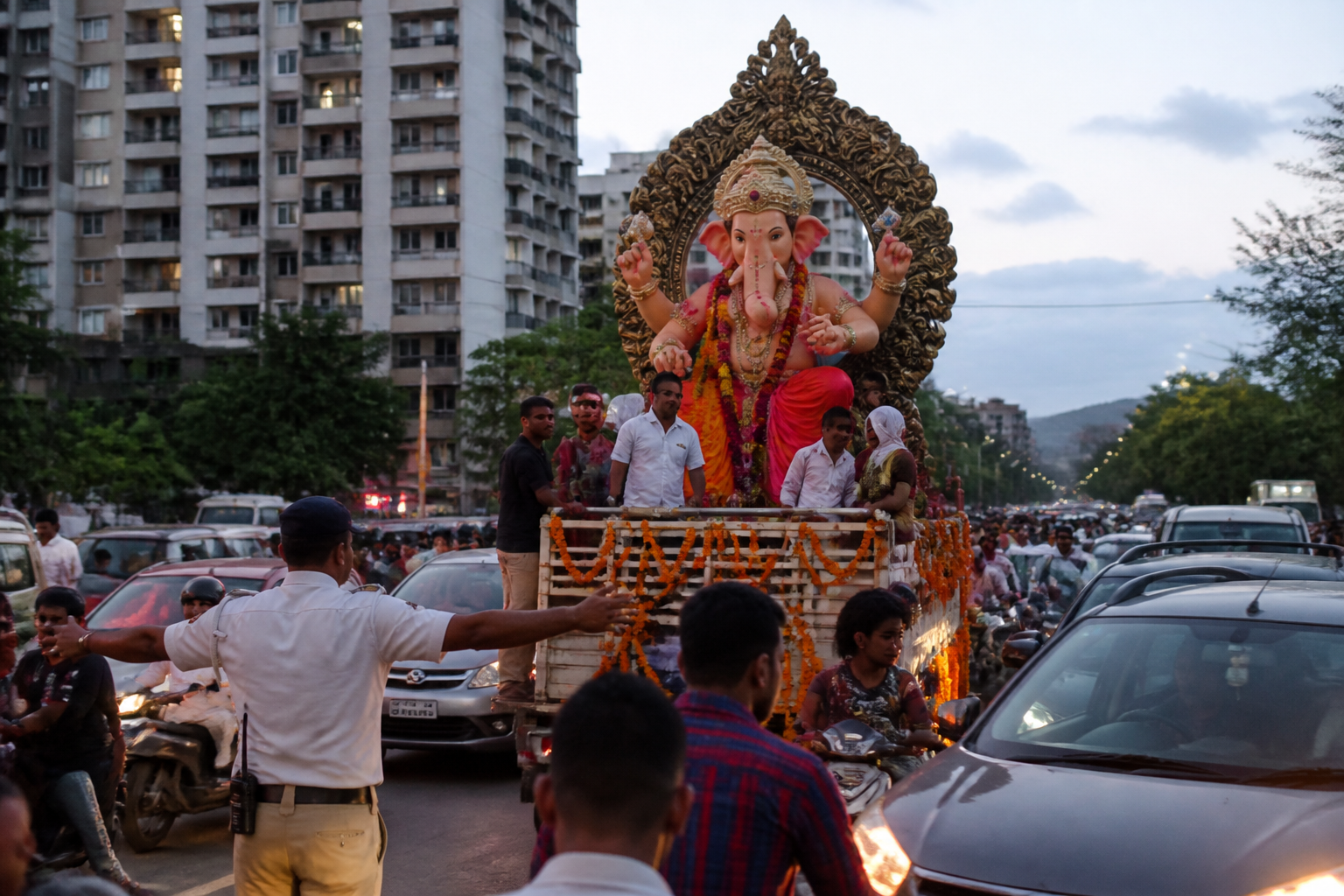
Vasai-Virar Ganpati processions have become an increasingly visible test of how the city manages public religious events, road space and competing claims on urban infrastructure. A report from Loksatta’s Vasai-Virar edition describes heavy congestion and noise during recent idol arrival ceremonies, including simultaneous large processions in Nalasopara that affected both the eastern and western parts of the city. The immediate demand is for clear rules for arrival ceremonies, similar to those applied to immersion processions. The larger question is whether a growing festival format has outpaced the city’s arrangements for traffic management, public safety and access to essential services.
The report says public Ganpati mandals in Vasai-Virar have increasingly adopted large-scale arrival ceremonies in recent years. These events begin 10 to 15 days before the main Ganesh festival and typically include drums, traditional percussion, amplified music and long processions. While public Ganpati celebrations have a long history in Maharashtra, the source describes the recent expansion of arrival ceremonies as a newer development, one that has added a further period of disruption before the festival itself begins.
That distinction matters for urban administration. Immersion processions are an established part of the civic calendar and are generally treated as events requiring route management, traffic diversions and coordination between organisers and authorities. Arrival ceremonies, by contrast, appear to have expanded as a major public activity without, according to the report, an equally clear or consistently applied regulatory framework. The demand for rules is therefore not only about noise or inconvenience. It is also about whether public authorities have a predictable system for approving, scheduling and managing events that occupy roads and affect several neighbourhoods at once.
The recent experience in Nalasopara illustrates the operational problem. The report says two major Ganpati arrival ceremonies were held at the same time in the evening, producing severe congestion in both the eastern and western sections of the area. The account does not provide traffic counts, the duration of the disruption or the number of vehicles affected. It does, however, identify simultaneous scheduling as a central cause of the problem. In a city where the same road network serves daily commuters, local trips, commercial movement and emergency vehicles, the timing of public processions becomes a planning decision rather than merely an event-management detail.
The report also raises the question of emergency access. It says ambulances can become trapped in traffic congestion and that processions may pass through areas near hospitals, causing significant difficulty for patients. These concerns are presented as a risk associated with inadequate planning; the report does not cite a specific ambulance delay or hospital incident in Vasai-Virar. That distinction is important. The available evidence establishes a credible public-safety concern, but it does not establish the scale or frequency of such incidents. Any formal policy response would need authorities to document affected routes, emergency-access arrangements and the actual impact on hospitals and patients.
A statement from Ashok Veerkar, deputy commissioner of police for Zone 2, indicates that authorities have already asked mandals to organise ceremonies in ways that do not inconvenience citizens and, where possible, to choose days with lower road traffic. He also says traffic police plan arrangements to keep vehicles moving during processions. This points to an administrative approach based on coordination and scheduling rather than a blanket prohibition. It also suggests that the police recognise the need to balance the continuation of public celebrations with the functioning of the road network.
The difficulty is that guidance alone may not resolve competition between events. When several mandals seek prominent routes, large crowds and high-visibility ceremonies, the pressure to organise at similar times can remain strong. The report refers to growing competition among mandals and argues that this competition is pushing the original purpose of the festival into the background. Rajendra Dhage, quoted in the report, has called for permission to be restricted to mandals that are at least 25 years old rather than being granted uniformly to all mandals. That is a viewpoint expressed by a local respondent, not an established policy proposal or an official decision.
The age-based suggestion also reveals the tension between cultural participation and administrative control. A rule favouring older mandals could reduce the number of processions, but the source does not provide evidence on how many mandals operate in the city, how many would qualify under such a condition or how permission is currently granted. Nor does it establish whether the number of mandals, the size of idols, procession length or sound levels has increased by a measurable amount. These are precisely the gaps that make a transparent regulatory framework important. Without publicly stated criteria, decisions may appear inconsistent even when authorities are attempting to manage a difficult calendar.
The source’s account of the festival’s history adds another layer to the debate. Public Ganpati celebrations in Maharashtra began before Independence and were associated with public awareness, community organisation and the communication of the freedom message. Over time, the tradition spread from larger cities such as Mumbai to surrounding suburbs. In Vasai-Virar, the report says public celebrations are organised by political party representatives, private institutions and local citizen groups. The city’s current challenge is therefore not whether public celebration should exist, but how its newer, larger and more mobile forms should operate within a dense urban environment.
Arrival ceremonies transform streets into temporary public spaces. That can create a collective cultural experience, but it also changes the function of roads for the duration of the event. The same space may need to carry buses, private vehicles, pedestrians, ambulances and procession participants. If two major events use connected or parallel routes at the same time, the impact can extend beyond the immediate location. The Nalasopara example shows how a local scheduling decision can affect both sides of an urban area. Yet the report does not identify whether route maps, time slots, maximum procession lengths or sound restrictions are currently published for residents.
Noise is another part of the governance problem. The report describes the use of drums, traditional percussion and DJs, and says residents faced noise pollution during the recent ceremonies. It does not provide decibel readings, timings or details of enforcement. As a result, the evidence supports the need to examine sound management but does not justify claims about the exact level of violation. A workable system would need to make the applicable conditions clear to organisers and residents, while also identifying which authority is responsible for monitoring compliance during moving processions.
The issue is consequently one of coordination across institutions. Police manage public order and traffic, while civic authorities are connected to permissions, roads, public spaces and local services. Mandals organise the events, and hospitals and emergency services bear the consequences when routes become inaccessible. The report confirms the police role in traffic planning and records instructions to mandals, but it does not describe the full approval process or the involvement of the municipal administration. That missing institutional detail is significant because congestion cannot be solved by traffic police alone if event permissions, road closures and route selection are handled separately.
A clearer system could begin with information that the report shows is currently needed: a consolidated calendar of arrival ceremonies, route and timing disclosure, coordination between events in the same locality, and explicit protection for hospital approaches and emergency corridors. These are analytical implications of the documented problems, not announced measures. The source records a demand for strict rules and police guidance on scheduling, but it does not say that a new formal regulation has been issued. Any future policy would therefore need to be assessed against whether it is formally notified, consistently applied and publicly accessible.
The Vasai-Virar case also raises a question about how cities measure the public cost of temporary events. The report identifies congestion, noise and potential ambulance obstruction, but supplies no systematic data on duration, affected roads or complaints. Without such information, the debate can remain divided between broad demands for restrictions and broad assurances that traffic will be managed. Publishing basic event and traffic information would make it easier to distinguish isolated inconvenience from recurring network failure.
What the available evidence confirms is that Ganpati arrival ceremonies have expanded in scale and duration in Vasai-Virar, while their effects are being felt beyond the participating mandals. The simultaneous Nalasopara events, concerns about emergency access and the police’s scheduling advice all point to a need for more structured event planning. What remains uncertain is the number of ceremonies, the formal permission process, the measurable extent of congestion and noise, and whether hospitals or emergency operators have been directly consulted. Those are the facts that will determine whether the city’s response remains case-by-case or develops into a citywide framework for public processions.
