


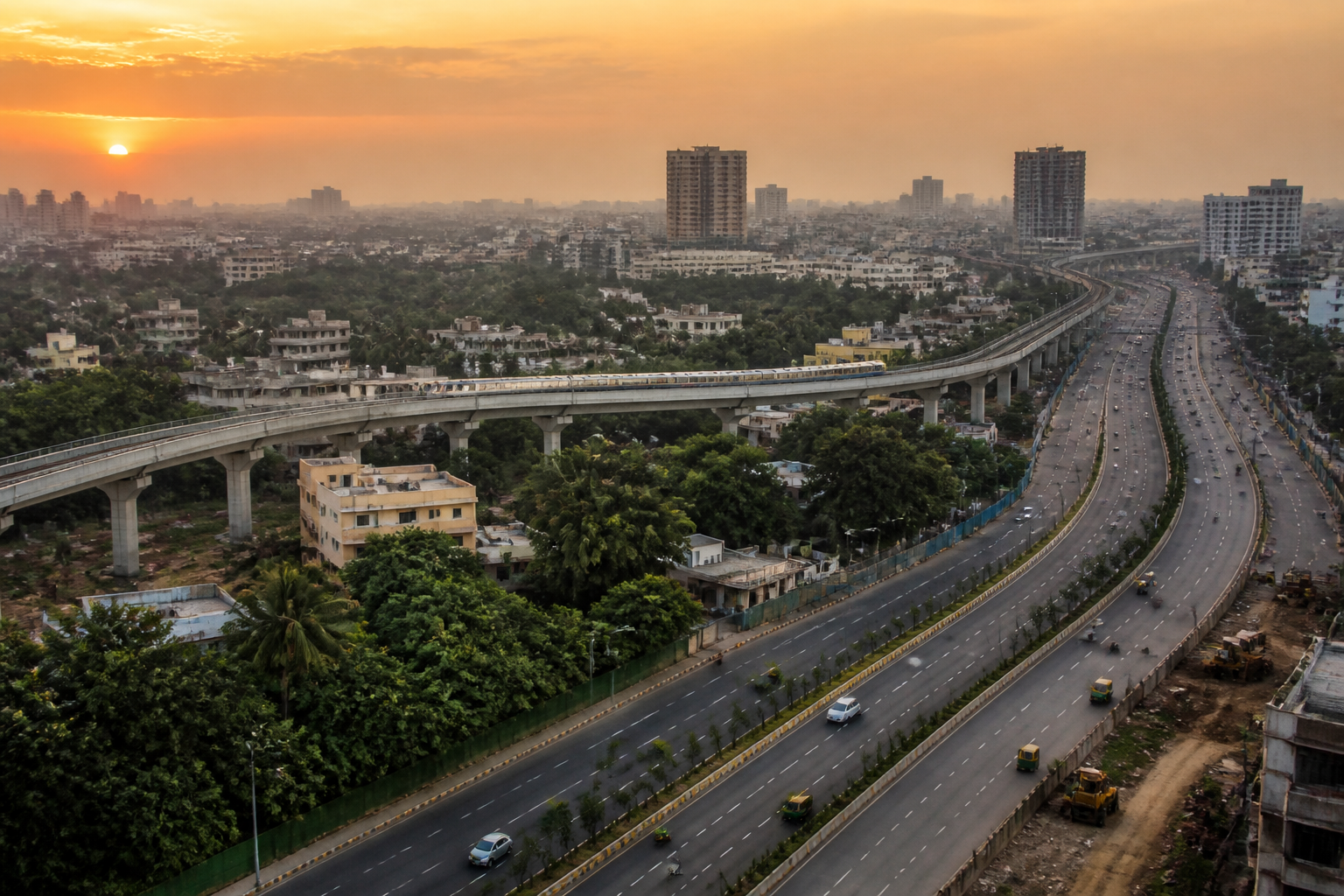
A discussion about which Karnataka city could become a “second Bengaluru” has opened a larger question about the state’s urban future: should growth be concentrated in one more major centre, or should several cities be strengthened according to their existing economic and infrastructure capacities?
The debate, highlighted by Prajavani in a special video analysis published on September 7, comes against the backdrop of growing pressure on Bengaluru. The source identifies population growth, traffic, water stress and infrastructure pressure as the central problems driving the search for an alternative. It names Tumakuru, Mysuru, Mangaluru, Hubballi-Dharwad, Belagavi, Davangere and Shivamogga as cities with their own economic and infrastructure potential.
The material does not establish that any one of these cities has been officially selected as Karnataka’s next metropolitan centre. Nor does it provide a comparative assessment of population, employment, land availability, transport capacity, water security or investment. That absence is important. The phrase “second Bengaluru” is powerful as a political and public shorthand, but it can also reduce a complex regional planning question to a competition between cities.
The first issue is the problem that the proposal is intended to solve. Bengaluru’s pressure is described in terms of four connected urban systems: population, mobility, water and infrastructure. These pressures do not operate independently. Population growth increases demand for housing and services. New housing and employment influence travel patterns. Traffic reflects the relationship between where people live, where they work and how they move. Water and other infrastructure systems must expand or be managed as the urban population and built-up area grow.
A new urban centre could be presented as a way to distribute some of this demand. But creating another large city would not automatically resolve the underlying pressures. If the new centre mainly reproduced Bengaluru’s pattern of concentrated jobs, long commutes, uneven infrastructure and expanding demand, it could eventually face similar constraints. The question, therefore, is not simply whether Karnataka can identify another city with growth potential. It is whether a different model of urban development can be built around that city.
This is where the distinction between a second Bengaluru and several strong cities becomes significant. A single alternative city would create a clear flagship destination for investment, administration and infrastructure. It could offer a focused development strategy and a recognisable economic identity. However, concentration also carries risks. If jobs, capital and institutions move disproportionately towards one selected city, other urban centres may remain dependent on Bengaluru or lose the opportunity to develop their own strengths.
A network of several cities would pursue a different objective. Instead of asking which city can replace Bengaluru, it would ask what role each city can perform within Karnataka’s wider urban system. Prajavani’s list reflects this possibility. Tumakuru, Mysuru, Mangaluru, Hubballi-Dharwad, Belagavi, Davangere and Shivamogga are presented as cities with distinct economic and infrastructure capacities, not as identical candidates for the same urban template.
That difference matters because cities do not begin from the same conditions. Their economic bases, regional connections, land markets, public infrastructure and relationships with surrounding settlements vary. The supplied material does not provide detailed evidence on those differences, so it is not possible to rank the cities or determine which one is most prepared for large-scale growth. But the framing itself points towards a more useful planning approach: development should be linked to existing capacity rather than driven only by the desire to create a replica of Bengaluru.
The debate also exposes a familiar weakness in the language of urban development. Cities are often described through labels such as “next Bengaluru”, “second city” or “emerging hub”. Such labels can help attract attention, but they may obscure the practical questions that determine whether urban growth is viable. Where will people live? What transport systems will connect homes to employment? How will water be supplied? Which institutions will manage expansion? What infrastructure will be available before new development begins? The source raises these questions indirectly through its reference to Bengaluru’s population, traffic, water and infrastructure pressures, but does not answer them for the potential cities.
The housing question is particularly important. A city cannot become a credible alternative employment centre merely through commercial or industrial investment. It also needs housing that is accessible to workers, supported by public services and connected to jobs. If housing is pushed to distant edges without reliable transport, the result may be a new pattern of long commutes rather than a reduction in urban pressure. The supplied report does not provide housing data for the named cities, which means any assessment of their readiness would require further evidence.
Mobility presents a similar test. Bengaluru’s traffic is cited as one of the reasons for considering another major city. Yet the relevant comparison cannot stop at road space or the number of proposed transport projects. It must consider how the urban form is organised, how far people travel, whether employment is distributed across multiple areas and whether public transport can serve daily trips. Without such information, the “second Bengaluru” concept remains a broad strategic proposition rather than an established solution.
Water is another constraint that makes replication difficult. Bengaluru’s water pressure is central to the discussion, but the source does not offer a water assessment of Tumakuru, Mysuru, Mangaluru, Hubballi-Dharwad, Belagavi, Davangere or Shivamogga. That gap prevents a definitive conclusion about which city could absorb substantial additional population. It also underlines why regional development cannot be planned through economic potential alone. Any new growth strategy would have to examine the capacity and reliability of basic utilities before the scale of expansion is determined.
The institutional question is equally consequential. A major shift in Karnataka’s urban geography would involve more than announcing a preferred city. It would require coordination among state agencies, municipal administrations, planning authorities, transport bodies, water providers and infrastructure departments. The source does not identify an official programme, funding framework, implementation authority or timeline. As a result, the current discussion should be understood as a planning debate rather than evidence that a second metropolitan centre has been formally approved.
This distinction between debate and policy is essential for readers. Public discussion can shape priorities, but it does not by itself create the conditions for balanced urbanisation. A city’s capacity is not only a matter of location or existing economic activity. It also depends on whether institutions can plan growth, acquire or regulate land, provide infrastructure, coordinate transport and protect access to basic services. None of the supplied material establishes how these responsibilities would be divided among the state and local authorities.
The strongest insight in the debate may therefore be its challenge to the idea that Karnataka needs one substitute for Bengaluru. The state’s urban future could instead be framed as a question of distribution: how employment, investment, infrastructure and public institutions are spread across multiple cities. This does not mean that every city must grow at the same pace or perform the same economic function. It means that the objective would be to develop a more balanced urban system rather than reproduce a single dominant model.
At the same time, the available evidence does not yet show whether a multi-city strategy would be more effective than selecting one major alternative. Prajavani identifies the pressure on Bengaluru and names possible cities, but it does not supply the comparative data needed to test the options. There are no figures in the supplied material on population growth, traffic volumes, water availability, infrastructure capacity, investment, employment or housing demand. Those are not minor omissions; they are the evidence required to move from a compelling public question to a defensible policy choice.
For now, the “second Bengaluru” debate is best understood as a signal of the limits of concentrated urban growth. It brings together the visible symptoms of pressure—population, traffic, water and infrastructure—and asks whether Karnataka should respond by creating another dominant centre or by building a stronger network of cities. The answer cannot be established by branding a city as the next Bengaluru. It will depend on evidence about capacity, governance, services, housing, mobility and the ability to support growth without reproducing the pressures the strategy is meant to address.
What the current discussion confirms is the need to examine Karnataka as an interconnected urban region rather than Bengaluru as an isolated metropolis. What remains uncertain is which cities can support additional growth, at what scale and under what institutional arrangements. Those questions will determine whether the debate becomes a regional development strategy or remains a slogan for dispersing Bengaluru’s pressure.
