


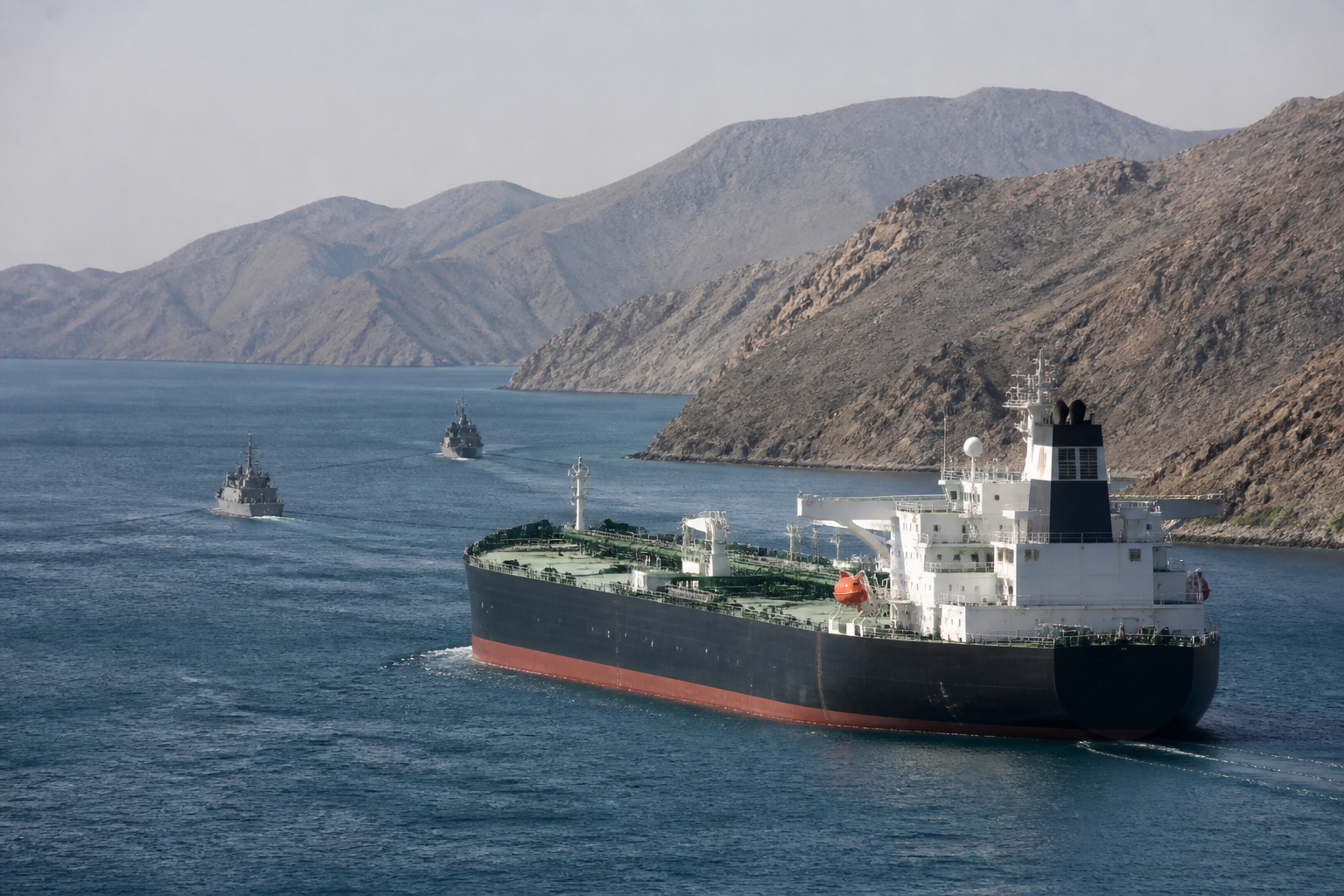
Subheadline: Falling tanker traffic, constrained Middle East exports and escalating attacks have turned a shipping route into the central pressure point for oil, gas and refined-fuel markets.
Standfirst: Goldman Sachs has warned that oil could reach $120 a barrel if attacks and shipping disruptions around the Strait of Hormuz worsen. Brent crude was trading near $97 when the warning was reported, while tanker traffic through the waterway had fallen to its lowest level since May. The immediate issue is not only the possibility of a higher oil price. The developments show how a conflict centred on vessels, ports and maritime access can move rapidly through energy markets and into the systems that support cities: transport, electricity, industrial production and household consumption. This analysis examines what the supplied evidence establishes about the Strait of Hormuz oil risk, why shipping has become more important than production alone, and what remains uncertain about the duration of the disruption.
The latest warning from Goldman Sachs places the Strait of Hormuz at the centre of the oil market. Daan Struyven, the bank’s co-head of global commodities research, said oil could rise to $120 a barrel in an upside scenario if shipping and supply disruptions become more severe. In a lower scenario, oil could fall to about $80 if Middle East exports return to normal. Brent crude was trading near $97 a barrel when the report was published.
That range captures the market’s central uncertainty. The immediate question is not simply how much oil the region produces, but how much of it can safely move through a strategically important maritime corridor. The supplied report says about one-fifth of the world’s oil supply used to pass through the Strait of Hormuz. A sustained reduction in tanker traffic would therefore affect the movement of energy even if production capacity itself remained available.
The distinction between production and shipping is important. A barrel that cannot be transported is not readily available to the market that needs it. The report says US and Iranian attacks on vessels have increased concerns about a longer supply disruption. US forces have attacked Iranian oil tankers, while Iran has announced plans for a restricted zone outside the strait. US naval forces are also blockading Iranian ports and escorting vessels belonging to other oil-producing countries out of the region, according to the supplied account.
The attacks have directly involved oil tankers. US Central Command said US forces struck three Iranian oil tankers on Saturday, including one near Kharg Island, an important Iranian oil-export hub. Iran’s Islamic Revolutionary Guard Corps navy said it had targeted three oil tankers travelling through unauthorised routes in the Strait of Hormuz, along with three additional US vessels elsewhere. Maritime intelligence firm Marisk described the attacks as a major escalation in the maritime conflict, as cited in the report.
This development changes the character of the disruption. Commercial shipping is no longer only operating in a difficult security environment; tankers themselves are becoming part of the confrontation. Marisk said tankers were being deliberately used as tools of economic pressure, making it more difficult to separate military operations from risks to ordinary commercial shipping. That distinction matters because a market can react sharply to the possibility that ships will avoid a route, even before a complete closure takes place.
The available traffic data shows that this risk is already affecting movement. An average of only 10 commodity ships a day crossed the Strait of Hormuz over the past 10 days, the lowest level since May, according to analytics firm Kpler. The figure does not establish that the waterway has been closed, but it indicates a significant reduction in traffic compared with normal movement. For energy markets, the direction of travel is as important as the current level: fewer vessels create concern that a larger supply shock could follow.
Priyanka Sachdeva, head of market insights at Phillip Nova, said the market could begin pricing in a much larger supply shock if tanker traffic slows significantly. She also said the decline in traffic suggested the market was already beginning to face that risk. The report therefore describes a feedback mechanism. Attacks raise the perceived danger of the route; higher danger reduces the willingness or ability of vessels to cross; lower traffic raises concern about supply; and that concern pushes prices higher.
Oil prices have already responded to the conflict. Brent crude gained 7.8% last week, while US West Texas Intermediate crude rose by almost 10%, according to Reuters. On Monday, Brent futures were up 0.8% at $96.28 a barrel and WTI was up 0.2% at $91.48 by 0806 GMT. These prices are market snapshots rather than forecasts, but they show that the risk is already being reflected in trading conditions.
The effect is extending beyond crude oil. Goldman Sachs is recommending that investors consider natural gas and refined-oil products such as diesel as protection against conflict-related risks. Struyven said the supply shock could be larger in natural gas and refined products than in crude oil. The report says industrial fuel diesel has more than doubled in 2026, while natural gas and petroleum products have gained more than crude during the more than six-month conflict.
For cities, this distinction is consequential even though the triggering events are taking place at sea. Diesel is linked to freight, construction equipment, buses, generators and other parts of the urban economy. Natural gas and petroleum products also feed into industrial and commercial activity. The supplied material does not provide city-level price or consumption data, so it cannot establish the size of any particular local impact. It does, however, show that the pressure is moving through several energy markets rather than being confined to petrol or crude oil.
The likely response of large importers is another part of the market’s adjustment. Goldman Sachs expects China to act as a stabilising force in the crude market by reducing oil imports when prices rise sharply. Struyven said China may not provide the same support in natural gas and refined products. This distinction suggests that demand may respond differently across energy categories, limiting some upward pressure on crude while leaving other markets more exposed.
OPEC+ has not changed its October oil output policy, according to Reuters. The producer group kept its policy unchanged at its Sunday meeting and still needs to agree on new production quotas. That decision leaves the shipping problem unresolved. Additional production policy can influence the balance between supply and demand, but it cannot by itself remove the security risk facing vessels that must move energy through the Strait of Hormuz.
The outlook presented by ANZ analysts is one of prolonged tension rather than an immediate return to normal. They identified a prolonged standoff combined with limited military action by both sides as the most likely scenario. Under that assessment, Middle East oil exports could remain below normal levels through the end of 2026. A gradual reopening could begin late in the fourth quarter, but a full return to pre-war oil flows may not occur until late in the first quarter or early in the second quarter of 2027.
These timelines are forecasts attributed to ANZ, not confirmed implementation schedules. Their significance lies in the duration of the risk. If exports remain constrained for months, the challenge becomes more than a short-lived price spike. Energy-intensive industries, transport operators and public agencies would have to operate in an environment where fuel and power costs remain exposed to maritime events. The supplied report does not quantify those downstream effects, but it identifies the conditions that could produce them.
The policy landscape is spread across several institutions. Military authorities control or influence access and security around the vessels. Iran’s Supreme National Security Council is expected to announce a restricted zone outside the strait, according to Iranian state media. OPEC+ controls a separate lever through production policy. Market participants and energy companies respond to prices, shipping availability and expected supply. The lack of a single institution responsible for all these factors helps explain why the market remains sensitive to each new vessel attack or security announcement.
The evidence currently supports three conclusions. First, the Strait of Hormuz remains the main pressure point for global oil markets because of the scale of energy movement historically associated with it. Second, tanker traffic has already fallen, and attacks on commercial vessels have increased the possibility of a broader disruption. Third, the price risk extends beyond crude oil into diesel, natural gas and other refined products.
What the evidence does not establish is whether the restricted zone will be implemented, how long reduced tanker traffic will continue, or whether military activity will expand further. It also does not establish that oil will reach $120. That level is Goldman Sachs’ upside scenario if shipping and supply disruptions worsen, not a confirmed outcome.
The next indicators are therefore operational rather than rhetorical: the number of vessels crossing the Strait of Hormuz, the treatment of commercial tankers by the parties to the conflict, the implementation of any restricted zone, OPEC+ decisions on future quotas and the pace at which Middle East exports recover. Until those signals improve, the Strait of Hormuz oil risk will remain tied to the wider stability of global energy and urban economic systems.

