


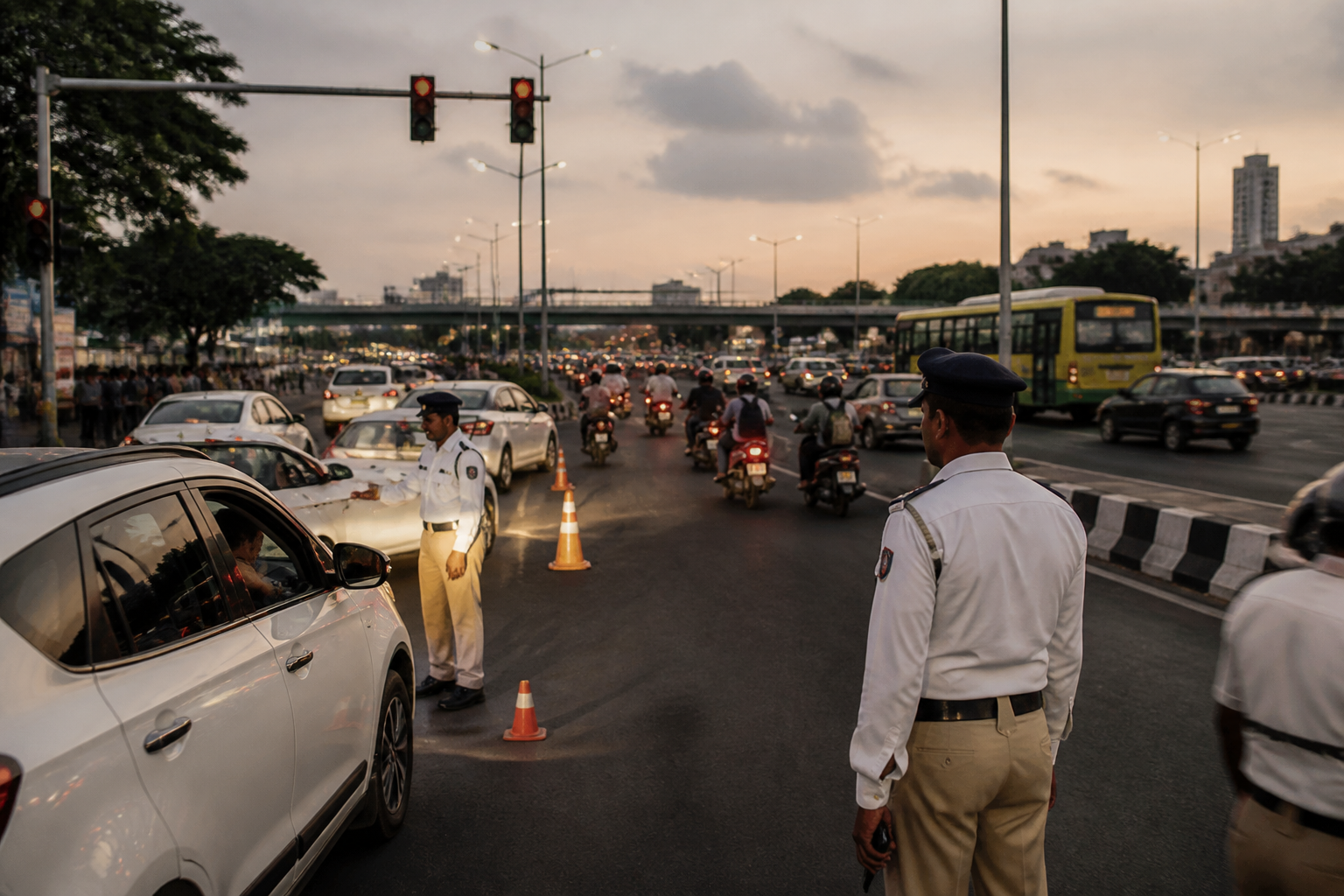
India’s proposed driving licence points system could change how traffic violations are recorded and punished, but its significance extends beyond the prospect of suspended or cancelled licences. The plan, outlined by Union road transport and highways minister Nitin Gadkari, brings together driver behaviour, enforcement, vehicle safety, training and emissions within a broader attempt to address the country’s persistent road safety problem.
The proposed framework would assign points to motorists for different traffic offences. A driver who accumulates points beyond a specified limit could have their licence suspended or cancelled, while motorists with better records could receive incentives, including possible benefits from insurers or other companies. Gadkari described the proposal at the 66th SIAM Annual Convention 2026 as a way to distinguish between responsible drivers and habitual offenders.
The announcement is not yet a fully operational policy. The supplied material does not establish the final rules, the offences that would attract particular penalties, the points threshold for suspension or cancellation, or the agencies that would administer the system. Those details will determine whether the proposal becomes a consistent road safety instrument or another layer added to an already complex enforcement system.
At its core, the proposal attempts to move traffic enforcement from isolated incidents towards a cumulative record of driving behaviour. Under the existing logic of a conventional traffic fine, each violation can be treated as a separate transaction. A points-based record would instead allow authorities to identify repeated conduct over time. The approach would make the driving licence a continuing account of compliance rather than only a document authorising a person to drive.
That distinction matters because the minister framed driver behaviour as a central road safety problem. Gadkari said India records about five lakh road accidents each year, resulting in approximately 1.80 lakh deaths. He also said most people killed in road accidents are between 18 and 36 years old. The figures were presented as part of the case for stronger measures, although the material does not provide a breakdown by road type, vehicle category, cause of collision or enforcement status.
The proposed system therefore rests on a simple principle: repeated violations should produce consequences that become more serious over time. Gadkari said that every offence would reduce points and that crossing a particular limit could lead to suspension or cancellation. He also said that drivers with good records could receive incentives, including possible insurance-related benefits. The proposal thus combines deterrence with a reward mechanism rather than relying only on punishment.
The effectiveness of such a framework would depend on the quality of the underlying records. A points system can only identify repeat offending if traffic violations are recorded accurately, linked to the correct driver and accessible across relevant jurisdictions. The supplied announcement does not explain how those administrative questions would be resolved. It also does not specify whether the system would be integrated with vehicle registration, insurance records, automated enforcement or existing licensing databases.
The minister referred to a graded points system for both driving licences and vehicle registration certificates. That suggests the proposed framework could extend beyond individual driver conduct to the regulatory history of vehicles. However, the announcement does not clarify how responsibility would be assigned when a vehicle is used by multiple people, when an offence is recorded against a vehicle rather than its driver, or when ownership changes. These unanswered questions are central to implementation and remain unresolved in the available material.
The proposal is part of a wider set of measures discussed at the convention. Gadkari said the government plans to establish 1,600 driving training centres across the country. According to the announcement, 24 centres are operational, another 112 are in the pipeline and around 10 lakh drivers have already received training. The figures indicate an effort to expand formal driver preparation, but the supplied material does not state how the centres are distributed, what curriculum they use or how training outcomes are assessed.
Training and enforcement address different parts of the road safety chain. Training is intended to improve knowledge and behaviour before or during a driver’s time on the road. A points system operates after violations have been recorded. Placing both measures within the same policy conversation reflects the government’s stated concern that driver behaviour contributes significantly to accidents. It also shows that the proposed response is not limited to penalties, even though the licence consequences are the most immediate public-facing element.
The same announcement linked driver conduct to vehicle safety. Gadkari said a new version of the Bharat New Car Assessment Programme is planned from October 2027. Bharat NCAP, launched in 2023, is described in the supplied material as India’s official independent vehicle safety rating system. Passenger cars undergo crash tests and receive ratings from one to five stars based on their ability to protect adult and child occupants in a collision.
Gadkari said Bharat NCAP 2.0 would evaluate the entire safety chain and incorporate new technologies developed by Indian startups. The announcement does not define the full scope of that safety chain or explain how the new programme would differ operationally from the current rating system. It does, however, place vehicle design and crash protection alongside driver behaviour as components of road safety rather than treating collisions only as a result of individual error.
That wider approach is significant because the proposed licence points system addresses conduct while Bharat NCAP addresses vehicle performance. A driver can be penalised for repeated violations, but vehicle occupants also depend on the safety characteristics of the vehicle in a crash. The material does not provide evidence to quantify the relative contribution of driver behaviour, vehicle design, road conditions or emergency response to India’s accident fatalities. It does show that the minister is presenting road safety as a system-wide concern.
The policy discussion also includes vehicle emissions. Gadkari said the government would announce a scheme for a device that could be retrofitted to BS IV vehicles. Trials have reportedly been completed, and he said emissions from vehicles fitted with the device were the same as those from BS VI vehicles. The device is expected to cost about Rs 4,000-5,000, according to the announcement. The material does not identify the device, provide independent test results or establish the proposed scheme’s eligibility and enforcement conditions.
The emissions proposal introduces another regulatory layer for the vehicle fleet. Rather than dealing only with new vehicle standards, it focuses on an existing category of BS IV vehicles and a possible retrofit. Its relevance to cities is direct: older vehicles operate within urban transport systems, where air pollution, road congestion and traffic safety overlap. Still, the supplied information does not establish how many vehicles could be covered, whether the retrofit would be mandatory or voluntary, or how compliance would be verified.
The policy landscape described by Gadkari therefore spans licensing, vehicle registration, driver training, crash testing and emissions control. Each area involves different administrative responsibilities and technical systems. The points proposal would require reliable violation records and licensing procedures. Training centres would require capacity and quality control. Bharat NCAP 2.0 would require testing and assessment arrangements. The emissions device would require technical validation and a framework for retrofitment. The announcement presents these initiatives together, but does not yet explain how they will operate as a single programme.
The available numbers establish the scale of the policy challenge but not its causes. India is described as witnessing five lakh road accidents and 1.80 lakh deaths annually. Around 10 lakh drivers have received training through the centres cited by the minister. Twenty-four driving training centres are operational, with 112 more in the pipeline against a stated national target of 1,600. The country is also described as the world’s third-largest passenger vehicle market. These figures point to a large and expanding transport ecosystem, but they do not by themselves demonstrate whether training, enforcement or vehicle safety measures have reduced accidents.
That evidence gap will matter when the proposed systems are assessed. A lower accident count would not automatically show that the points system caused the change, just as a high number of recorded violations would not necessarily prove that driving behaviour had worsened. The administration would need clear definitions, consistent data and transparent reporting to show how the system works. None of those measurement arrangements has been announced in the supplied material.
For cities, the central question is how a national road safety framework will interact with everyday urban enforcement. Traffic violations occur across municipal roads, highways and other parts of the transport network, while licensing and vehicle registration operate through government systems that may involve different authorities. The announcement does not specify the institutional mechanism for coordinating them. That makes the final design of the points system as important as the principle itself.
The proposal nevertheless marks a shift in emphasis. It treats a driving licence as a record of continuing responsibility, links incentives to a good driving history and places repeated violations at the centre of enforcement. Alongside expanded training, vehicle crash assessments and possible emissions retrofits, it reflects an attempt to address road safety through several connected interventions.
What the announcement confirms is that the government is developing a graded points framework and intends to expand driver training, introduce Bharat NCAP 2.0 from October 2027 and pursue a BS IV emissions-control retrofit scheme. What remains uncertain is the legal design, enforcement architecture, points thresholds, data-sharing process and implementation timetable for the licence proposal. Those details will determine whether the plan becomes a workable national road safety system. The next developments to monitor are the formal rules for the points framework, the expansion of training centres, the design of Bharat NCAP 2.0 and the announced emissions scheme.

