


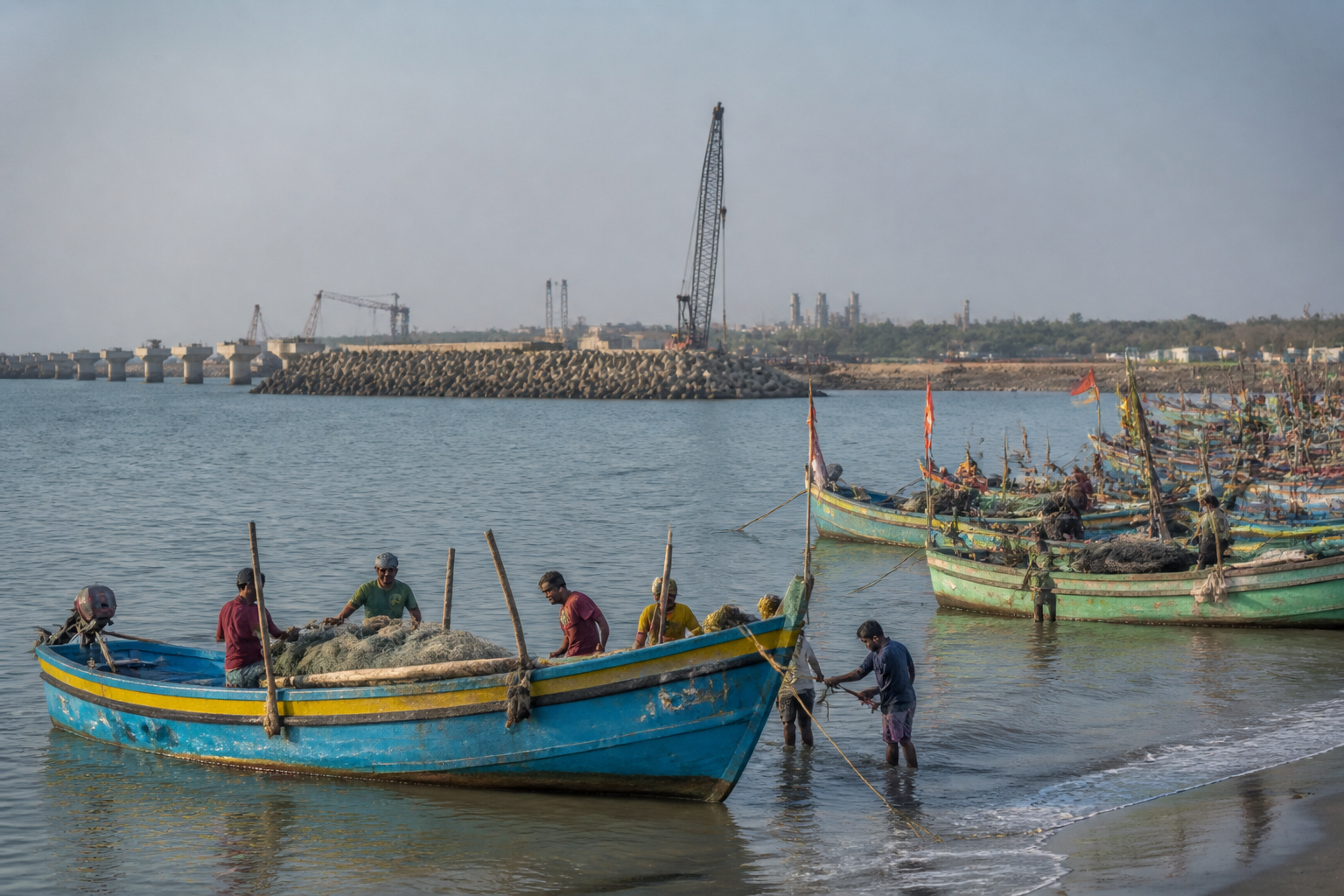
The proposed compensation package for fishermen affected by the Vadhavan Port project places Palghar’s coastal rehabilitation process at a critical stage. The district administration has scheduled a stakeholder meeting for 8 September, with the Jawaharlal Nehru Port Authority (JNPA) expected to present the draft compensation and welfare package to local residents, fishermen’s representatives and other stakeholders.
The meeting comes as the Vadhavan Port Opposition Action Committee and 17 affiliated organisations continue a month-long campaign seeking the project’s permanent cancellation. The committee declined to comment on the proposed package, according to the report, maintaining that its position against the entire project remains unchanged. The result is a sharply defined institutional challenge: the administration is attempting to build a compensation and welfare framework while a section of the affected community is questioning the project itself.
The proposed package is therefore more than a schedule of monetary payments. It is also an attempt to define who is affected, how dependence on fishing should be measured, what form livelihood loss takes, and whether a one-time payment can be accompanied by infrastructure and skills support. The information currently available describes a draft under discussion, not a final settlement or an approved rehabilitation framework.
The compensation calculations draw on a Maharashtra government resolution dated 9 March 2023. That resolution established compensation rates for four categories of fishermen. The proposed amounts have been revised using the Consumer Price Index up to 2025, according to the district administration’s release. JNPA prepared the draft after using survey information and discussions with stakeholders.
The survey process itself reveals one of the central difficulties in compensating coastal communities. JNPA had conducted a field survey to understand how heavily families in the affected area depend on fishing for their livelihood. However, the survey could not be completed because participation from some sections of the fishing community remained limited. The administration subsequently increased its dialogue with fishermen and other local stakeholders, citing the need to create greater awareness and trust.
That limitation matters because fishing-related losses do not necessarily appear in a single employment or income record. The package distinguishes between fishing methods, location and levels of dependence on fishing. Its categories include people fishing within the proposed port limits, those fishing outside those limits, people manually collecting fish, shellfish or other marine life, and those dependent on fishing for subsistence. The draft therefore recognises different forms of economic exposure rather than treating all fishing households as identical.
Under the proposal, fishermen operating within the port limits would receive ₹14.15 lakh for a one-day Dol Net fishing activity and ₹15.72 lakh for multi-day Gill Net fishing. For those fishing outside the port limits, the proposed amounts are ₹7.08 lakh and ₹7.86 lakh respectively. People who manually collect fish, shellfish or other marine organisms would be eligible for a proposed ₹4.90 lakh, while those dependent on fishing for subsistence would be offered ₹2.45 lakh.
The proposed rates indicate that the administration is linking compensation to the type of activity and the potential impact on livelihood. Fishing within the port limits is assigned higher amounts than comparable activities outside those limits. The figures also distinguish between fishing operations that take place over a single day and those that continue for several days. Whether these categories adequately capture actual household dependence is one of the questions the 8 September consultation is expected to address.
The draft also proposes a two-times multiplier for fishermen in the C3 and C4 categories, with the stated objective of increasing compensation for more vulnerable sections of the community. The available material does not provide the full classification criteria for these categories, so the practical effect of the multiplier cannot be assessed from the current information alone. Its implementation will depend on how the categories are defined, verified and applied to individual households.
This is where the unfinished survey becomes particularly important. A compensation formula can be transparent on paper while still producing disputes if affected families are not accurately identified or if the evidence used to classify them is incomplete. The administration has said that the proposed package will be presented to stakeholders, who will be invited to submit suggestions and grievances before the package is moved forward for final approval. The consultation is thus intended to test both the substance of the proposal and the process used to determine eligibility.
The welfare component expands the proposal beyond direct compensation. Instead of the ₹50 crore fishermen’s welfare fund mentioned in the 2023 government resolution, the draft proposes a ₹100 crore fund. The stated uses include community welfare, livelihood enhancement, skills development, fisheries-related infrastructure and community development. The proposal does not, in the supplied material, specify the fund’s governance structure, release schedule, beneficiary selection process or monitoring mechanism.
The absence of those operational details leaves an important distinction between an announced allocation and a functioning public programme. A welfare fund can support long-term livelihood security only if affected communities know how decisions will be made and whether the benefits will reach households that experience indirect as well as direct losses. The proposed stakeholder meeting may provide an opportunity to clarify those arrangements, although the administration’s release, as reported, does not yet set them out.
A second major component is a proposed ₹250 crore fishing harbour to be developed with the cooperation of the state government. The harbour is intended to provide safer berthing and fish-landing facilities, better arrangements for fish handling and marketing, improved safety, and more sustainable livelihood opportunities. It is presented as infrastructure that could strengthen the fishing economy while the port project proceeds.
The relationship between the proposed fishing harbour and the existing fishing system remains central to the rehabilitation question. The package describes the harbour as a way to improve facilities and livelihood opportunities, but the supplied information does not establish its location, design, construction schedule, capacity or implementation agency. Those details will determine whether it functions as a practical replacement or enhancement for affected fishing activities, rather than simply as a parallel infrastructure announcement.
The package also proposes ₹100 crore to develop five existing government Industrial Training Institutes in Palghar district as Centres of Excellence. The proposed training areas include modern fishing methods, fisheries technology, fish handling, value addition and marine safety. This element suggests that the administration is treating skills and value-chain capacity as part of the response, not only cash compensation.
Training, however, addresses a different time horizon from direct compensation. Cash payments respond to identified loss, while institutes and skills programmes are intended to create capabilities over a longer period. The supplied material does not state how many people would be trained, when the centres would be upgraded, or how training would connect fishermen to jobs, markets or new fisheries infrastructure. Those questions are relevant to assessing the proposal’s long-term value.
The administration has consistently stated that the livelihoods and social and economic interests of local fishermen should receive appropriate priority during implementation. Its stated objective is to create a rehabilitation and compensation arrangement that is fair, transparent, based on available information and studies, and centred on the interests of the fishing community. That position places consultation and evidence at the centre of the process.
At the same time, the continuing opposition campaign shows that compensation is not the only measure of public acceptance. The action committee’s refusal to comment on the draft package reflects its stated demand that the project itself be cancelled. This means the administration is conducting a package consultation in a setting where at least some organisations do not view compensation as an adequate response to the underlying concern.
The Vadhavan Port case therefore raises a broader question about how large coastal infrastructure projects define impact. The immediate proposal contains specific payment amounts, a welfare fund, a fishing harbour and training institutions. Yet its credibility will also depend on the completeness of the affected-person survey, the clarity of eligibility rules, the treatment of vulnerable categories, and the extent to which objections can influence the final framework.
What the available evidence confirms is that the compensation proposal has moved from preliminary discussion to a formal stakeholder-consultation stage, with detailed monetary figures and wider welfare measures placed on the table. What remains unresolved is whether the survey can be completed inclusively, how the proposed categories will be verified, and whether the package will receive final approval. The 8 September meeting is the next documented milestone in that process.
