


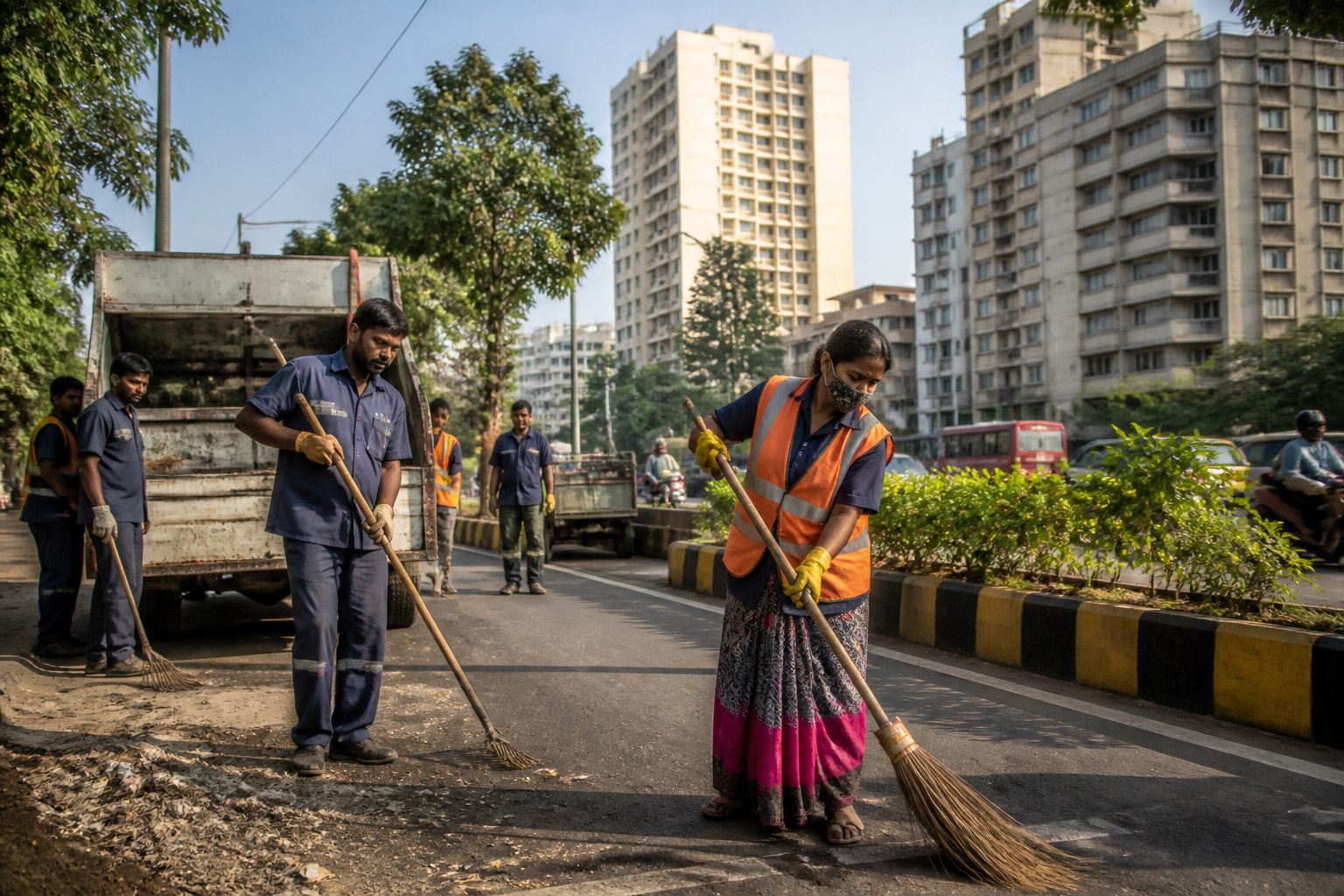
Across municipal corporations and councils in the Mumbai Metropolitan Region’s Thane, Palghar and Raigad districts, a large gap between sanctioned and filled posts is pushing civic bodies towards contract labour. A Loksatta review of staffing figures found 13,875 vacancies against 35,237 sanctioned posts across the municipalities covered, with shortages concentrated in the workforce responsible for daily public services.
The numbers describe more than an administrative backlog. They show how urban local bodies are attempting to maintain sanitation, solid-waste management, public health, fire services and other basic functions while operating with substantially fewer permanent employees than their approved staffing structures provide for. In several municipalities, contract workers now form a significant part of the operational workforce, even as recruitment to permanent posts remains constrained by establishment-cost limits, pending approvals or legal proceedings.
The scale of the gap varies between cities, but the pattern is consistent. Thane Municipal Corporation has 10,870 sanctioned posts, of which 5,257 are vacant, according to the report. The largest shortages are in Class III and Class IV categories, with 2,738 and 2,040 vacancies respectively. These are the categories whose employees are directly involved in many day-to-day civic operations. The corporation has appointed about 4,500 contract workers across departments to address its staffing needs.
The Thane administration attributed the vacancies partly to a rise in retirements in recent years. Deputy Municipal Commissioner Gajanan Godepure said the corporation was processing promotions under its service rules and had approved additional posts in its staffing structure. Recruitment to both newly approved and vacant posts was being undertaken in phases, he said. He also said that e-office systems and computerisation had reduced the pressure on existing staff.
The Thane figures also expose a financial tension. Establishment expenditure accounts for about 45 per cent of the corporation’s total expenditure, according to the report. Municipal bodies must therefore balance the need to fill operational posts with restrictions on the share of their budgets that can be committed to salaries and allowances. A vacancy can reduce the permanent payroll in the short term, but it can also create pressure to purchase services or hire workers through agencies.
Kalyan-Dombivli Municipal Corporation illustrates how this tension appears within a specific service. About 6,500 posts are sanctioned in the corporation, while 375 of the 2,200 posts approved for the solid-waste department are vacant. The department has around 330 contract workers and another 84 employees working on six-month extensions. The report states that the salaries of the extended employees cost Rs 16.38 lakh per month, while payments to contract workers amount to about Rs 88.98 lakh per month.
The corporation has begun a recruitment process through TCS for around 450 posts, the report said. That process is significant because it indicates that contract staffing is not necessarily replacing recruitment permanently; in some cases, it is functioning as an interim response while municipal bodies attempt to fill approved positions. The available information, however, does not establish how quickly the recruitment will be completed or how many contract positions will subsequently be discontinued.
Navi Mumbai presents a different version of the same problem. The municipal corporation has 4,124 government-approved posts, of which 2,098 are filled, leaving about 2,000 vacant. Alongside the permanent workforce, the corporation has 478 employees appointed on a contractual basis and 8,099 contract workers. Employee salaries and allowances cost Rs 866.41 crore annually, or about 12.95 per cent of total expenditure, according to the report.
Deputy Municipal Commissioner Kisanrao Palande said state government restrictions require establishment expenditure to remain below 35 per cent of total expenditure. He also said employee organisations had approached the court against the recruitment process, leaving the matter sub judice and preventing fresh recruitment for the time being. Navi Mumbai’s case shows that a low reported salary share does not automatically remove the institutional barriers to filling posts when approvals and litigation are involved.
Ulhasnagar Municipal Corporation has 1,943 sanctioned posts, but only 633 are filled. The remaining 1,310 posts are vacant. In Ambernath Municipal Council, 750 of 879 sanctioned posts are filled, leaving 129 vacant; the council reported that it currently has no contract employees and spends about 35 per cent of its total expenditure on salaries. Kulgaon-Badlapur Municipal Council also uses contract staff while some sanctioned posts remain vacant, with employee salaries accounting for about 22.27 per cent of total expenditure.
The distribution of vacancies matters as much as the aggregate total. In Bhiwandi-Nizampur Municipal Corporation, 954 of 4,189 sanctioned posts are vacant. The report records 12 vacancies in Class I, 50 in Class II, 646 in Class III and 246 in Class IV. The shortage is therefore heaviest in Class III, where 431 of 1,077 posts are filled, and not limited to senior administrative positions. The corporation also has 76 contract employees across departments.
Vasai-Virar Municipal Corporation has one of the widest gaps between its approved structure and its filled posts. Under its 2014 staffing structure, 2,852 posts were sanctioned, but only 920 employees were working, leaving 1,932 vacancies. The corporation has instead appointed 1,531 Class C and Class D contract workers. Their annual remuneration is reported at about Rs 193.63 crore.
A proposal to create 9,996 additional posts would have taken the corporation’s total sanctioned strength to 12,848. That proposal is currently stalled. Deputy Municipal Commissioner for Establishment Swati Deshpande said a revised staffing structure had been placed before the general body and would be sent to the state government after approval. Recruitment would begin after final government approval, she said. The sequence demonstrates how staffing expansion depends on multiple institutional stages rather than a municipal decision alone.
Mira-Bhayandar’s revised staffing structure was approved by the state government in 2022. It provides for 2,562 posts in Classes II to IV, of which 1,306 are filled and 1,255 are vacant. The shortages include 35 of 65 Class II posts, 34 of 77 posts in one Class III category, 391 of 703 posts in another Class III category and 695 of 1,547 Class IV posts. The municipality has submitted a proposal concerning recruitment and promotions to the general body, according to Deputy Municipal Commissioner Sachin Bangar.
Panvel Municipal Corporation has 1,046 sanctioned posts for direct recruitment, with 496 employees currently in place. Of the 647 Class III posts, 161 are vacant, including 75 clerk-typist posts, 40 firefighter posts and 37 sanitation-worker posts. Junior engineers, drivers and other technical positions are also vacant. At the same time, 438 contract workers are deployed against 472 posts approved for outsourcing.
Panvel Commissioner Mangesh Chitale said the corporation’s priority was to maintain financial discipline and limit establishment expenditure. He said less than 15 per cent of the municipal budget was spent on the establishment department, leaving the remaining funds for development works. Recruitment to vacant posts would be carried out in accordance with state government directions, he said.
Taken together, the figures reveal three separate layers of municipal staffing pressure. The first is demographic and operational: the municipalities have expanded and urbanisation has increased the demand for services. The second is institutional: staffing structures require approvals, revisions, promotions and recruitment procedures that can take time. The third is fiscal: salary expenditure is monitored through limits and budgetary priorities, encouraging municipal bodies to seek flexible forms of labour.
The reliance on contract workers may help civic bodies maintain services when permanent recruitment is delayed. But the supplied report does not provide a comparable assessment of service quality, worker conditions, accountability arrangements or the relative cost of each staffing model across all municipalities. Those unanswered questions are important because the same service may be delivered by permanent employees, contract workers, outsourced agencies or staff working under temporary extensions, with different administrative chains and employment terms.
The central urban question is therefore not simply how many posts are vacant. It is whether municipal staffing structures are keeping pace with the responsibilities assigned to rapidly urbanising local governments, and whether recruitment, budgeting and service delivery are being planned together. The report’s figures show that vacancies are widespread, while the official responses show that each municipality is navigating a different combination of retirements, expenditure ceilings, pending approvals, litigation and recruitment processes.
What is established is the size and distribution of the reported vacancy problem, as well as the growing use of contract labour in several municipalities. What remains unclear from the supplied material is the timeline for filling most vacancies, the outcome of the pending court case in Navi Mumbai and the final status of proposed staffing structures in Vasai-Virar and other municipalities. Those administrative milestones will determine whether the present dependence on contract workers is temporary or becomes a lasting feature of civic service delivery.
