


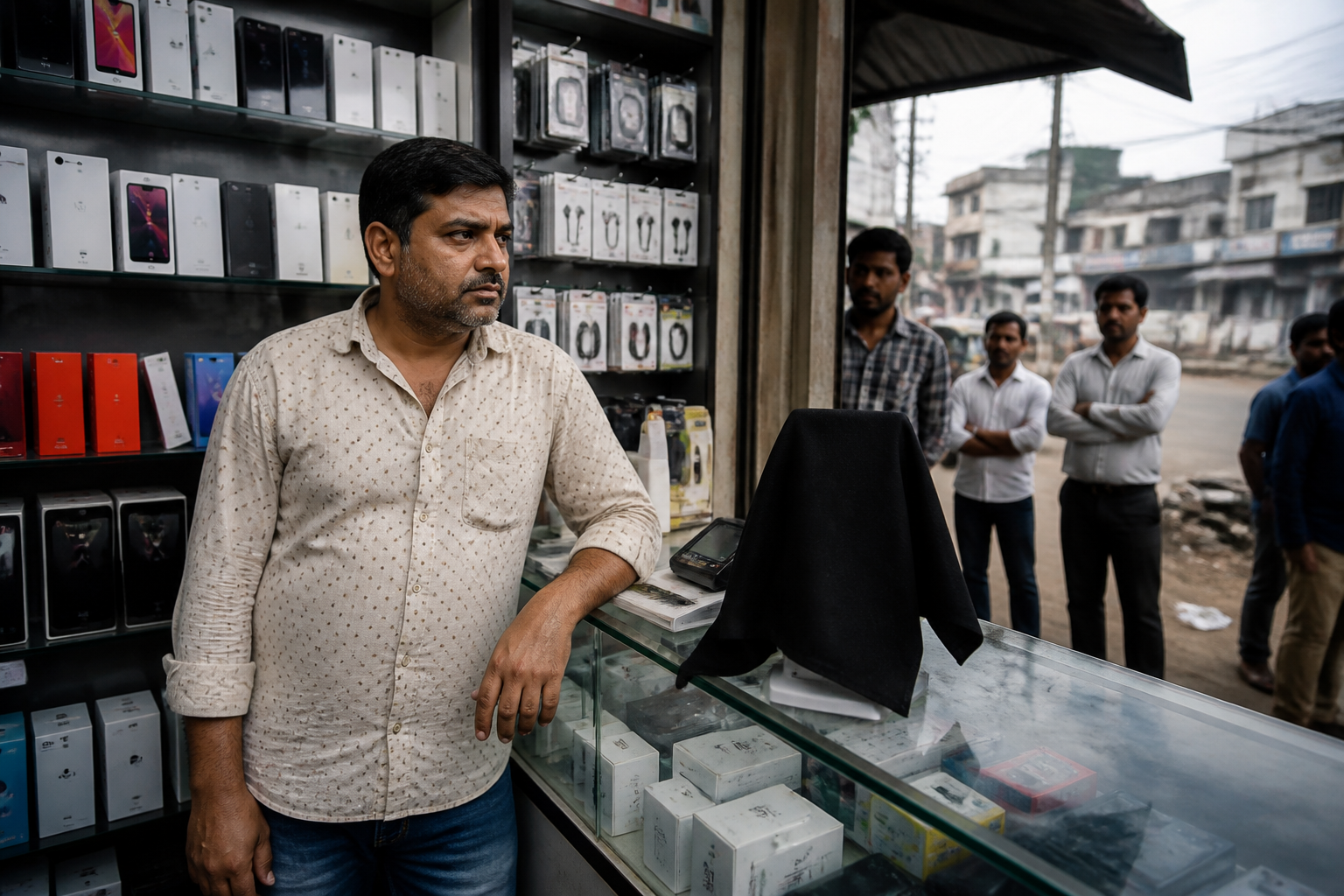
The planned nationwide “No UPI Day” by mobile phone retailers has brought a larger question about India’s digital payments architecture into the open: who should pay for a system that has been built around free merchant transactions? The All India Mobile Retailers Association (AIMRA) says it will ask retailers to stop accepting UPI payments on October 2, while the government’s proposed 0.4% Merchant Discount Rate (MDR) for specified merchant transactions above Rs 2,000 is scheduled to take effect from October 15.
AIMRA has asked retailers to symbolically cover their UPI QR codes with black cloth and refrain from accepting UPI payments on Gandhi Jayanti. The association says its protest is not against UPI or digital payments, but against the additional cost that the new framework could impose on small mobile retailers. Tarvinder Singh, AIMRA vice president and Delhi NCR president, said the association wants merchant UPI payments to continue under a zero-MDR structure.
The dispute is significant because UPI has become a routine part of retail commerce. For a mobile phone shop, where individual transactions can be high in value but margins may be limited, a charge linked to each eligible payment can directly affect monthly earnings. AIMRA’s representation to Finance Minister Nirmala Sitharaman estimates that a retailer processing between Rs 5 lakh and Rs 30 lakh through UPI each month could face a monthly net loss of between Rs 2,000 and Rs 12,000.
The retailers’ body has also estimated that the proposed charge could create a burden of around Rs 40 crore a month and nearly Rs 500 crore a year for small mobile retailers across India. These figures are estimates submitted by AIMRA and represent the association’s assessment of the impact, rather than an independently established financial outcome in the material available.
What is changing under the MDR framework
The proposed framework applies a 0.4% MDR to specified UPI person-to-merchant transactions above Rs 2,000. Person-to-person transactions and small payments will remain outside the charge framework. The MDR will be capped at Rs 300 for transactions of Rs 75,000 and above.
The framework also sets separate rates for selected sectors. Essential and thin-margin sectors, including railways, telecom, insurance, fuel and agricultural inputs, will face a flat MDR of Rs 5 per transaction above Rs 2,000. Transactions involving mutual funds, securities and stockbrokers and dealers will attract an MDR of 0.02%, also capped at Rs 300.
The distinction between person-to-person and person-to-merchant payments is central to the policy. According to the report, person-to-person UPI transactions account for 37% of transaction volume and 70% of transaction value. They will continue to attract zero charges irrespective of the transaction size. The proposed change therefore targets a specified segment of merchant payments rather than the entire UPI network.
The framework would end nearly six years of fully free UPI payments for the specified merchant transactions. That transition raises a structural question for retailers: whether the cost of digital payment acceptance should be absorbed by merchants, distributed among payment-system participants or eventually reflected in the prices paid by customers.
The government’s position is that consumers will not pay
The Centre has said the MDR is not a government charge and that consumers will not be required to bear it. Sitharaman said the cost would be borne by traders, merchants, banks and other participants in the payment ecosystem. She also said the money collected through MDR would not go to the government.
“The MDR is being charged by NPCI, the aggregator, the service provider, those who provide the POS machines and the merchant bank,” Sitharaman said. “The merchant is the one who is going to pay. That money is not coming to the Government of India and we are not imposing it.”
This explanation places the charge within the operating economics of the payment network rather than treating it as a tax or government levy. The money would move among the entities involved in processing, aggregating and settling transactions, including merchant banks and service providers.
The government has also said the MDR will not be passed on to customers. The Indian Banks’ Association is expected to put in place a mechanism to ensure that merchants do not recover the charge from consumers. The finance ministry is expected to hold discussions with merchants and the Confederation of All India Traders on concerns related to the new framework.
The practical implementation of that assurance will matter to retailers and consumers alike. If the charge is formally imposed on merchants but enforcement against customer recovery is weak, the price impact could become difficult to monitor. If merchants absorb the cost, the effect would instead appear in their margins. The available material confirms the government’s stated position, but does not establish how the proposed monitoring mechanism will operate in individual shops.
Why small retailers are resisting
AIMRA’s protest reflects the specific economics of small-format retail. A mobile retailer may process substantial payment value without having the pricing power of a large chain. The association’s estimates suggest that the proposed MDR could create a recurring cost even when the retailer’s monthly UPI turnover is relatively modest by national payment-system standards.
The concern is not limited to the percentage itself. The proposed rate would operate across a large number of transactions, and the cumulative effect would depend on the retailer’s payment mix, transaction values and ability to negotiate with banks or service providers. The source material does not provide an independent comparison of margins across mobile retailers or a sector-wide assessment of how many businesses would be affected.
That limitation is important. AIMRA has provided estimates of losses and the overall burden, while the government has explained who would bear the charge and said it would not be passed on to consumers. Neither position, as presented in the supplied material, resolves the detailed question of how the MDR would affect different categories of merchants.
The legal challenge adds another layer
The proposed MDR framework is also facing a legal challenge in the Supreme Court. A petition has challenged the Centre’s September 14 notification and the framework announced on September 15, which is scheduled to take effect from October 15.
The petition alleges that the levy was introduced without adequate statutory safeguards, transparency or public consultation. It also questions the distinction between UPI transactions and RuPay debit card payments. The petition seeks the quashing or suspension of the framework insofar as it imposes a charge on eligible UPI person-to-merchant transactions above Rs 2,000.
Alternatively, it seeks reconsideration after consultation, publication of empirical data and an impact assessment, along with safeguards for micro and small enterprises. The Supreme Court is scheduled to hear the challenge, but the supplied material does not establish the outcome of that hearing or indicate whether the implementation date will change.
The legal challenge shifts the debate beyond merchant dissatisfaction. It places procedure, evidence and consultation at the centre of the policy. The petitioners’ demand for empirical data and an impact assessment also mirrors the core uncertainty visible in the public dispute: the parties agree that the charge will affect payment transactions, but differ over how its costs should be measured and allocated.
The larger urban and economic question
UPI is not only a financial technology platform. It is part of the everyday operating system of Indian commerce, connecting customers, neighbourhood retailers, banks, payment aggregators and service providers. A change in its pricing structure can therefore affect the way small businesses accept payments, manage margins and interact with customers.
For urban India, where retail transactions increasingly move through QR codes and mobile interfaces, the issue also shows how infrastructure costs are distributed. The government’s policy treats consumers as protected from a direct charge, while the retailers’ association argues that merchants will face a significant additional burden. The payment ecosystem’s intermediaries are positioned to receive the MDR, but the cost ultimately has to be absorbed somewhere within the commercial system.
The available evidence confirms three immediate developments: AIMRA has announced an October 2 protest; the proposed 0.4% MDR for specified merchant UPI transactions above Rs 2,000 is scheduled to begin on October 15; and the framework is being challenged in the Supreme Court. What remains unresolved is how the charge will affect different merchants in practice, how the no-pass-through rule will be enforced and whether the court challenge will alter the framework before implementation.
The next milestones are the proposed “No UPI Day” on October 2, the Supreme Court hearing and the scheduled October 15 start of the MDR regime.
