


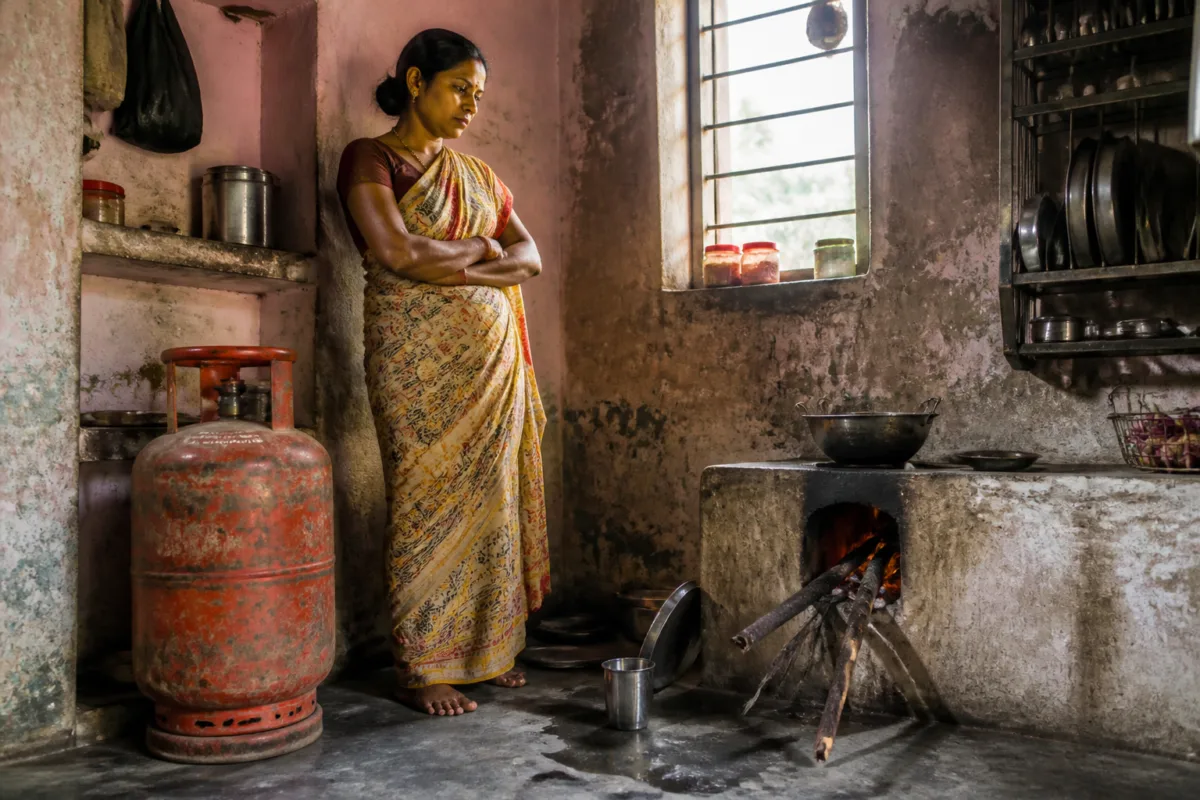
The Ujjwala scheme in Gujarat has reached a point where access to a cooking-gas connection and the ability to keep using it appear to be diverging sharply. Gujarat Samachar, citing a central government report, said more than 2.89 lakh beneficiaries did not refill a cylinder even once during 2025-26, raising a broader question about whether household energy schemes are being measured by connections distributed or by clean fuel actually used in kitchens.
The reported figure does not mean that every beneficiary abandoned LPG permanently, and the supplied report does not provide a district-wise breakdown, household-level reasons or the number of refills made by other beneficiaries. But it does establish a significant usage gap within a scheme designed to reduce dependence on firewood and other smoky fuels among poor and rural women. A connection can remove the initial barrier to entry; it cannot, by itself, guarantee that a family can afford regular refills.
That distinction is central to understanding the economics of welfare delivery. The first stage of the Pradhan Mantri Ujjwala Yojana was built around providing eligible households with a free gas connection and cylinder. The intended benefits were wider than convenience. The scheme was presented as a way to reduce women’s exposure to smoke, limit the time spent collecting firewood and improve household health. Its success therefore depends on repeated use, not simply on the installation of equipment or the creation of a customer record.
The Gujarat report places that question against the cost of cooking fuel. The article says a domestic LPG cylinder is priced close to Rs 1,000, a level that can represent a substantial one-time expense for households already managing food, transport, rent and other essential costs. It also says that available subsidy support is perceived by families as too small to make refills consistently affordable. The supplied material does not specify the exact cylinder price, subsidy amount or the date on which either figure was recorded, so those details require caution. The affordability pressure, however, is the central issue identified in the report.
For a household with irregular income, a refill is not a monthly utility payment in the same way as electricity or water. It is a large, periodic expenditure that must be made in full before the fuel becomes available. Families may therefore continue to possess a functioning connection while postponing a refill, using less LPG or shifting temporarily to another fuel. The reported 2.89 lakh no-refill figure is important precisely because it captures this difference between nominal access and usable access.
The source report says some households are returning to firewood, cow dung cakes and coal, while others are using stoves or electric induction equipment. These alternatives are not equivalent. Solid fuels can expose households to smoke and require storage, collection or purchase. Induction cooking avoids combustion inside the home but depends on reliable electricity, an appliance capable of handling cooking loads and the ability to pay the electricity bill. The supplied report does not establish how many households use each alternative, but the range of fuels mentioned shows that families are adapting their cooking systems around affordability and availability rather than following a single transition path.
This matters because household energy transitions are rarely linear. A family may use LPG for some meals and firewood or an induction stove for others. It may refill only during periods of higher income, or reserve the cylinder for occasions when smoke, time or weather makes solid fuel impractical. A scheme can therefore appear successful in administrative records while producing a much more uneven pattern of use on the ground. The absence of a refill during a financial year is a strong signal of non-use or interrupted use, but it is not, on its own, a complete account of a household’s cooking behaviour.
The Gujarat figure also highlights a measurement problem for public administration. Distribution targets are relatively easy to count: connections issued, beneficiaries enrolled and cylinders delivered. Sustained adoption is harder to measure because it requires tracking refill frequency, household income, local fuel availability, electricity access and changes in family circumstances. If evaluation stops at connection coverage, the state may record progress even when the intended health and environmental benefits are not being realised consistently.
The administrative responsibility is spread across several parts of the energy-delivery system. The Union government designs and funds the broad policy framework, oil marketing companies distribute LPG and manage customer transactions, and state-level institutions operate within the wider welfare and price environment. Retail prices, subsidy arrangements, distribution access and household purchasing power interact at the point where a beneficiary decides whether to order a cylinder. The supplied report does not identify a specific administrative failure or state-level corrective measure, so the evidence does not support assigning responsibility to one institution.
What it does show is that the final stage of delivery takes place inside the household budget. Even if a connection is available, the policy’s practical outcome depends on whether the family can pay for the next refill when it is needed. This is particularly relevant for informal workers and low-income households whose earnings may vary from week to week. The source describes the pressure on poor and middle-class families but does not provide income data or a consumption survey. The affordability argument should therefore be read as a policy concern supported by the reported usage figure, not as a complete statistical explanation of every non-refilling household.
The public-health implications are equally significant. The original promise of the Ujjwala scheme was to reduce women’s exposure to smoke from traditional cooking fuels. If some beneficiaries are unable to refill LPG and return to firewood, coal or biomass, the health benefit becomes intermittent. The supplied material does not provide measurements of indoor air pollution, respiratory illness or time spent collecting fuel in Gujarat. It nevertheless identifies the mechanism through which a price barrier can weaken a health-oriented intervention: the connection remains, but the cleaner fuel is not consistently used.
There is also an urban and peri-urban dimension to the issue. Cooking-fuel choices are often discussed as a rural welfare matter, but fuel costs affect migrant workers, informal settlements and low-income households across expanding towns and cities. In dense settlements, storing firewood or using smoky stoves can affect neighbours as well as the cooking household. At the same time, induction cooking may be attractive only where electricity supply, wiring and household appliances are adequate. The report does not separate rural, urban and peri-urban beneficiaries, leaving an important gap in understanding how the problem varies across Gujarat’s different settlement types.
The figure from 2025-26 should therefore be treated as a warning about the difference between infrastructure of access and infrastructure of use. A gas connection is a physical and administrative gateway, but the policy outcome depends on recurring affordability and reliable delivery. The same principle applies across urban welfare systems: a water connection does not ensure adequate supply, a housing allotment does not guarantee habitability and an electricity connection does not ensure sufficient consumption. In each case, the last mile is not merely the point of installation; it is the point at which a household can continue to use the service.
The evidence supplied establishes the scale of the reported non-refill problem but leaves several questions unanswered. It does not show how many households refilled only once or twice, whether non-refill rates differ by district, how subsidy payments were received, or how many families shifted to electricity or solid fuels. It also does not include a response from the Gujarat government, the Union government or LPG distributors. Those details would be necessary to determine whether the problem is driven mainly by price, irregular income, distribution constraints, fuel preference or a combination of factors.
For now, the reported 2.89 lakh no-refill figure makes one conclusion difficult to ignore: giving a household a clean-cooking connection is not the same as making clean cooking affordable. The next meaningful assessment of the Ujjwala scheme in Gujarat will need to look beyond enrolment and count sustained use, refill regularity and the household conditions that determine whether the cylinder can actually be filled.

