


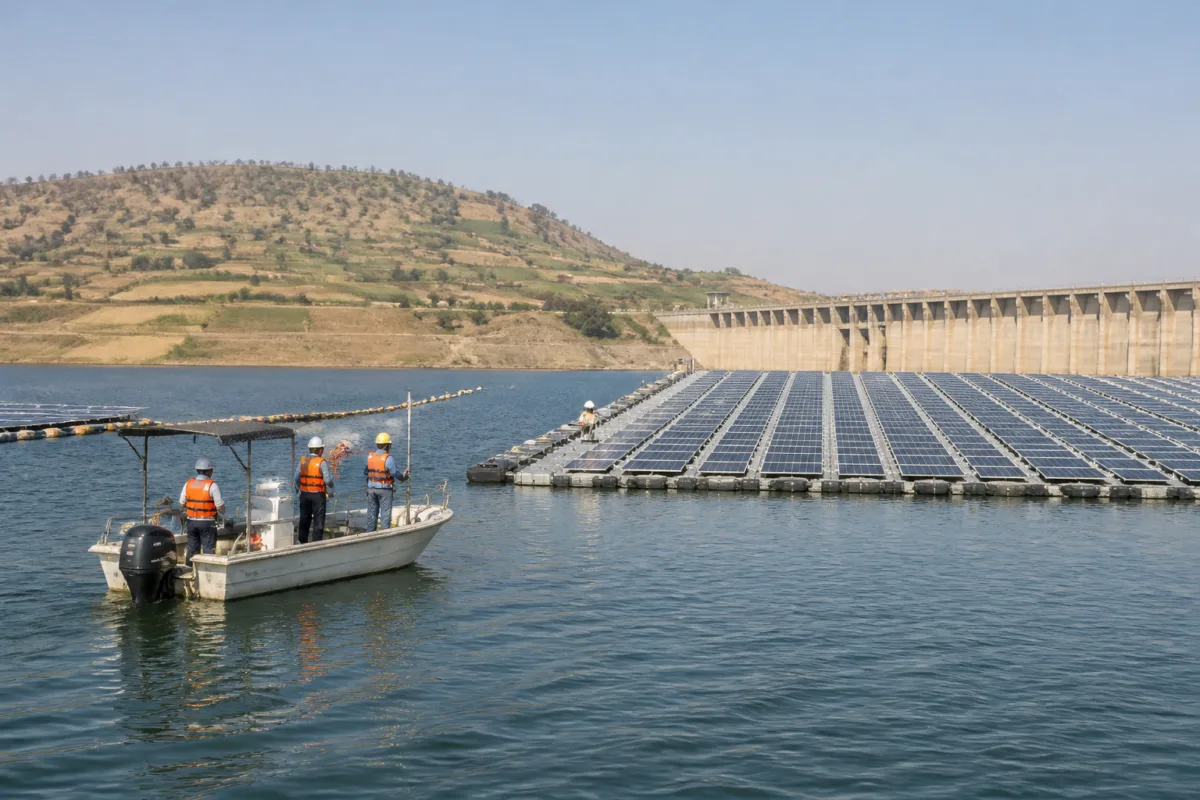
The Ujani solar project will cover about 9% of the dam’s reservoir area, while the remaining 91% will remain open, officials from the Sina-Madha project subdivision and the Ujani Dam management subdivision have said. The floating solar project is expected to generate 2,000 megawatts of electricity and create around 2,800 permanent and 40,000 direct and indirect jobs.
The project is planned across 3,000 hectares of the Ujani reservoir’s 33,630-hectare area at full reservoir level. Officials said the project would use a maximum of half a TMC of water annually. The clarification was issued after questions and concerns emerged locally over the project’s impact on the reservoir, water availability, land use and the proposed data centre.
The Maharashtra government signed a memorandum of understanding for the project in April. Along with the floating solar installation, the plan includes a battery-storage system with a capacity of 1,800 megawatts and an advanced data centre with a capacity of 1.4 gigawatts.
For the first phase, 415.75 acres of government land in Bhimanagar-Ranjani in Madha taluka, and Tartegaon and Hingangaon in Indapur taluka, have been proposed. A further 174 acres may be used in the second phase if the Forest Department grants approval. The administration said no private land or additional government land is planned to be acquired beyond these identified areas.
Water consumption by the data centre has been a central concern for residents. Officials said the facility would use closed-loop direct-to-chip cooling instead of conventional water-based cooling. According to the administration, this would keep water use limited. It also said that treated wastewater or any other wastewater from the facility would not be discharged into the Ujani reservoir or the river.
The stated water requirement of up to half a TMC a year will need to be considered alongside the project’s proposed power-generation and storage capacities. The information released by the project authorities does not provide a detailed water-use assessment, operating schedule or independent environmental findings. The officials’ clarification establishes the proposed limits and technology, but implementation will depend on approvals and project-stage decisions.
To address local concerns, the Maharashtra Krishna Valley Development Corporation will appoint an independent project coordinator. The administration said citizen communication would be conducted through four representatives each from Bhimanagar, Tartegaon and Hingangaon.
The project’s land and water arrangements place it within the wider challenge of adding renewable-energy infrastructure to an existing water system without disrupting established uses. In this case, the authorities have sought to distinguish the floating solar area from the rest of the reservoir, while also stating that no private land acquisition is planned.
The next stage will involve progressing the proposed first-phase land arrangements, securing the required permissions for any second-phase forest land and setting up the project’s local coordination mechanism. The administration’s stated position is that the solar installation will remain limited to 3,000 hectares and that the remaining 91% of the reservoir will remain open.

