


Ahmedabad and Thiruvananthapuram have signed a twin-city partnership to exchange practical knowledge on urban governance, municipal finance, waste management, water and sewage treatment, roads and technology-led civic services. The memorandum of understanding was signed at the Ahmedabad Municipal Corporation headquarters in Danapith during a visit by an eight-member delegation led by Thiruvananthapuram mayor V V Rajesh.
The delegation held discussions with Ahmedabad mayor Hitesh Barot and municipal commissioner Banchha Nidhi Pani on areas of mutual cooperation in municipal administration. Ahmedabad Municipal Corporation officials presented the city’s initiatives in municipal bonds, solid waste management, sewage treatment plants, water treatment plants and road infrastructure.
The partnership places municipal finance alongside core service delivery issues. The discussions included ways to strengthen institutional coordination, improve civic services and adopt technology-driven solutions for urban management. The source report did not specify the financial value of the MoU, a fixed project pipeline or a separate implementation fund.
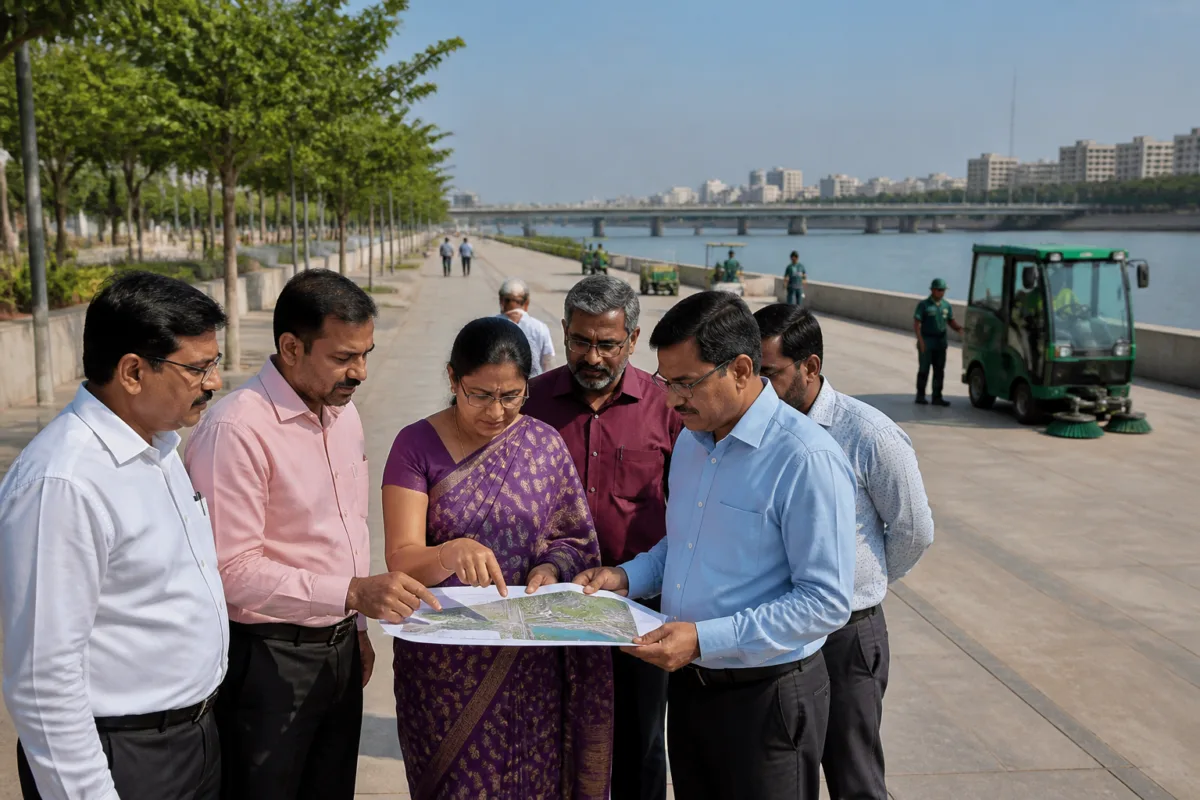
During the visit, the Thiruvananthapuram delegation inspected Ahmedabad’s waste segregation facilities, the Sabarmati Riverfront and the Atal Bridge. The visits provided an opportunity to review the city’s public infrastructure and urban development projects, while allowing the visiting officials to examine how Ahmedabad’s municipal systems are organised and operated.
Officials said the engagement could lead to regular exchanges and capacity-building programmes between the two cities. Potential areas identified for future collaboration include waste processing, water conservation, transport planning and financial management. The emphasis on exchange rather than a single construction project means the immediate outcome is administrative cooperation and knowledge sharing between the two municipal bodies.
For municipal corporations, such cooperation can bring operational practices into direct comparison across different urban contexts. Ahmedabad’s experience with municipal bonds, waste segregation facilities and large public infrastructure projects is being presented to Thiruvananthapuram alongside broader discussions on water, sewage, roads and digital civic services. The partnership also gives both cities a formal framework to identify areas where institutional coordination can be strengthened.
The next steps are expected to include further exchanges and capacity-building programmes. The report did not provide a schedule for these activities or identify specific targets against which the partnership’s results will be measured.

