


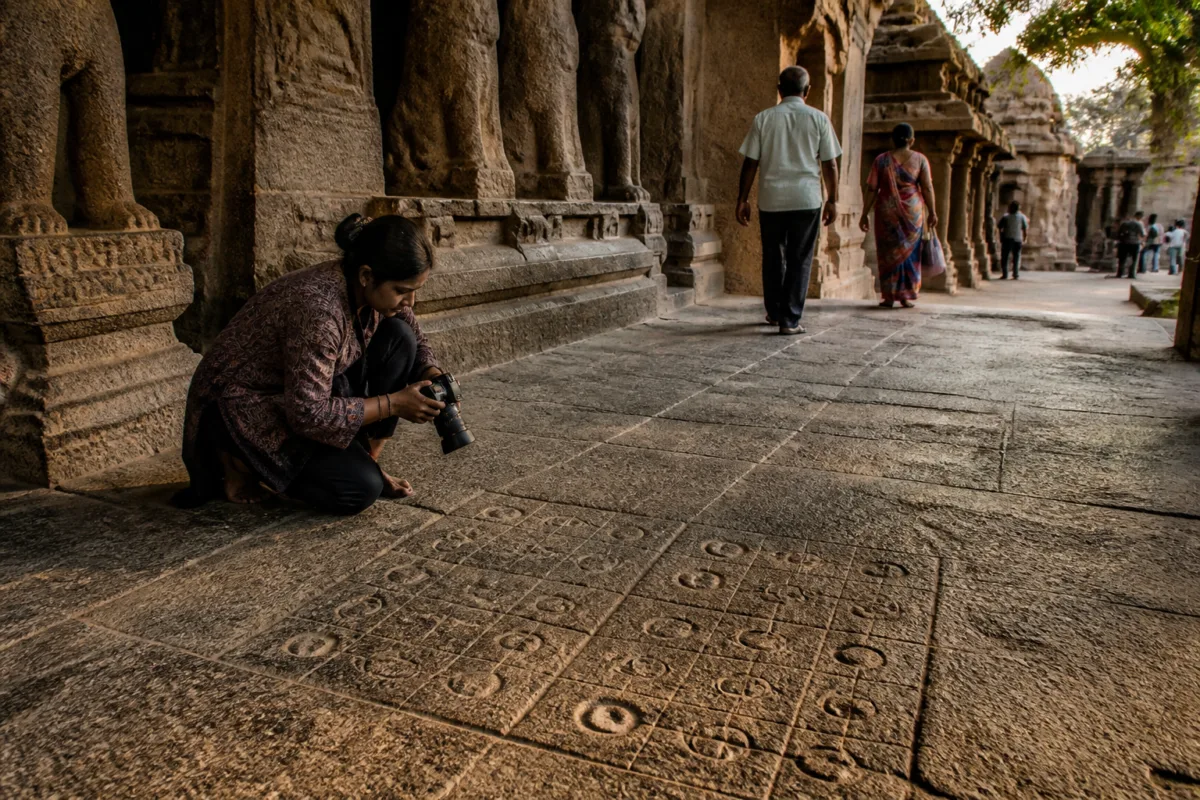
Traditional games of India are leaving behind an unexpected architectural record: carved boards on temple floors, fort shelters, compound walls and other built spaces where people once waited, gathered and played. Researchers tracking these markings across more than 100 sites are finding evidence that historic religious and defensive structures were not only places of worship or surveillance, but also everyday social environments.
The research is significant because the game boards are easy to overlook. Visitors generally look up at temple towers, sculptures and deities, while the markings remain underfoot. Researchers Vinita Sidhartha and the Mysuru-based cultural trust Ramsons Kala Pratishtana have instead made the floor part of the historical record they study. Their work suggests that the use of these sites extended beyond formal ceremonies and monumental architecture.
Sidhartha’s latest research, published in the CSMVS Journal, examines the age and spread of dahdi, also described as three nested squares. She found one such board at the entrance to the Saluvankuppam temple near Mamallapuram, a site unearthed by the 2004 tsunami. A similar game was found in the narrow space beneath Krishna’s Butterball in Mamallapuram, where the marking was so inaccessible that it could not plausibly have been carved there for ordinary play after the boulder was in place.
That discovery gives the physical setting an important role in interpreting the evidence. Sidhartha argues that the board beneath the Butterball must have been etched before the boulder came to rest there, possibly before the 12th century according to the legend associated with it. The conclusion is not simply about the age of a game. It shows how landscape, construction and later historical interpretation can intersect in ways that are invisible when a monument is viewed only as a finished object.
The distribution of the markings also challenges the idea that temple architecture was used in a single, predetermined way. Dharmendra Raghu of Ramsons Kala Pratishtana says the trust has documented boards in temples across Karnataka, Odisha, Maharashtra, Uttar Pradesh and Tamil Nadu. They are often found on elevated platforms or in shaded areas where people could sit comfortably. In forts, the boards appear at vantage points with wide views, including lookout shelters at Salem Fort.
The placement of these boards points to the practical rhythms of historic sites. A shaded platform could serve as a place to rest or wait. A fort lookout could give guards a way to pass time while remaining at their post. In both cases, the game was incorporated into an existing space rather than requiring a separate recreational building. The built environment accommodated play through small adaptations to surfaces and routines.
The distinction matters for understanding historic public spaces. Temples are often described through their religious, artistic or administrative functions, while forts are primarily associated with defence and military control. The game boards add another layer: these sites also hosted informal social activity. They show that people used monumental spaces through ordinary behaviours such as sitting, waiting, teaching, competing and watching.
Some locations make the interpretation more complicated. At the Erikatarama temple in Madurantakam, Sidhartha found a game etched on a compound wall. Her explanation is that a horizontal stone may have been reused during renovation. At Delhi’s Jawaharlal Nehru campus, she found a board behind foliage and later learned that the area had originally been a quarry. These examples show why the physical history of a site is essential. A marking cannot be understood only by its present location; alterations, reused stone and changes in land use may have shifted it from its original setting.
The boards also offer clues about movement and craft. Sidhartha believes that artisans involved in temple construction or renovation may have travelled between sites, helping explain why similar games appear in different parts of India. Some markings have deep, precise cuts that she says would have required skilled hands and tools. If that interpretation is correct, the spread of game forms may be connected not only to players but also to the networks of artisans who shaped the built environment.
Yet the markings do not provide an easy historical catalogue. A single board can accommodate several games, and the rules of many games were not written down. R G Singh says researchers compare anthropologists’ records, rules documented by British writers, texts such as Krida Kausalya and Manasollasa, and recent academic research. They also rely on living knowledge. Rules for everyday games often survive in people’s memories and are passed from one generation to another.
That dependence on local memory changes the role of heritage research. The evidence is not contained entirely in stone. Autorickshaw and taxi drivers near temples in Karnataka and Tiruvannamalai have explained games such as chowkabara to the researchers, drawing on games they play while waiting for passengers. In Hampi, the team found women using leaf sap to draw boards on marble temple floors. These practices connect archaeological traces with continuing forms of informal occupation and public life.
The games themselves also carry different kinds of social meaning. Pallanguzhi, a traditional counting game from Tamil Nadu, resembles the mancala family of games found in Africa. V Balambal, former professor of history at the University of Madras and author of Folk Games of Tamil Nadu, says versions of the game have been used to teach arithmetic and develop mental skills in parts of Africa and the West Indies. She has conducted workshops for children with special needs and visually impaired children, describing the game as inclusive.
Paramapadam, which inspired modern snakes and ladders, carried an explicit moral structure. According to Balambal, honesty and kindness moved players up ladders, while lying, stealing and greed sent them down. Contemporary versions often retain the mechanics but not the ethical lessons associated with the older game. The change illustrates how games can survive as formats while losing the social ideas that once gave them meaning.
Aadu puli attam presents another model. Three tigers play against 15 goats, which must cooperate to trap the stronger animals. Sidhartha interprets the game as reflecting how a community can overcome a larger challenge by acting together. Whether or not every historical player understood the game in those terms, its structure records a relationship between individual strength and collective strategy.
The evidence also raises a preservation problem. Most visitors to the temples studied do not know that the markings are games. Archaeologists can sometimes mistake them for architectural plans before identifying their recreational purpose. As surfaces weather, sites are renovated and vegetation changes, the context needed to interpret the boards can disappear. A carved line without its surrounding social and architectural clues becomes much harder to read.
This is particularly important because temple and fort conservation often focuses on prominent structures, sculpture and visible architectural elements. Small floor markings may not attract the same attention, even though they can reveal how people occupied a site. Their protection requires close observation of platforms, shaded corners, wall stones, lookout shelters and other ordinary surfaces that may not appear significant in a conventional monument inventory.
The research also records a shift in contemporary access to play. Sidhartha argues that traditional games are vanishing faster than classical art forms because children are losing opportunities for unstructured play. Instead of playing chess or cricket freely, children may attend classes for those activities. In this account, the loss is not only of particular games but of play as an everyday, self-directed use of space.
Revival efforts are therefore taking place through both education and craft. Sidhartha has spent 25 years working through Kreeda, the organisation she founded, conducting school workshops and running an experience centre. Ramsons Kala Pratishtana has trained teachers and worked with dhurrie weavers to explore how traditional weaving techniques could create game boards. The approach links intangible cultural knowledge with contemporary making and classroom use.
The work remains incomplete. Researchers continue to find boards whose rules are uncertain, including two arrowheads pointing towards each other on a temple floor in K R Nagar near Mysuru. Singh says the team is testing different combinations to work out how the game may have been played. That uncertainty is itself part of the record: historic public spaces preserve traces of activity more readily than they preserve the explanations attached to them.
What the documented boards confirm is that India’s temples and forts were lived environments shaped by more than ritual, power and architecture. Their floors and platforms accommodated waiting, competition, teaching and social interaction. What remains uncertain is the precise age, rules and original use of many markings. The continuing search across these sites may therefore recover not only forgotten games, but also a fuller account of how people used historic built spaces in everyday life.

