


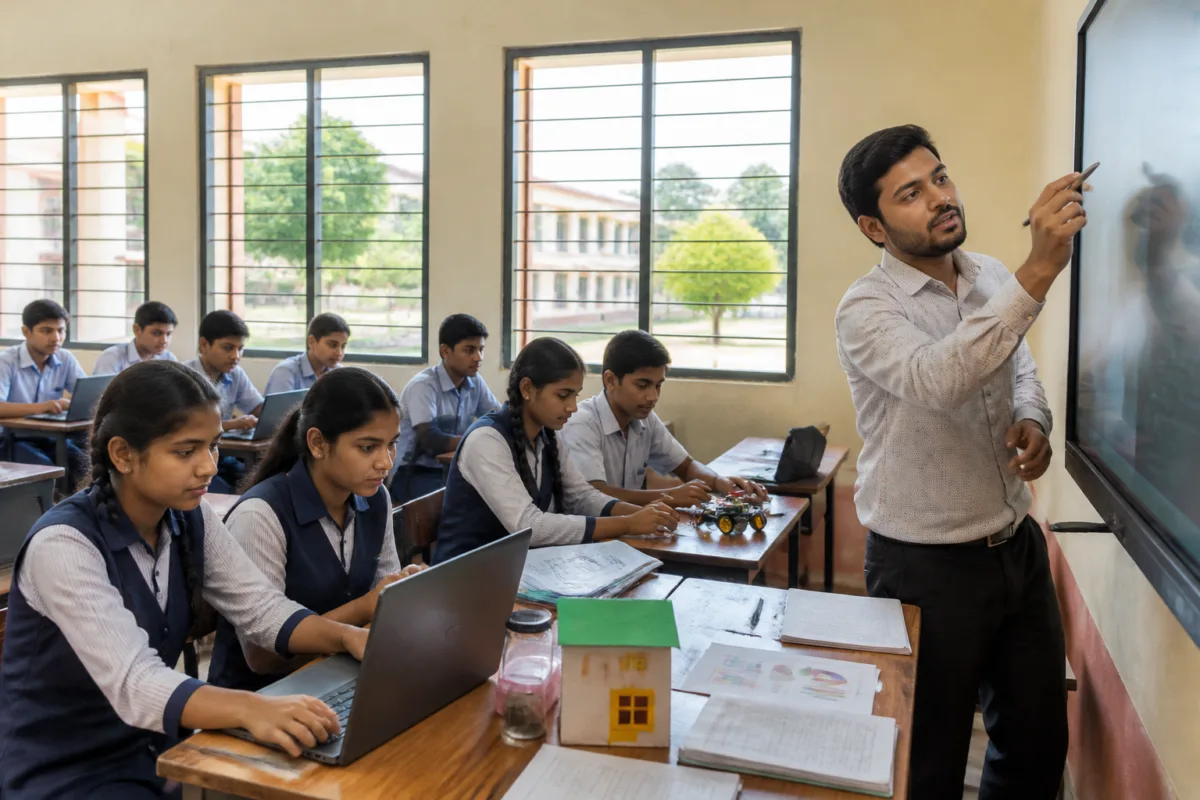
Project Praveen is expanding the role of schools in Uttar Pradesh from places that primarily prepare students for examinations to institutions expected to provide early exposure to work, technology, money management and entrepreneurship. The programme’s 2026-27 targets—training approximately two lakh students across 515 schools, alongside a focused initiative for 2,672 girls in 71 Kasturba Gandhi Balika Vidyalayas—show how the state is attempting to bring vocational education closer to secondary-school students.
The shift matters because the distance between formal education and economic opportunity is not only a question of curriculum. It is also a question of access. Students who live far from specialised training centres, or whose families cannot easily support additional courses after school, may have limited opportunities to understand trades, workplace expectations or small-business pathways. Project Praveen uses the existing school network to introduce those elements during Classes 9 to 12.
Implemented by the Uttar Pradesh Skill Development Mission, the programme combines technical trade training with soft skills, digital learning, financial literacy and entrepreneurship. The stated objective is not to replace academic education, but to reduce the rigid separation between academic and vocational routes. This approach is consistent with the National Education Policy 2020’s emphasis on practical learning and on removing the traditional hierarchy between classroom-based education and skill-based education.
The programme’s design reflects a broader change in how employability is understood. A student may possess a school qualification but still lack the ability to communicate in a workplace, use basic digital tools, manage earnings or identify a viable service opportunity. Project Praveen’s framework attempts to address these gaps before students complete secondary education. According to the programme details reported by The Times of India, students receive 180 hours of technical trade training, 30 hours of soft-skills training and four hours of artificial intelligence and digital-skills training. The new financial-literacy and entrepreneurship modules add two hours each.
These numbers indicate a layered model rather than a single vocational course. Technical training is intended to provide an occupational foundation. Soft skills address communication and workplace readiness. Digital and artificial-intelligence modules introduce students to changing technologies, while financial literacy and entrepreneurship connect skills to economic decision-making. The stated training package remains relatively limited in duration, but its importance lies in whether it helps students identify further pathways such as apprenticeships, advanced vocational courses, employment or self-employment.
The financial-literacy module, introduced from October 24, 2026, is being delivered through an arrangement between the Uttar Pradesh Skill Development Mission and the National Stock Exchange of India. It covers savings, needs and wants, budgeting and informed financial decision-making. The entrepreneurship module is being delivered with the National Institute for Entrepreneurship and Small Business Development, an institution under the Union Ministry of Skill Development and Entrepreneurship. It addresses business ideas, customer needs, market opportunities, resource planning and problem-solving.
The institutional partnerships are significant because they bring specialised organisations into a school-based programme. At the same time, the modules are only two hours each, which means their likely role is introductory. The available material supports describing them as an attempt to establish basic awareness, not as a complete financial or enterprise education programme. Whether students can apply these lessons will depend on the depth of instruction, the relevance of the trades offered and the support available after training.
The programme’s potential reach is one of its clearest features. The target of approximately two lakh students across 515 government secondary schools, aided schools, Kasturba Gandhi Balika Vidyalayas, Sarvodaya Vidyalayas and Atal Residential Schools places the initiative across different types of institutions and student communities. This is especially relevant in a state with wide differences in economic opportunity between districts. Delivering training through schools may reduce the need for students to travel to separate institutions, although the supplied material does not establish how many students will ultimately enter employment or further training as a result.
The special focus on girls in Kasturba Gandhi Balika Vidyalayas adds another dimension. The target of 2,672 students across 71 Kasturba schools covers healthcare, information technology and IT-enabled services, apparel, media and entertainment, green jobs, artificial intelligence, computer technology and soft skills. These institutions serve girls from disadvantaged communities, making access to employment-oriented education an important part of the programme’s stated purpose.
The training duration for this initiative has been fixed at a maximum of 300 hours. Students are also required to complete an artificial-intelligence course available through the Mission Portal or the YUVA AI for ALL initiative. Textbooks and study materials are to be distributed within seven working days of classes beginning, with proof of distribution uploaded to the Mission Portal. These administrative requirements show that the programme is not limited to announcing a curriculum; it also includes prescribed procedures for resources, registration and digital reporting.
This implementation architecture is central to the programme’s credibility. Training centres and batches are expected to be approved promptly, with decisions on applications to be taken within two working days of receipt on the Mission Portal. Training must follow the curriculum prescribed by the relevant Sector Skill Council and comply with applicable National Council for Vocational Training and National Skills Qualifications Framework standards. Students are to be assessed through the respective council after completing their training.
District Programme Management Units are required to inspect training centres and equipment every 15 days. The Mission Director has warned that action will be taken against institutions that do not begin classes on schedule or fail to meet quality requirements. These provisions identify the main administrative risks: delayed starts, inadequate equipment, missing learning materials and weak assessment. They also establish a monitoring chain that runs from training providers to district units and the state mission.
The geographical list of participating Kasturba schools includes districts such as Agra, Aligarh, Bareilly, Budaun, Bulandshahr, Chandauli, Ghaziabad, Gonda, Hardoi, Jhansi, Lakhimpur Kheri, Mathura, Meerut, Mirzapur, Moradabad, Prayagraj, Sitapur, Sonbhadra, Unnao and Varanasi. The spread indicates that the programme is intended to operate beyond the state’s largest urban centres. It also means that implementation will have to work across districts with different local economies, institutional capacities and access to employers or further training providers.
That local economic connection is important to the entrepreneurship component. The programme’s own examples link tailoring to garment-making or alteration services, information technology to repair and digital-support work, and beauty, wellness or automobile training to service businesses. Such possibilities do not guarantee viable enterprises. They do, however, show the intended logic: a technical skill becomes more useful when a student also understands customers, costs, resources and the organisation of work.
The programme therefore raises a larger question about what schools are expected to deliver in a changing labour market. Adding vocational subjects can broaden students’ choices, but it also creates demands for trained instructors, functioning equipment, credible assessments and curricula that remain relevant to local opportunities. The supplied report provides targets and monitoring provisions, but it does not provide outcome data on placements, earnings, enterprise creation, student completion or employer satisfaction. Those indicators will be necessary to judge whether the programme moves beyond enrolment and training hours.
For now, Project Praveen represents a significant administrative attempt to connect secondary education with economic participation. Its 2026-27 expansion combines school access, technical trades, digital exposure, financial awareness and entrepreneurship, with special provisions for girls in disadvantaged communities. The evidence confirms the scale and structure of the initiative. What remains to be established is how consistently training will be delivered across 515 schools, how students will use the skills after Class 12 and whether the programme’s monitoring systems can translate a broad policy promise into durable livelihood pathways.

