


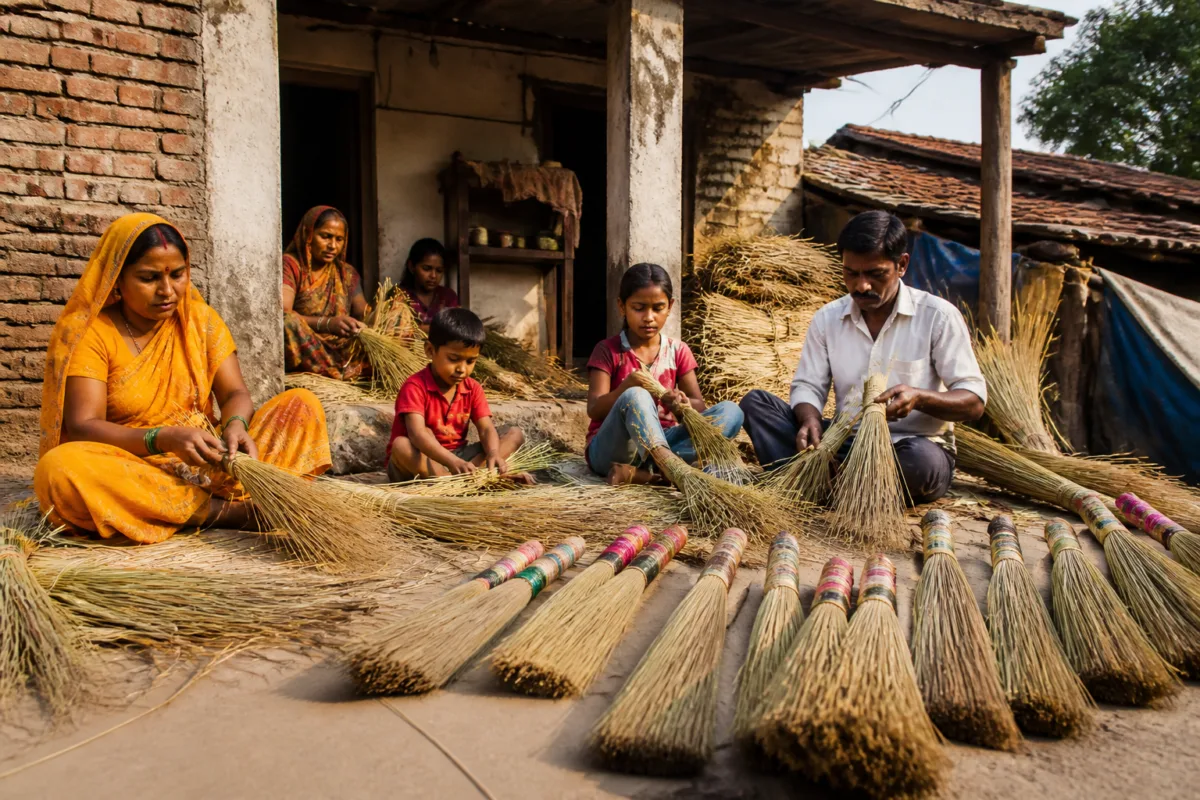
Traditional broom making in Loni’s Panchraswadi is entering its busiest season, with 30 to 40 families preparing an estimated 15,000 to 20,000 handcrafted brooms for Diwali markets across Pune district. The annual rush is more than a festival ritual: it shows how a small household-based production network connects agricultural village homes with urban and semi-urban consumers, wholesale traders and seasonal demand.
The work is concentrated in Panchraswadi in Loni, in Ambegaon taluka. According to a report by Sakal – Pune, families in the settlement have continued making the brooms for several generations from the fronds of the shindad tree. The brooms are made in different sizes and decorated with patterns, with specially designed pieces prepared for Lakshmi worship during Diwali.
The production cycle begins well before the festival. The report says the activity gathers pace about two months before Diwali, while the immediate production rush begins when the festival is roughly a week away. Women, men and children in the participating households work together. An individual worker produces an average of 50 to 60 brooms a day, while a family generally prepares between 500 and 1,000 pieces during the season.
These figures reveal the basic structure of the trade. It is not organised around a factory, a formal production unit or a single large employer. Instead, it is distributed across household workshops, with family members contributing labour and finished products being consolidated for sale. The arrangement allows production to expand during a predictable seasonal window, but it also means that the livelihood depends on the availability of raw material, family labour and access to traders who can move the products to markets.
The brooms are sent to Rajgurunagar, Manchar, Chakan, Shirur, Ghodegaon, Pune, Bhosari and nearby villages a few days before Diwali. The list includes major urban and industrial locations as well as smaller settlements. This distribution pattern places Panchraswadi within a wider regional market rather than treating the craft as an activity consumed only within the village where it is made.
The role of wholesale traders is central to that connection. The report states that the brooms are dispatched for sale through ठोक व्यापाऱ्यांच्या माध्यमातून, or wholesale traders, who take the products to surrounding cities. This indicates a simple but important institutional link: the producers do not necessarily sell every broom directly to the final buyer. Traders provide the channel through which a dispersed village production base reaches markets with larger seasonal demand.
That arrangement also shapes how value is distributed. A broom that normally sells for Rs 40 to Rs 50 is reported to fetch between Rs 70 and Rs 150 during Diwali, depending on the product. The report does not provide a breakdown of the price received by producers, the trader’s margin, transport costs or the cost of collecting the shindad fronds. It therefore establishes a seasonal price increase, but not the net income retained by each household.
The price variation is significant because these are not standardised industrial products. The brooms are made in different sizes and include decorative work, particularly those intended for Lakshmi worship. Their festival value is therefore linked not only to their cleaning function but also to their ceremonial use and appearance. The higher Diwali price reflects the concentration of demand during a short period, although the available report does not establish whether the increase is driven mainly by production costs, trader margins, consumer preference or scarcity.
The most important pressure identified by the producers is the growth of plastic brooms. Subhash Jaywant Panchras, identified in the report as a broom producer, said that traditional brooms have been pushed aside as the use of plastic brooms has increased in recent years. This is the clearest structural issue in the story. Panchraswadi’s craft is sustained by a seasonal cultural market, but it is competing with a manufactured alternative that is available beyond the Diwali period.
The comparison is not simply between two household products. It is also between two production systems. The traditional broom is made through family labour from tree fronds and reaches consumers through local and regional trading networks. The plastic broom belongs to a different supply chain, although the supplied report does not provide details about its manufacturers, prices, durability or distribution. What can be established is that producers themselves perceive the increased use of plastic brooms as a reason their traditional products have become less prominent.
The report also shows that the craft has not disappeared. The target of 15,000 to 20,000 brooms this year, together with the participation of 30 to 40 families, suggests that the activity remains economically and culturally relevant in Panchraswadi. At the same time, the scale is seasonal and household-based. There is no evidence in the supplied material of a permanent expansion in production, formal branding, cooperative organisation, government support or institutional procurement.
That absence is important when considering the future of such livelihoods. The report records production capacity and market destinations, but it does not establish whether younger members of these families intend to continue the craft, whether raw material access is becoming more difficult, or whether the seasonal income is sufficient to sustain the households throughout the year. It also does not say whether producers have direct access to the Pune market or remain dependent on wholesale intermediaries.
The urban connection is visible in the destinations listed by the report. Pune and Bhosari are part of the sales network, alongside Rajgurunagar, Manchar, Chakan, Shirur and Ghodegaon. These markets differ in size and character, but together they create the demand that makes seasonal production worthwhile. The craft therefore sits between village production and urban consumption: the work is performed in household spaces in Loni, while a substantial part of the market lies outside the settlement.
This pattern is often difficult to see in city-centred accounts of the festive economy. Urban consumers encounter the finished broom in neighbourhood markets or through traders, but the production network begins much earlier and farther away. Each product carries the labour of multiple family members, the collection and preparation of natural material, and the logistical work required to move goods before the festival. The report does not quantify each stage, but it makes the network visible through its production, pricing and distribution details.
The craft also illustrates how cultural demand can preserve a product after its everyday use has weakened. Traditional brooms are described as having a respected place in Lakshmi worship, while ordinary sales prices remain lower outside the festival period. The Diwali market consequently provides a concentrated opportunity for producers to sell a larger volume at improved prices. Without that seasonal demand, the economic viability of the household activity could be different, but the supplied report does not provide year-round sales figures for comparison.
The distribution timeline is similarly compressed. Finished brooms are sent to the listed markets a few days before Diwali. This means production, aggregation and transport must be completed within a limited window. Any disruption in raw material availability, household labour or trader movement could affect the season’s sales, although the report does not identify a specific disruption this year. The stated production target indicates that families are currently working to meet expected demand rather than responding to a reported supply crisis.
For local administration and market institutions, the story raises questions that remain unanswered. There is no information in the report about whether the producers are registered as an artisan group, whether they have access to credit, whether local bodies provide workspace or market access, or whether any scheme supports traditional livelihoods. There is also no official assessment of the trade’s annual value. These gaps do not disprove the existence of support; they simply mean that the supplied material cannot establish it.
The evidence does establish a functioning, if seasonal, production system. A worker can make 50 to 60 brooms a day; a family can prepare 500 to 1,000; the settlement aims to produce 15,000 to 20,000; and the goods move through wholesale channels to markets including Pune and Bhosari. Those numbers are modest compared with industrial supply chains, but they are large enough to show that the activity is not limited to symbolic production for a few households.
The larger urban question is whether regional cities can continue to support the small production networks that serve their cultural and everyday needs. In this case, the answer depends on the relationship between a village craft cluster, wholesale intermediaries, festival demand and changing consumer preferences. The report shows that this relationship remains active, but also records the pressure created by plastic alternatives.
What the evidence confirms is that Panchraswadi’s traditional broom makers remain part of the Diwali economy supplying markets across the Pune region. What it does not establish is the trade’s long-term income security, its environmental comparison with plastic products, or the institutional support available to producers. The immediate milestone is the dispatch of this year’s estimated 15,000 to 20,000 brooms to surrounding markets before Diwali.

