


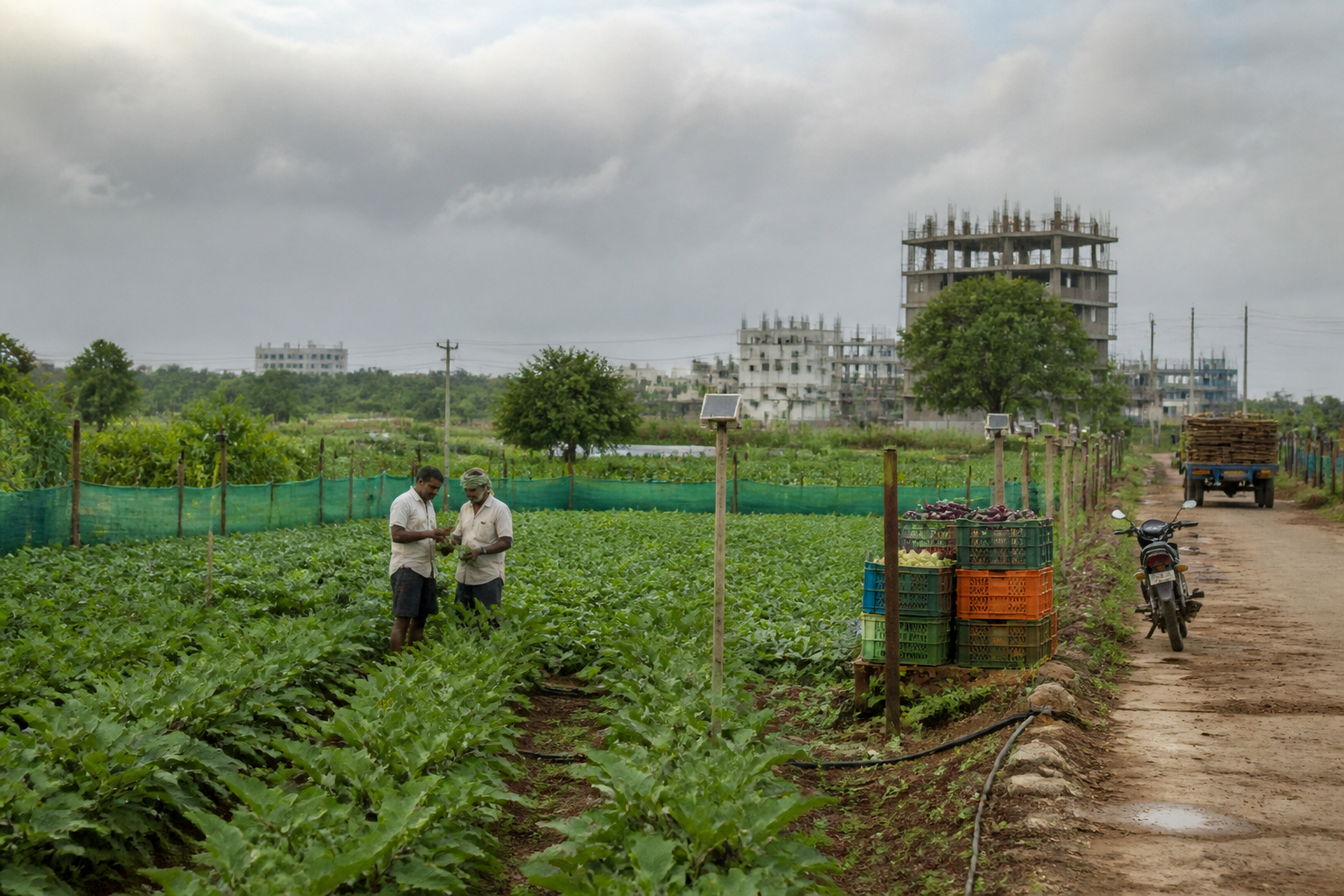
Telangana’s crop diversification debate in the Assembly has exposed a wider urban question: what happens to the food-producing belt when peri-urban land becomes more valuable for real estate than for cultivation? The concerns raised by Congress MLAs point to a system in which farmers are being asked to shift crops without assured prices, storage, protection from wildlife and reliable access to planting material.
During Question Hour, Achampet MLA C Vamshi Krishna said very few farmers were taking up crop diversification across the State. He also linked the decline in vegetable cultivation to the growth of real estate activity in peri-urban areas. His intervention placed agricultural change within a land-use transition that is familiar around expanding cities: farming continues, but the economic and physical conditions supporting it become less secure as urban development moves outward.
The discussion did not establish the extent of vegetable cultivation lost to real estate or identify particular peri-urban districts where the change has been measured. It did, however, identify the mechanism described by the MLA. As land around urban settlements is absorbed into real estate activity, cultivation competes with another use that can offer farmers a different financial return. The result is not only an agricultural concern. It can also affect the availability of fresh produce near cities and increase the distance between urban consumers and the farms that supply them.
Vamshi Krishna said farmers were reluctant to cultivate vegetables and horticultural crops because they lacked a Minimum Support Price. The issue is significant because crop diversification changes the risk profile of farming. A farmer moving away from a more established crop needs confidence that the new crop can be sold at a viable price. Vegetables and horticultural produce can also be more vulnerable to price fluctuations and delays because they are perishable. The Assembly discussion did not provide price data or quantify losses, but it identified the absence of assured price support as a reason farmers were not making the shift.
The MLA sought a committee to create awareness among farmers and conduct training sessions on crop diversification. He also referred to support from NABARD and urged the government to provide subsidies for farmers cultivating vegetables. These demands show that the policy question is not limited to persuading farmers to plant different crops. It involves information, technical capacity and financial protection. Awareness campaigns may explain what to grow, but they cannot by themselves resolve the market and infrastructure risks that determine whether a farmer can sustain the decision.
Cold storage was another major part of the discussion. Bhupalpally MLA Gandra Satyanarayana called for the establishment of cold storage units in the State so farmers could protect their stocks. The demand addresses a basic weakness in the movement of perishable produce. When farmers cannot store their harvest, they have less flexibility over when to sell. That can make them more exposed to immediate market conditions, particularly when several producers bring similar crops to market at the same time.
The source material does not specify how many cold storage units Telangana has, where the gaps are located or what capacity would be required. It also does not establish whether the proposed facilities would be operated by the government, farmer groups or private agencies. Those details matter because a storage facility is useful only when farmers can access it at an affordable cost and when it is connected to transport, aggregation and reliable buyers. The Assembly intervention nevertheless makes clear that storage is being treated as a necessary part of the diversification problem rather than as a separate agricultural issue.
The debate also brought crop protection into the picture. Satyanarayana said monkey menace was significantly affecting maize farmers. Nagarjunasagar MLA K Jayaveer Reddy said monkeys were forcing farmers to avoid vegetable and horticultural cultivation and that residents of Nandikonda Municipality were facing severe hardship because of the animals. He proposed subsidies for solar fencing to protect farms.
This is an important governance overlap. A crop-loss problem is being experienced both in agricultural fields and within a municipality. The account does not specify the scale of damage, the agency responsible for managing the monkey population or whether solar fencing has been tested in the affected areas. But the references to Nandikonda and farming show that the boundary between rural administration and urban local governance is not clear in lived experience. Residents and farmers encounter the same landscape, even when government responsibilities are divided between departments and local bodies.
The oil palm discussion adds another layer to the diversification challenge. Jayaveer Reddy said sweet lime farmers in his constituency were shifting to oil palm cultivation, but that there was a shortage of oil palm saplings. This suggests that even where farmers are willing to change crops, implementation can be constrained by the availability of basic inputs. The source does not say how many farmers are affected, how long the shortage has continued or which agency controls sapling supply. It does show that policy intent and field-level capacity are not automatically aligned.
Taken together, the Assembly interventions identify four linked requirements: a reason for farmers to change crops, protection against price and production risks, infrastructure to hold and move perishable produce, and timely access to planting material. Each belongs to a different part of the administrative system. Agricultural extension may handle training, departments may administer subsidies, market institutions may influence price support, and local bodies may confront problems such as monkeys and land-use change. The fragmentation itself can become a barrier when the farmer experiences all these problems at once.
The policy landscape described in the discussion is therefore broader than a single subsidy programme. Vamshi Krishna referred to NABARD support, while also asking the State government to provide subsidies and organise farmer training. Satyanarayana sought cold storage. Jayaveer Reddy proposed solar-fencing support and called for action on oil palm sapling shortages. These demands cover finance, knowledge, physical infrastructure, crop protection and input supply.
What remains unclear is how these measures would be coordinated. The source does not identify a State-level diversification target, a budget allocation, a district-wise implementation plan or a monitoring framework. It also does not say whether the proposed committee would have decision-making authority or only an advisory role. Without those details, it is not possible to assess whether the proposals represent a new programme or requests for improvements within existing schemes.
The discussion also exposes a data gap. No figures were provided on the decline in vegetable cultivation, the area being converted to real estate, the number of farmers affected by monkey damage, the volume of cold storage available or the shortage of oil palm saplings. There are no crop-wise production trends, price comparisons or district-level indicators in the supplied account. That absence limits the conclusions that can be drawn, but it also indicates what a serious policy response would need to measure.
For cities, the most important evidence is the connection between land conversion and food systems. Peri-urban areas are often treated as vacant or transitional land, even when they support cultivation and supply nearby settlements. Once real estate activity expands, the land-use decision can be difficult to reverse. The Assembly discussion does not quantify this process in Telangana, but the reference to declining vegetable cultivation establishes it as a concern raised by legislators.
The wider urban question is whether planning systems recognise farming as part of urban infrastructure. Roads, housing and utilities are usually planned as the visible components of expansion. Food production, cold storage and short supply chains receive less attention, even though they shape how cities are supplied. Telangana’s debate suggests that crop diversification cannot be separated from the way peri-urban land is valued, protected and connected to markets.
The evidence currently confirms a set of linked concerns, not a completed policy outcome. Legislators have identified weak crop diversification, declining vegetable cultivation, peri-urban real estate pressure, missing price assurance, inadequate cold storage, monkey damage and oil palm sapling shortages. The next stage will depend on whether the government responds with measurable information and coordinated measures: the proposed awareness committee, farmer subsidies, storage facilities, crop-protection support and improved sapling availability. Until those details emerge, the central issue remains clear: Telangana’s ability to diversify agriculture is being tested not only in fields, but also along the expanding edges of its towns and cities.
