


Tamil Nadu’s Mental Health Regulations 2026 attempt to close one of the most consequential gaps in addiction and psychiatric care: the difference between a facility that can provide counselling or rehabilitation and one that can manage a life-threatening medical emergency. The rules create enforceable standards for psychiatric hospitals, de-addiction centres and psychosocial rehabilitation homes, while restricting the admission of critically ill patients to facilities that may not have acute-care capacity.
The regulations were notified by the Tamil Nadu State Mental Health Authority under the Mental Healthcare Act, 2017, nine years after the central law was enacted. Their significance lies not only in the list of prescribed facilities and staffing requirements, but in the attempt to establish a clearer chain of responsibility before a patient enters an institution.
Under the new framework, facilities are classified into five categories: standalone mental health establishments, psychiatry departments in medical colleges, psychiatric wards in multi-speciality hospitals, standalone de-addiction centres, and centres for psychosocial rehabilitation. Each category performs a different role in the care pathway, but the regulations make clear that they cannot be treated as interchangeable.
That distinction is particularly important in addiction treatment. Before admission to a standalone de-addiction centre, a psychiatrist must assess the person and determine whether the facility is suitable or whether the patient requires acute treatment elsewhere. People with severe mental illness, violent behaviour, suicidal tendencies or serious medical illness cannot be admitted to standalone de-addiction or psychosocial rehabilitation centres under the regulations. They must be referred to a registered clinical establishment or a mental-health facility equipped for acute care.
The rule responds to a practical problem described by Dr M Maalaiappan, director of the Institute of Mental Health. Families often approach the nearest facility displaying a de-addiction sign without knowing whether it has the infrastructure or medical personnel needed for an emergency. In that situation, the physical presence of a facility can create an impression of capability that may not match its actual function.
The distinction is medically important. Severe alcohol withdrawal, including delirium tremens, acute drug overdoses and extreme behavioural agitation can become medical as well as psychiatric emergencies, according to Maalaiappan. Such conditions can involve seizures, aspiration, severe electrolyte imbalances and cardiovascular collapse. A centre oriented towards counselling, psychosocial rehabilitation and long-term recovery may not have 24-hour intensive-care infrastructure, emergency crash carts, continuous multi-parameter monitoring or immediate access to acute medical specialists.
The regulations therefore place acute stabilisation in a general hospital or a multi-speciality medical facility with a psychiatry department. The change is not simply a question of adding more paperwork to admissions. It separates the stages of care: emergency medical treatment must occur where the required monitoring and specialist response are available, while rehabilitation and longer-term recovery can take place in facilities designed for those purposes.
This creates a more defined institutional map for a system in which the word “de-addiction” can cover different kinds of establishments. A patient and family may encounter a facility focused on counselling, another offering residential rehabilitation, and a hospital capable of managing acute withdrawal. The regulations provide a formal basis for distinguishing those functions and require a clinical assessment before admission to the less medically equipped categories.
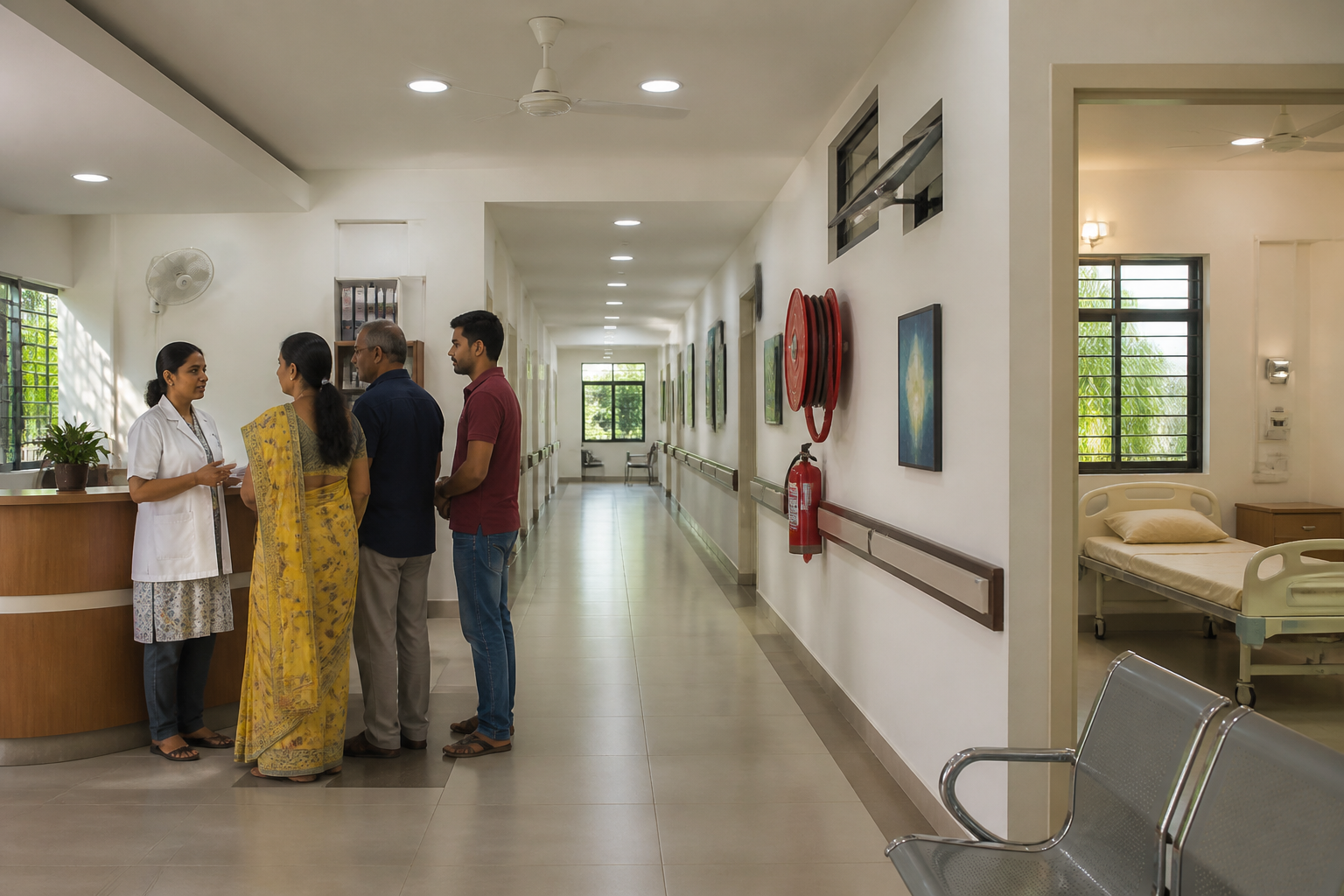
The rules also treat the built environment as part of patient safety. All covered facilities must provide adequate ventilation, lighting, bedding, drinking water, nutritious food, sanitation and fire-safety arrangements. Wards must provide at least six square metres per bed. Facilities must have one toilet for every eight patients and one bathroom for every 10 patients.
These requirements convert basic living conditions into measurable standards. Ventilation and lighting affect the habitability of wards; water, food and sanitation affect daily health; and fire-safety arrangements become particularly important in institutional settings where patients may be distressed, medically unstable or unable to evacuate independently. The space requirement also establishes a minimum physical condition rather than leaving accommodation standards entirely to individual operators.
The framework includes measures intended to make facilities more transparent to patients and families. Registration certificates and treatment tariffs must be displayed. A charter of patients’ rights must be available in Tamil and English. Facilities must also provide a gender-neutral ward or dormitory for inpatients who do not wish to be placed in either male or female wards.
These provisions connect regulation to the experience of entering a mental-health or rehabilitation facility. A displayed registration certificate can help families establish whether an institution is formally recognised. Publicly available tariffs make the financial terms of treatment more visible. A patients’ rights charter creates a defined reference point for people who may otherwise have limited information about their treatment, accommodation or avenues for complaint.
The requirement for a gender-neutral ward or dormitory also recognises that institutional accommodation cannot be organised only around a male-female binary for every patient. The regulation does not eliminate the operational challenges of providing such spaces, but it creates a formal obligation for facilities to account for patients who do not wish to be assigned to either category.
The rules place limits on physical restraint, another area where institutional power and patient safety intersect. Restraint may be used only when it is the sole means of preventing immediate harm. It requires psychiatric approval, documentation and intimation to the patient’s family member or nominated representative within 24 hours.
The conditions establish a record of justification rather than allowing restraint to operate as an unrecorded routine practice. The requirement of psychiatric approval links the decision to professional oversight, while documentation creates an institutional record. Informing a family member or nominated representative within 24 hours provides an additional communication obligation, although the supplied material does not specify how compliance will be monitored or what penalties will apply for violations.
Registration is another central element of the state’s regulatory architecture. All mental-health establishments, except those under the Union government, must obtain permanent registration from the State Mental Health Authority. The authority will also maintain a digital register of practising mental-health professionals and update it every month.
The registration requirement gives the state a mechanism to identify establishments operating within its jurisdiction. The digital professional register adds a second layer by focusing on the people providing care rather than only the buildings in which services are delivered. Monthly updates indicate an effort to keep the record current, although the supplied report does not establish how the information will be verified, made accessible or connected to inspections and enforcement.
That implementation question will determine how far the regulations change the operating reality of facilities. The rules prescribe standards for staffing, patient care, building safety, hygiene, records and rights protection. They also define the circumstances in which a patient must be referred elsewhere. But a regulatory framework becomes meaningful only when facilities are registered, assessed and held accountable for compliance.
The regulations nevertheless represent a shift from treating mental-health and de-addiction care as a broad service category towards recognising different levels of clinical and institutional capability. A standalone centre cannot be assumed to provide the same response as a multi-speciality hospital with a psychiatry department. The new admission safeguard makes that distinction operational at the point where the risk to a patient may be greatest.
For families, the immediate issue is whether a facility can safely manage the person’s condition at the time of admission. For the state, the issue is whether the care network has clearly separated roles and an effective referral pathway. For facility operators, the rules establish minimum obligations related to space, sanitation, safety, records, rights and professional oversight.
The central fact established by the notification is that Tamil Nadu now has a state-level regulatory framework covering five categories of mental-health and rehabilitation facilities, with specific restrictions on admissions to standalone de-addiction and psychosocial rehabilitation centres. The next phase will depend on registration, enforcement and the ability of hospitals and other establishments to receive patients referred for acute care. The State Mental Health Authority’s registration system and monthly professional register will be important indicators of how the framework is implemented.
