


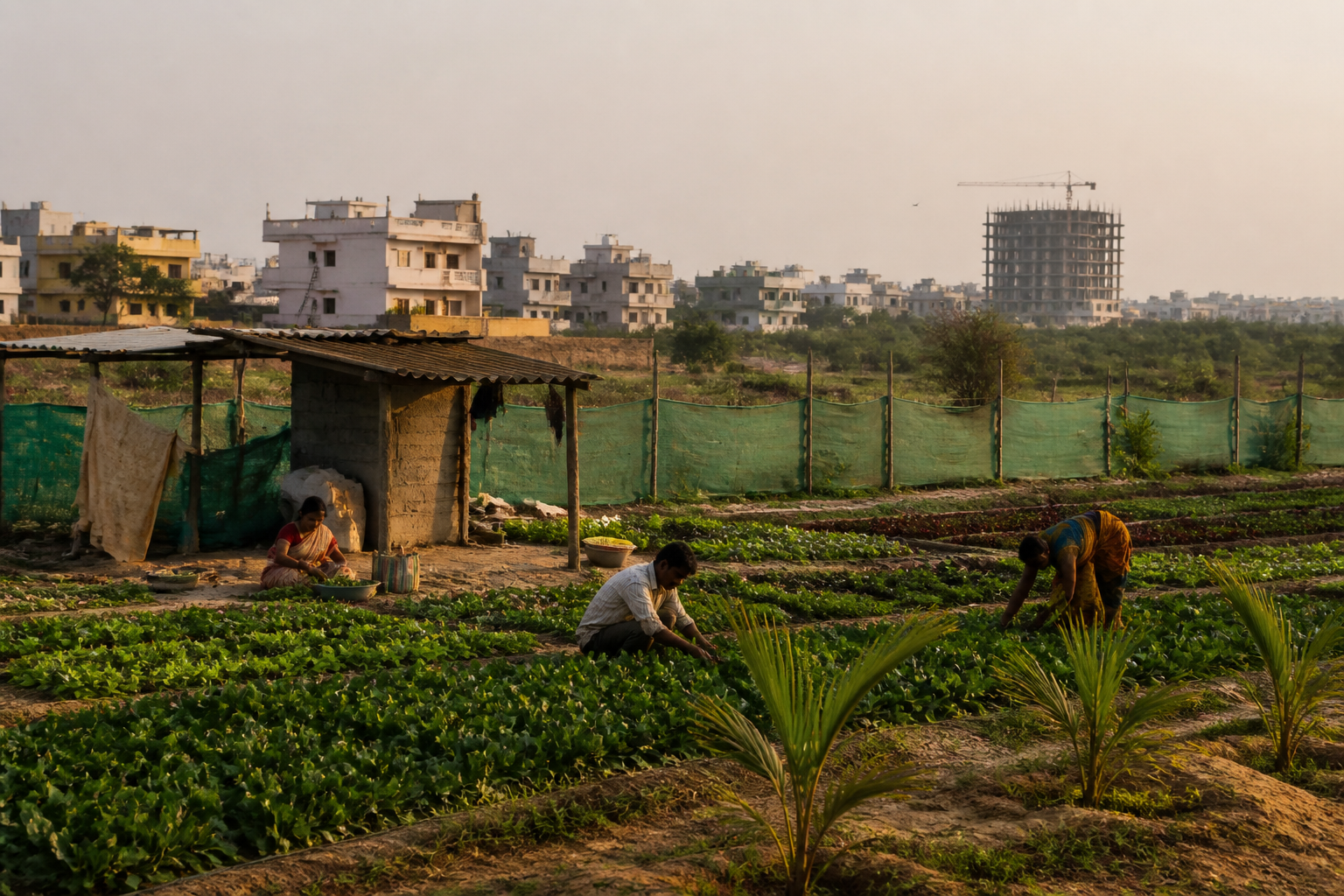
The Telangana Assembly discussion on crop diversification has exposed a problem that extends beyond farm-level choices: the state’s changing peri-urban landscape, weak post-harvest infrastructure and gaps in public support are influencing what farmers can afford to grow. The concerns raised by Congress MLAs on Wednesday linked declining vegetable cultivation to real estate activity, inadequate storage, the absence of a Minimum Support Price for some crops, monkey damage and a shortage of oil palm saplings.
The significance of the discussion lies in that connection. Crop diversification is often presented as an agricultural matter, but the issues raised in the Assembly show that it is also shaped by land markets, municipal expansion, infrastructure availability and the quality of state-backed risk protection. Farmers are not making decisions in isolation from the built environment around them. They are responding to changing land values, uncertain returns, limited storage and direct damage to crops.
Achampet MLA C Vamshi Krishna said very few farmers were taking up crop diversification across the state. He also flagged a decline in vegetable cultivation, attributing the trend mainly to the growth of real estate activity in peri-urban areas. His intervention placed agricultural change within the geography of urban expansion, where land that was previously used for cultivation faces competing pressures from development and rising property activity.
The report does not provide figures on the extent of farmland converted, the number of peri-urban villages affected or the rate at which vegetable cultivation has declined. That absence is important. The Assembly discussion identifies a relationship between real estate growth and reduced cultivation, but the supplied account does not establish the scale, location or pace of that change. A clearer policy response would require those dimensions to be measured rather than treated only as a general trend.
Still, the institutional question is clear. If peri-urban land is increasingly exposed to real estate pressure, the continuation of local vegetable cultivation depends not only on farmers’ willingness but also on whether cultivation remains financially viable. Vamshi Krishna said farmers were reluctant to grow vegetables and horticultural crops because they lacked a Minimum Support Price. He urged the government to provide subsidies for vegetable cultivation and to constitute a committee to create awareness and conduct training sessions on crop diversification.
This highlights two different policy needs. Awareness and training address knowledge and adoption. Subsidies and assured returns address financial risk. The Assembly discussion, as reported, suggests that the second problem may be more decisive for farmers considering vegetables and horticultural crops. Training can explain alternative crops, but it cannot by itself resolve the possibility of unsold produce, price volatility or damage before the crop reaches a market.
The reference to NABARD support also points to the importance of institutional coordination. Vamshi Krishna said NABARD was extending support for crop diversification, while asking the state government to provide additional subsidies. The supplied report does not specify the form, value or coverage of that support. It nevertheless indicates that crop diversification involves more than one agency and that farmers’ access to schemes may depend on how financial assistance, training and implementation are connected at the local level.
The storage problem raised by Bhupalpally MLA Gandra Satyanarayana adds another layer. He called for cold storage units in the state to help farmers safeguard their stocks. For vegetables and other horticultural produce, the ability to store output can influence whether farmers are forced to sell immediately or can wait for a viable market. The report does not establish how many cold storage units currently exist, where capacity is concentrated or what commodities they serve. It does show that legislators see storage as a practical constraint on farm income.
Cold storage is also an urban infrastructure issue. It connects production areas with wholesale markets, retail networks and consumers in towns and cities. Without adequate facilities, the distance between a farm and an urban market becomes more than a transport problem. It can become a time-sensitive loss of value. However, the supplied material does not provide data on post-harvest losses, transport distances or market prices, so those outcomes cannot be quantified here.
The discussion of monkey damage demonstrates how the boundary between settlement expansion and agricultural land can create new forms of conflict. Jayaveer Reddy said monkey menace was significantly affecting maize farmers and was also forcing farmers to avoid vegetable and horticultural crops. He further said residents of Nandikonda Municipality were facing severe hardships because of monkeys.
This is a shared governance problem rather than a narrowly agricultural one. The same issue affects farms and municipal residents, requiring coordination between local administration, agricultural authorities and agencies responsible for managing human-wildlife conflict. The report does not identify the responsible departments, the size of the affected area or the measures already attempted. It records, however, that the problem is being experienced both in cultivated areas and within a municipality.
Jayaveer Reddy proposed subsidies for vegetable and horticultural farmers to install solar fencing. The suggestion reflects the cost of protecting cultivation from recurring damage. It also raises an implementation question: whether individual farmers are expected to finance protection around separate plots or whether coordinated, community-level measures would be more practical. The supplied account does not answer that question, and no decision by the government on the proposal is reported.
The oil palm issue shows that diversification can create a new supply-side bottleneck. Jayaveer Reddy said sweet lime farmers in his constituency were shifting to oil palm cultivation but that oil palm saplings were in short supply. In this case, farmers appear to be responding to changing cultivation conditions or perceived opportunities, yet the transition is constrained by the availability of planting material.
That distinction matters for policy design. Encouraging diversification without ensuring access to saplings, technical support, market arrangements and protection from crop damage can produce incomplete adoption. The report does not establish why sweet lime farmers are shifting, how many farmers are involved or whether oil palm is more profitable in the affected areas. It does establish that the transition described in the Assembly has not been matched by adequate sapling supply.
Taken together, the issues raised by the MLAs reveal several layers of the same system. Land conversion and real estate activity affect the space available for cultivation. Price uncertainty affects the willingness to grow vegetables and horticultural crops. Storage limitations affect the ability to hold produce after harvest. Wildlife damage raises production costs and discourages cultivation. Shortages of saplings constrain farmers who are already attempting to change crops.
None of these problems can be solved through a single awareness campaign. The report does not describe a government decision or a unified programme responding to all of them. Instead, it records separate requests for a committee, training, subsidies, cold storage, solar fencing and more oil palm saplings. The institutional challenge is therefore one of alignment: support for crop diversification needs to connect land-use pressures, production decisions, protection infrastructure, storage and market access.
The peri-urban dimension deserves particular attention. As real estate activity expands around cities and towns, agricultural land can become part of a wider property market. The supplied report does not say that all such land is being converted or that development is the only reason for declining vegetable cultivation. But the concern raised in the Assembly suggests that agricultural planning and urban planning cannot be treated as separate conversations in areas where the two land uses meet.
The same applies to municipal infrastructure. Nandikonda Municipality appears in the report not only as a place where residents face monkey-related hardship but also as part of a wider discussion about protecting cultivation. This overlap means that local governments may encounter agricultural, environmental and settlement pressures within the same administrative area. The available material does not clarify whether municipal plans or district-level agricultural plans address this intersection.
The evidence supplied is therefore strong enough to identify the policy problem but not to measure its full scale. There are no state-wide figures in the report for crop diversification, vegetable acreage, cold storage capacity, monkey-related crop losses, solar fencing demand or oil palm sapling shortages. There is also no reported government response to the specific proposals made in the Assembly. Those gaps should be treated as unanswered administrative questions, not filled with assumptions.
What the discussion confirms is that Telangana’s crop diversification challenge is inseparable from the systems surrounding farms. Farmers need viable returns, but they also need land-use stability, storage, planting material and protection from recurring damage. The state’s response will be judged not only by whether it promotes alternative crops, but by whether the supporting infrastructure and administrative arrangements make those alternatives workable.
The next developments to watch are the government’s response to the proposed committee and training programme, any decision on subsidies for vegetable and horticultural farmers, plans for cold storage units, action on solar fencing and measures to address the shortage of oil palm saplings. Until those details are established, the Assembly debate remains an important diagnosis of the problem rather than evidence that a solution has been implemented.
