


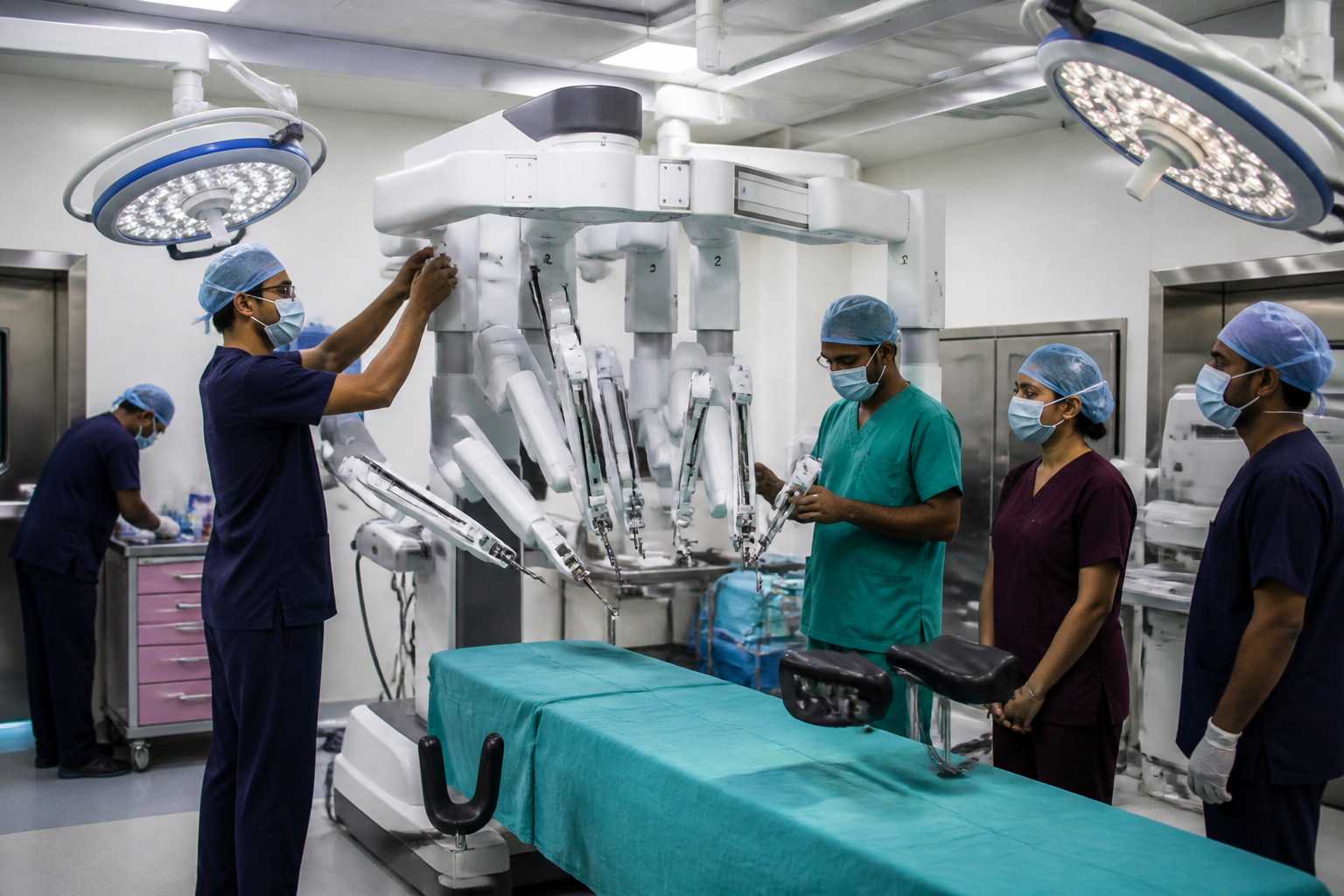
Telangana is planning to make three to six months of robotic surgery training mandatory for postgraduate medical students as part of a wider effort to expand advanced surgical services beyond Hyderabad and into district-level government hospitals.
The health department’s proposal aims to create a larger pool of uniformly trained surgeons who can operate robotic systems across the public healthcare network. The government is also preparing to establish robotic surgery centres in selected government hospitals in phases.
The proposed locations include government medical colleges and hospitals at Sanathnagar, LB Nagar and Alwal, along with the new Osmania General Hospital, Warangal Super Speciality Hospital, Gandhi Hospital and Niloufer Hospital. Nine regional referral centres have also been identified at RIMS Adilabad and the government general hospitals in Karimnagar, Nizamabad, Nalgonda, Sangareddy, Khammam, Warangal, Mahabubnagar and Vikarabad.
An indent has been placed with the Telangana Medical Services and Infrastructure Development Corporation for 15 robotic surgery systems, according to sources cited in the report. Three systems are proposed for the Telangana Institute of Medical Sciences, while Osmania General Hospital, Gandhi Hospital and Niloufer Hospital would receive one each. The remaining nine systems are intended for the identified regional hospitals.
A recent pan-state multispecialty robotic surgery training programme was held at the Marri Chenna Reddy Telangana Institute of Medical Sciences in Sanathnagar. TIMS director Dr A Narendra Kumar said surgeons from 35 medical colleges and 47 hospitals, excluding speciality hospitals, were already being trained in robotic surgery at Nizam’s Institute of Medical Sciences and MNJ Cancer Institute.
“The training would be central to expanding robotic surgery, either through a hub-and-spoke model or dedicated robotic units at the district level. The idea is to ensure that robotic surgery does not remain concentrated in a handful of premier institutions in Hyderabad,” Kumar said.
The proposed expansion could allow patients from smaller cities and rural areas to access specialised procedures closer to home, reducing dependence on major tertiary hospitals in Hyderabad. NIMS has recently completed nearly 1,000 robotic surgeries, with eligible patients receiving financial coverage under the Rajiv Aarogyasri scheme.
Officials and experts have stressed that installing robotic systems alone will not be sufficient. The expansion will require appropriate infrastructure, trained faculty, structured clinical protocols, multidisciplinary teams and institutional support. Dr N Vani, director of medical education, said young surgeons should combine exposure to newer technologies with clinical judgement, human touch and compassion.
Robotic surgery expert Dr Sudhir Srivastava said decentralising the service could help patients from rural and smaller communities access specialised treatment without travelling to major cities. The health department plans to approach the National Medical Commission for permission to introduce the dedicated training period within the existing three-year postgraduate programme.
