


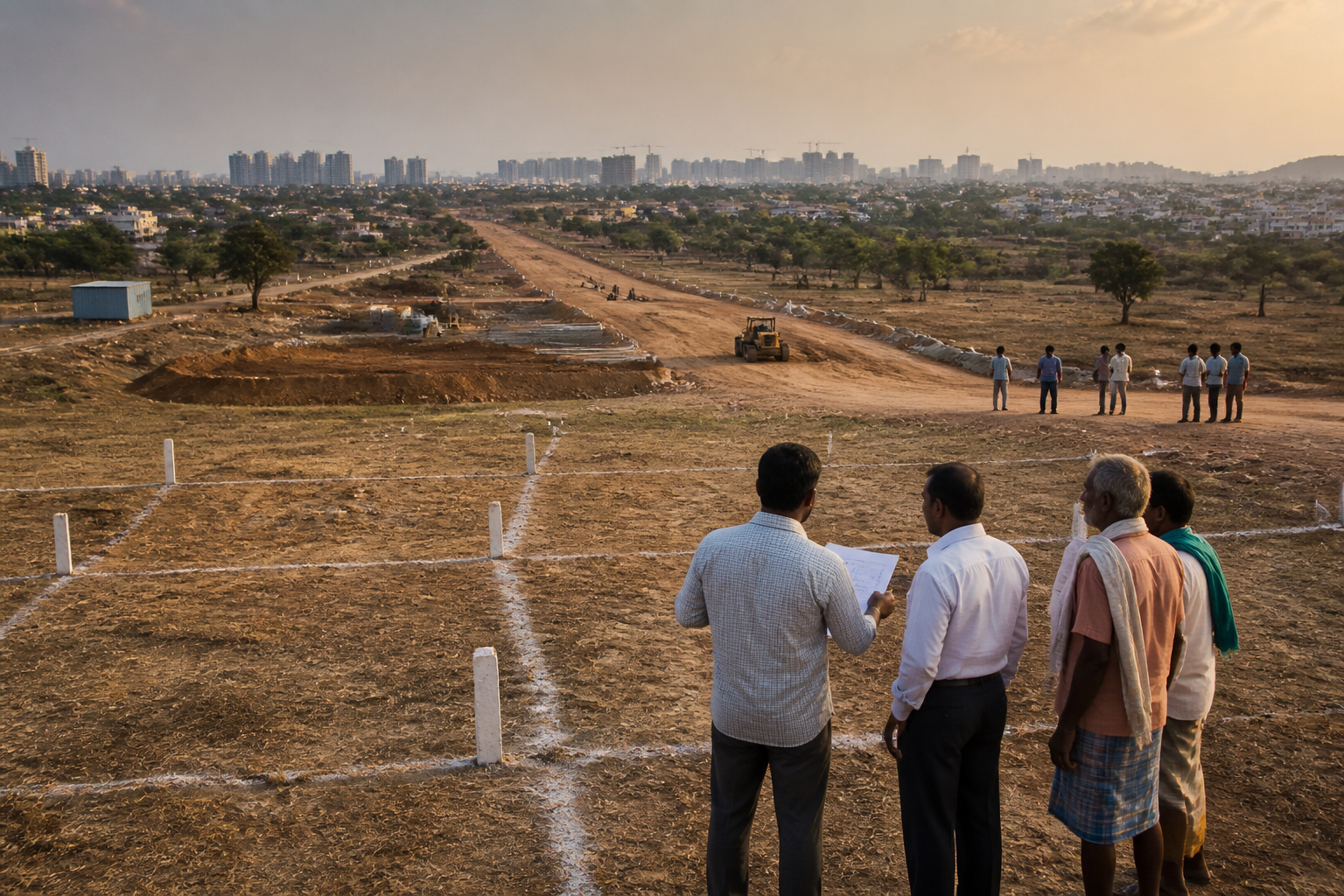
Telangana’s proposed land pooling policy is designed to solve one of the most difficult problems in infrastructure delivery: how the state can assemble large parcels of land without bearing the full cost of immediate cash compensation. By offering landowners developed plots instead of relying only on monetary acquisition, the policy seeks to connect public infrastructure creation with the future value of urban development. Its success, however, will depend on how consent, valuation, plot allotment, environmental restrictions and dispute resolution work in practice.
The proposed framework comes as Telangana faces rising land acquisition costs for projects around Hyderabad and elsewhere in the state. The government is preparing a Telangana Comprehensive Area Development and Planning Bill, 2026, which officials say could make land pooling available for infrastructure and other projects across departments, including irrigation, roads and buildings. The proposal would extend a model already being used for selected projects involving the Musi riverfront, the Hyderabad Metropolitan Development Authority, the Hyderabad Growth Corridor Limited and the Musi Riverfront Development Corporation Limited.
This is more than a change in compensation technique. Conventional acquisition generally requires the state to pay landowners before a project can proceed, while land pooling attempts to retain part of the land’s future development value with those who surrender it. The government receives land for roads, public facilities and planned development, while eligible landowners receive serviced or developed plots. The state’s immediate financial burden may therefore be reduced, but the arrangement also shifts the central question from how much cash is paid today to how fairly future development value is distributed.
The policy is particularly significant for the Hyderabad metropolitan region because the state requires land for projects such as the Regional Ring Road, a greenfield expressway, a proposed bullet train terminal and other infrastructure within the HMDA limits and the core urban region economy area. The report identifies Rangareddy district as a key area of demand. These projects require not only construction finance but also a land-assembly mechanism capable of handling fragmented ownership, different forms of tenure and competing claims over development potential.
The framework proposes two distinct routes. Consent-based land pooling would allow landowners to voluntarily come together and ask the government to undertake development through pooling. Guided land pooling would be initiated by the government in strategically important areas, including ring roads, urban expansion zones, industrial corridors and proposed townships. The difference is consequential. A voluntary scheme is more likely to depend on agreement among owners, while a government-initiated scheme may proceed without unanimous consent in every case.
The proposed guided model therefore raises the strongest institutional and procedural questions. Officials say it would use provisions available for infrastructure projects under the Land Acquisition, Rehabilitation and Resettlement Act, 2013, while retaining compensation, rehabilitation and resettlement benefits wherever applicable. The draft also provides for public notifications, declarations of intent, periods for objections and suggestions, and time-bound approvals. These steps are intended to prevent land pooling from becoming an informal shortcut around acquisition law.
The distinction between landowners is another central feature. The proposed benefits would cover patta landowners, assigned landholders, occupants of ceiling surplus and Bhoodan lands, and certain categories of government land occupants. But the quantum of developed land would vary according to ownership status and location. Patta landowners would receive a higher share, while occupants of government land would receive smaller extents. Assigned-land conditions, including tenure and non-alienation restrictions, would continue even after substitution with a final plot, according to the institutional details supplied in the report.
The operational examples in Hyderabad show how sharply the returns can differ. Under GO 240 for the Musi riverfront development project and GO 243 covering HMDA and HGCL projects, patta landowners would receive either a 50:50 share of developed land between the government and the landowner or 1,400 square yards per acre, whichever is lower. Land in lake or river buffer zones would qualify for 800 square yards per acre or transferable development rights, while land in full tank level areas would qualify for 400 square yards per acre or TDR. Encroachers on government land in such areas would receive 300 square yards per acre.
These provisions show that the proposed return is not a uniform promise of equivalent land. It is conditioned by legal status, environmental restrictions and the development potential of the location. The difference between ordinary patta land, buffer-zone land, full tank level land and government-land occupation will determine how affected households experience the policy. It also means that public communication and plot valuation will be as important as the headline principle of returning developed land.
The environmental provisions are particularly relevant to Hyderabad’s urban expansion. Lands in full tank level zones and lake or river buffers would attract lower returns because of restrictions on development. That approach recognises that not every parcel can be urbanised in the same way. At the same time, lower returns in environmentally constrained areas could become a source of dispute if affected occupants believe the restrictions have reduced the value assigned to their land without providing adequate rehabilitation or alternative rights.
The proposed institutional structure attempts to place these decisions inside a formal administrative system. The state government would designate appropriate authorities with defined jurisdictions and powers. A Land Reconstitution Officer would act as a quasi-judicial officer for guided schemes, with authority to finalise plot allotments, valuations and compensation. A Board of Appeal would hear disputes involving compensation, contributions, ownership and land-related matters, while the draft proposes barring the jurisdiction of civil courts.
That design could make implementation faster by concentrating technical and quasi-judicial decisions within the scheme. It also makes the quality, independence and accessibility of the appeal system especially important. The supplied framework provides for grievance redressal mechanisms, digital and participatory platforms, associations of owners and beneficiaries, and a Technical Advisory Committee to review draft schemes. These mechanisms are intended to give affected households a role in implementation rather than treating landowners only as parties receiving compensation.
The draft also proposes earmarking land for economically weaker section housing, public purposes and green or social infrastructure. This is significant because land pooling can otherwise become primarily a land-conversion mechanism. If pooled land is used only for roads, commercial development or higher-value plots, the public benefit may be difficult to distinguish from ordinary land monetisation. The inclusion of EWS housing and social infrastructure indicates an attempt to link land assembly with a broader urban development plan, although the supplied report does not specify the scale, location or delivery standards for these uses.
The framework’s proposed finance provisions point to a wider shift in how the state could fund urban growth. A dedicated land pooling fund and accounts, development charges, land-value capture, waivers and public-private partnerships are listed as possible components. Together, these tools suggest that the government is considering land not only as a project input but also as a source of value to finance infrastructure. The policy’s institutional challenge will be to make that value visible, calculate it consistently and ensure that the benefits are not captured only by the authority or future developers.
This is where the policy connects directly to the geography of Hyderabad’s expansion. Ring roads, expressways, industrial corridors and new townships can increase the value of surrounding land, but that increase is uneven. A landowner whose parcel becomes accessible to a major road may gain significantly from development, while another household may lose agricultural use, face relocation or receive a final plot in a less valuable location. The policy’s promise of a developed plot therefore depends on details such as servicing, access, infrastructure provision, plot location and the time taken to deliver the final asset.
The proposed law also contains dedicated provisions for slum redevelopment, industrial clusters and agricultural land pooling. That breadth indicates that the government is considering land pooling as a general development instrument rather than a project-specific response to the Musi riverfront or HMDA works. Each application, however, involves a different relationship between land, livelihood and settlement. Agricultural land pooling, industrial redevelopment and slum redevelopment cannot be assessed using identical assumptions about ownership, income or relocation.
The policy’s immediate test will be the projects where land pooling is already being operationalised. Officials describe the response from land losers as positive because affected people could benefit financially from developed projects. That claim remains a policy position presented by officials, not an independently established outcome in the supplied material. The effectiveness of the model will depend on whether participating families receive legally secure, serviced and usable plots, whether the promised timelines are met, and whether disputes over eligibility and valuation are resolved transparently.
The draft also leaves important questions to be settled through implementation. The supplied report does not establish the final status of the Comprehensive Area Development and Planning Bill, 2026, the detailed rules for valuation, the schedule for returning developed plots or the performance of the schemes under GO 240 and GO 243. It also does not provide the number of affected landowners, the total acreage already pooled or the financial comparison between land pooling and conventional acquisition.
Those missing details matter because land pooling is ultimately a test of trust. The government’s case is that it can acquire land for infrastructure with less upfront expenditure while allowing landowners to retain a stake in future development. Landowners will judge the model through the value and usability of the final plot, the security of their tenure, the treatment of different ownership categories and the credibility of the appeal process. For Hyderabad, the stakes extend beyond individual projects: the mechanism could influence how the metropolitan region grows, who benefits from that growth and how environmental limits are treated.
Telangana is therefore attempting to institutionalise land pooling at the point when Hyderabad’s next phase of expansion is demanding large-scale land assembly. The proposal confirms a shift from acquisition based primarily on immediate payment towards development-linked compensation and land-value capture. What remains uncertain is whether the legal safeguards, administrative structure and promised returns will be strong enough to produce consent, resolve disputes and deliver public infrastructure without deepening inequality among landholders. The progress of the proposed bill, the implementation of the Musi and HMDA schemes, and the first actual allotments will determine whether the model becomes a workable alternative or another contested layer in the state’s land and infrastructure system.
