


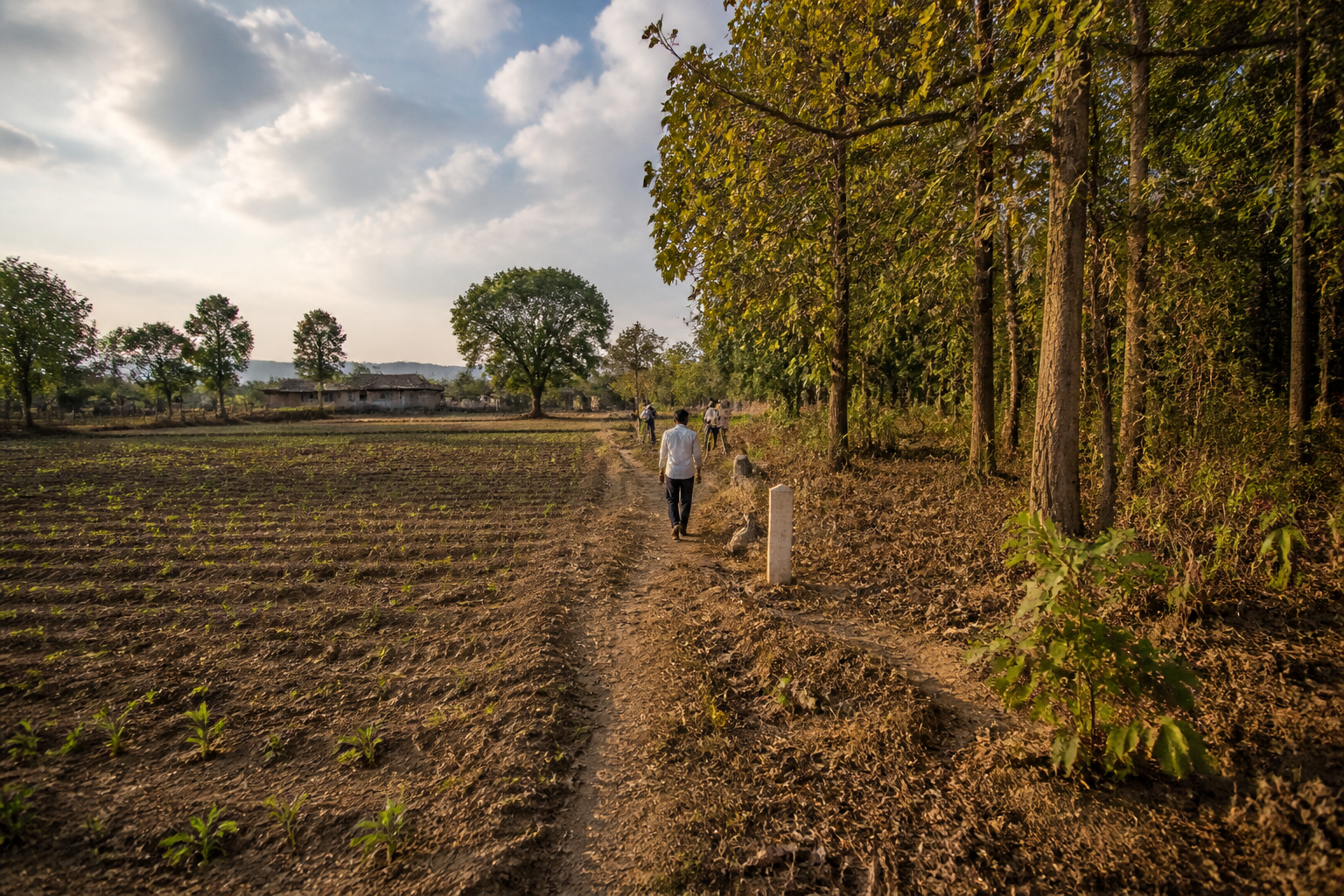
The Telangana High Court’s warning that revenue authorities cannot issue pattas or interfere in forest land has brought a recurring administrative fault line into sharp focus: the conflict between land records, forest protection and the livelihood claims of people cultivating disputed parcels. The court’s observations in a case involving 44 acres in Kumuram Bheem Asifabad district do not settle the farmers’ claims, but they establish that jurisdiction itself cannot be treated as an administrative formality.
The dispute concerns nine farmers from Rajaram village in Sirpur (Tandur) mandal, who approached the court after the forest department moved to dispossess them from land they said they had cultivated for decades. The petitioners claimed to possess pattadar passbooks and patta certificates and argued that their families depended on the land for their livelihood. The forest department’s action, as described in the proceedings, brought those claims into direct conflict with the legal status of the land.
During the hearing, Justice Anil Kumar Jukanti stated that revenue authorities have no role in forest lands and cannot issue titles or intervene in such areas. The judge also said that political or executive pressure could not override the legal protection applicable to forests, observing that even directions from the highest executive authority could not justify giving away forest land. The comments were made while the court was examining the circumstances surrounding the petitioners’ claims and the forest department’s action.
The significance of the case lies in the institutional division at its centre. Revenue departments generally maintain land records and administer titles, while forest departments exercise authority over forest areas. When a parcel is treated as forest land for legal and administrative purposes but appears in documents relied upon by occupants or cultivators, the resulting dispute is not simply a disagreement between the state and individual farmers. It becomes a question of which agency was legally competent to create, recognise or alter rights over the land.
The court specifically questioned instances in which revenue authorities allegedly granted pattas in reserved forest areas. It stressed that district administrations and collectors do not possess authority over forest land and directed that Supreme Court guidelines governing forest areas must be followed. That position places the legal classification of the land ahead of the existence of a revenue document, at least in the jurisdictional question considered during the hearing.
This distinction is important for understanding why land records alone may not resolve a forest-land dispute. A pattadar passbook or patta certificate may be relied upon by a cultivator as evidence of possession or an administrative grant. But the court’s observations indicate that such documents cannot, by themselves, confer authority over land that is legally protected as forest land. The validity and effect of the documents in the Asifabad dispute remain part of the matter to be examined through the court process.
The case also exposes the practical consequences of fragmented land administration. A farmer may interact with the revenue administration for land records, taxation or title-related documentation, while forest officials enforce restrictions attached to the land’s legal status. If the two departments do not share a consistent record or do not act through a coordinated process, citizens can receive conflicting signals from the state itself. The result may be long-term cultivation followed by eviction proceedings, or official documents that later become central to a challenge against forest protection measures.
The High Court expressed dissatisfaction with the lack of coordination between revenue and forest authorities. It underlined the need for structured engagement between collectors and district forest officers to prevent jurisdictional conflicts and protect forest land. This is an administrative instruction with broader relevance because the dispute is not confined to the conduct of one official or the claims of one group of cultivators. It points to the need for departments dealing with land to establish a common understanding of boundaries, classifications and decision-making powers.
The institutional problem is particularly difficult in areas where villages, farms and forest boundaries exist close to one another. The source material does not establish how the disputed 44 acres were originally classified, when the pattas were issued, or whether the documents were granted before or after the land received protected status. Those facts will be important to determining the individual claims. What the court has made clear at this stage is that political influence, administrative directions or revenue records cannot be used to bypass the legal regime governing forest land.
The farmers’ livelihood claims add a second layer to the dispute. The petitioners said their families had cultivated the land for decades, making the case about more than the technical validity of documents. Dispossession can affect household income, agricultural activity and access to a place on which families have depended over time. At the same time, the court’s intervention shows that livelihood claims must be examined within the legal framework governing protected forests, rather than through an automatic conversion of long-term occupation into title.
That balance is central to the public importance of the proceedings. Forest protection can be weakened if unauthorised titles are created inside reserved forest areas. But administrative confusion can also place cultivators in a vulnerable position when they rely on documents issued by the state. A system in which one department grants or recognises a claim and another later contests the occupation creates uncertainty for both conservation and citizens. The court’s insistence on jurisdiction addresses the first institutional failure: ensuring that an authority does not make decisions beyond its legal power.
The case also shows why district-level land governance cannot be separated from environmental administration. Forest land is not simply another category in a revenue register. Its legal status carries restrictions that affect occupation, title, development and government action. When those restrictions are not reflected consistently across departmental records and field-level decisions, land disputes become harder to resolve and more costly for all parties.
The court’s direction to the district collector is therefore significant. The collector was summoned to appear through video conference, and after considering the collector’s submissions, the judge ordered a comprehensive report. The report is expected to place the circumstances of the dispute before the court, including the administrative basis for the competing claims. The proceedings will provide an opportunity to clarify how the land was classified, how the petitioners obtained the documents they rely on and why the forest department initiated the dispossession action.
The next stage will also test whether the district administration can present a coordinated account. The High Court’s concern over the relationship between revenue and forest officials suggests that the court is looking beyond the immediate petition. It wants the responsible departments to explain their respective actions and demonstrate compliance with the legal framework for forest areas. The emphasis on coordination makes the matter relevant to land administration across forested districts, even though the present dispute is located in Rajaram village.
The source does not establish that the farmers’ pattas are valid, that the forest department’s action is unlawful, or that any official deliberately acted in breach of the law. Those questions remain unresolved. Nor does the court’s warning amount to a final adjudication of the individual petitioners’ rights over the 44 acres. The verified development is that the court has asserted the limits of revenue jurisdiction, expressed concern over pattas in reserved forest areas and sought a detailed report from the district collector.
The larger urban and regional planning question is how governments manage land at the edge of settlements and protected areas. Even when a dispute arises in a rural district, the underlying systems—land records, environmental regulation, departmental coordination and livelihood protection—shape the way India’s wider built environment expands. Clear authority and reliable records are essential to prevent both unauthorised conversion of protected land and avoidable uncertainty for people who depend on land documents issued by public agencies.
The Telangana High Court has listed the matter for further hearing on October 16. The collector’s comprehensive report and the responses of the revenue and forest departments will determine how the court assesses the competing claims. Until then, the proceedings establish a clear institutional principle: revenue officials cannot override the legal protection attached to forest land, and disputes involving such land must be handled through the authority assigned to the forest regime and the directions of the courts.
