


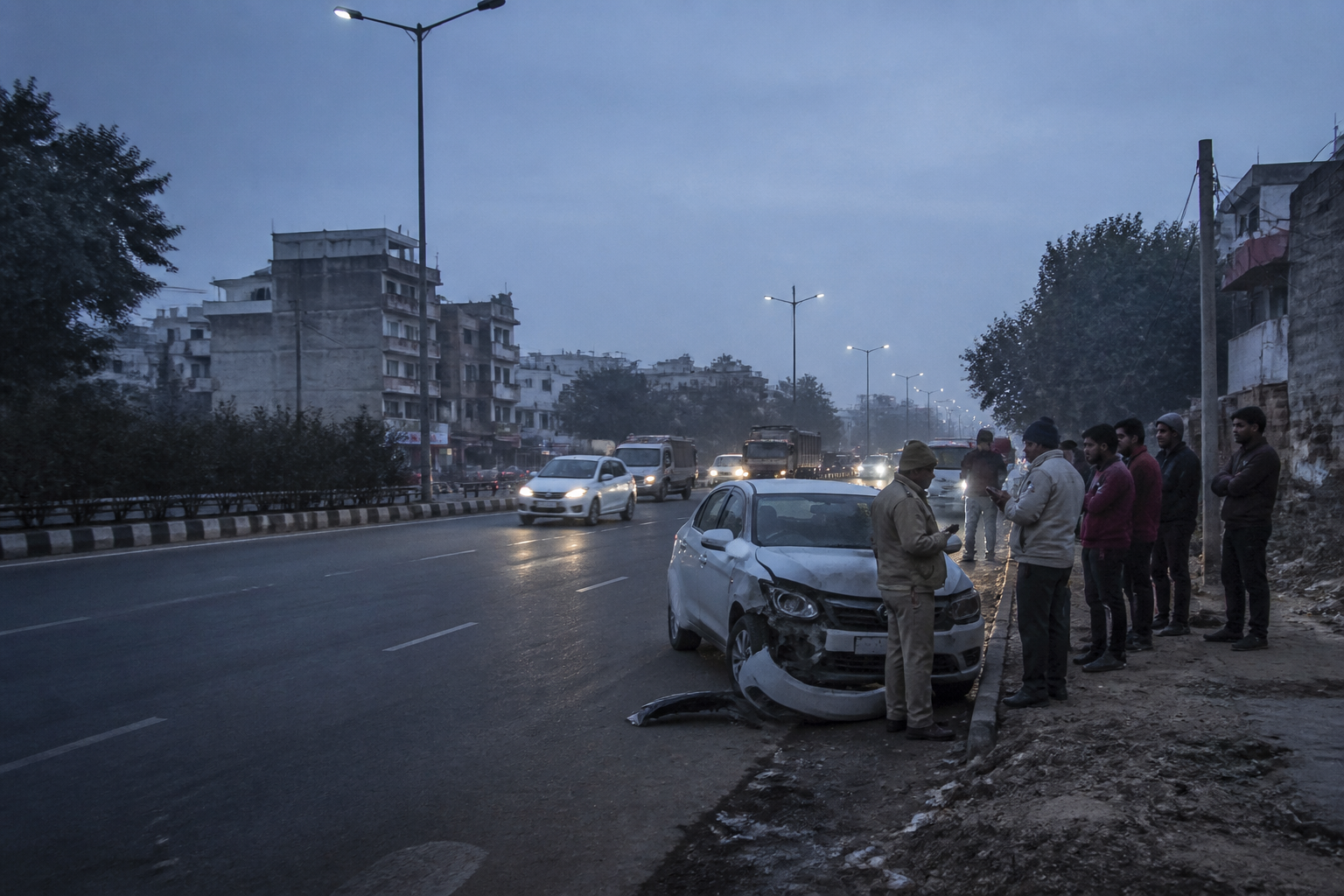
The Nangloi hit-and-run that killed 35-year-old Mahesh Kumar on Main Rohtak Road has ended in an arrest, but the police account also reveals how quickly a roadside collision can become a test of Delhi’s urban safety systems. The case moved through several connected stages: a pre-dawn impact, an emergency call, hospital confirmation of death, CCTV-based investigation and the seizure of the suspected vehicle.
Police said the incident occurred at about 4.54am on September 15, when a speeding white car allegedly hit Kumar as he was walking along the side of Main Rohtak Road in outer Delhi. A PCR call was received at around 5.11am. By the time a police team reached the location, the car was damaged and lying on the roadside, while Kumar was found unconscious nearby. He was taken to Sanjay Gandhi Memorial Hospital in Mangolpuri, where doctors declared him brought dead at 6.14am.
The sequence matters because it shows that pedestrian safety is not determined only by driver behaviour. It also depends on the physical conditions of the road, the visibility of people walking before sunrise, the availability of immediate assistance, the speed of emergency communication and the ability of investigators to establish what happened after the vehicle and driver have left the scene.
The supplied police account does not establish whether the stretch had a footpath, street lighting, pedestrian barriers, marked crossings or other safety infrastructure at the point of impact. It does establish that Kumar was walking along the side of the road, rather than in a protected pedestrian space. That detail places the incident within a familiar urban problem: people often move along road edges because the formal pedestrian network is absent, discontinuous or not suited to the route they need to take. The available evidence in this case is not sufficient to determine which of those conditions applied in Nangloi, but it makes the road edge central to understanding the collision.
The timing is another important element. The CCTV footage cited by police records the impact at 4.54am, several hours before normal daytime activity begins. At that hour, a pedestrian may be less visible to approaching traffic, while traffic speed may be higher because fewer vehicles are on the road. The police described the car as speeding, and the footage reportedly showed it hitting Kumar as he walked along the roadside. These facts identify the immediate circumstances of the crash, but they do not by themselves establish the road’s design, lighting or traffic-management conditions.
The response after the collision followed the institutional chain available in the report. A caller alerted the police through the PCR system, but investigators later found that the phone was unreachable. The caller therefore could not be contacted for further information. Police reached the location, identified the damaged car and arranged for the injured man to be taken to hospital. The FIR was subsequently registered, and investigators used CCTV footage to reconstruct the incident.
That chain highlights both the value and the limits of urban surveillance. CCTV helped police identify the collision and supported the investigation after the caller became unavailable. It provided a timestamp and showed passers-by rushing towards the victim. But a camera recording is not the same as a complete account of the conditions that produced a crash. It can show the movement of a vehicle and the moment of impact; it may not show whether a pedestrian had a safe alternative route, whether the road was adequately lit or whether the driver had faced a visible speed-control measure.
The arrest of Rinku Goyal, a 22-year-old student and Nangloi resident, followed the investigation. Police said the vehicle involved was seized and that Goyal was on his way to Noida to pick up his sister when the incident occurred. The report identifies the arrest as the immediate investigative outcome. It does not provide details of the sections invoked in the FIR, the condition of the vehicle beyond the reported damage, the driver’s version, the road’s posted speed limit or the status of any prosecution proceedings. Those details are material to assessing accountability, but they are not established in the supplied account.
The case also demonstrates why the language of a “hit-and-run” captures only part of the urban governance problem. The term directs attention to the driver’s conduct and the subsequent police investigation. The death, however, occurred within a larger transport environment in which pedestrians, vehicles, road geometry, lighting, enforcement and emergency services interact. If a person is walking beside a major road before dawn, the safety of that movement depends on more than whether a driver remains at the scene.
Delhi’s road-safety response is distributed across several functions rather than controlled by one institution at one moment. Police receive the emergency call, secure the scene, register the case and investigate. Hospitals establish the medical outcome. CCTV systems provide evidence where coverage and image quality allow. Road-owning and traffic-management authorities are responsible for the conditions in which vehicles and pedestrians share space, although the supplied report does not identify the agency responsible for this stretch of Main Rohtak Road or indicate whether a safety inspection has been ordered.
That division of responsibility can make individual cases easier to close than systemic risks are to correct. The arrest and vehicle seizure address the alleged conduct connected to this particular death. They do not, on the evidence supplied, answer whether other pedestrians face the same exposure on the same road, whether the stretch has recorded previous crashes or whether engineering changes are planned. The report also does not say whether the location was examined for lighting, signage, crossing facilities, road-edge obstructions or speed management after the collision.
The known timeline nevertheless provides a measurable picture of the emergency response. The collision was recorded at 4.54am, the PCR call came at approximately 5.11am, and the hospital declared Kumar dead at 6.14am. The first interval was around 17 minutes, while the time between the call and the hospital’s declaration was approximately 63 minutes. These intervals cannot, on their own, be used to judge the adequacy of the response because the report does not state when the police team arrived, when the ambulance or transport departed, the distance to the hospital or the nature of Kumar’s injuries.
The numbers do show how quickly the incident moved from collision to death confirmation and investigation. They also underline the importance of preserving evidence at the scene. In this case, the damaged car, CCTV footage and the FIR created an investigative trail despite the loss of contact with the original caller. Passers-by were visible in the footage, but the report does not say whether any witnesses were identified or whether their statements were recorded.
For residents, the immediate concern is not limited to the arrest. A pedestrian using a road edge in the early hours is exposed to a combination of risks that may not appear in a conventional account of traffic flow. The route may be the only practical connection to a workplace, transit point, home or neighbourhood service. Without verified information about the site, it would be wrong to claim that infrastructure caused this particular death. It is equally incomplete to treat the incident only as a matter of individual criminal liability when the available account places a pedestrian and a speeding vehicle in the same unprotected road space.
The evidence currently confirms a fatal collision, the police response, the use of CCTV, the arrest of the alleged driver and the seizure of the car. It does not establish the condition of Main Rohtak Road at the impact point, the legal findings that will follow the arrest, or whether authorities will examine the location for wider pedestrian risks. Those are the developments that will determine whether the case remains an isolated criminal investigation or prompts scrutiny of the road environment in Nangloi. The next formal milestones are the continuing investigation and the legal proceedings arising from the FIR.
