


The Telangana drought controversy is no longer only about whether a business summit should be postponed. It has exposed a difficult urban governance question: how should a state allocate water, electricity, public money, officials and administrative attention when a large part of its territory is facing a declared drought and Hyderabad is also reporting severe shortages?
Hyderabad-based civil society groups, resident welfare associations and activists have asked the Telangana government to postpone the Invest Telangana Global Summit, scheduled from December 7 to 9 at Bharat Future City near Hyderabad. In an open letter to Chief Minister A Revanth Reddy, the United Federation of RWAs said the event should not proceed while drought conditions persist across 365 mandals in 31 districts.
The groups’ demand is based on the reported declaration under Government Order Ms No. 3, dated October 24, 2026. According to the report, the order declared drought across Telangana because of El Niño conditions. The federation said the situation could worsen in the coming months and asked that the summit be deferred until conditions normalise and the drought order is withdrawn.
The central issue raised by the signatories is not simply the cost of hosting a three-day event. They argue that a summit of this scale requires scarce public resources at a time when the state’s administrative machinery is already expected to respond to water shortages, protect vulnerable households and support livelihoods. Their letter specifically refers to water, electricity, public funds, government officials and administrative attention that could otherwise be directed towards drought relief.
This framing places the summit within the wider infrastructure of crisis management. Large public events depend on temporary and permanent arrangements: water supply, sanitation, electricity, transport management, security, public works and coordination between departments. The report does not provide a cost estimate for the Invest Telangana Global Summit or quantify the additional water and power demand expected at Bharat Future City. However, the groups’ objection is that even unquantified operational requirements could compete with relief priorities when the state is already reporting widespread stress.
The geographical scale cited in the report is significant. Drought has been reported across 365 mandals in 31 districts, making the issue broader than a localised failure of supply. Mandals are administrative units through which state programmes and relief measures are implemented. A drought declaration across such a large number of mandals therefore creates a state-wide administrative obligation, even though the severity of shortages may differ between districts and communities.
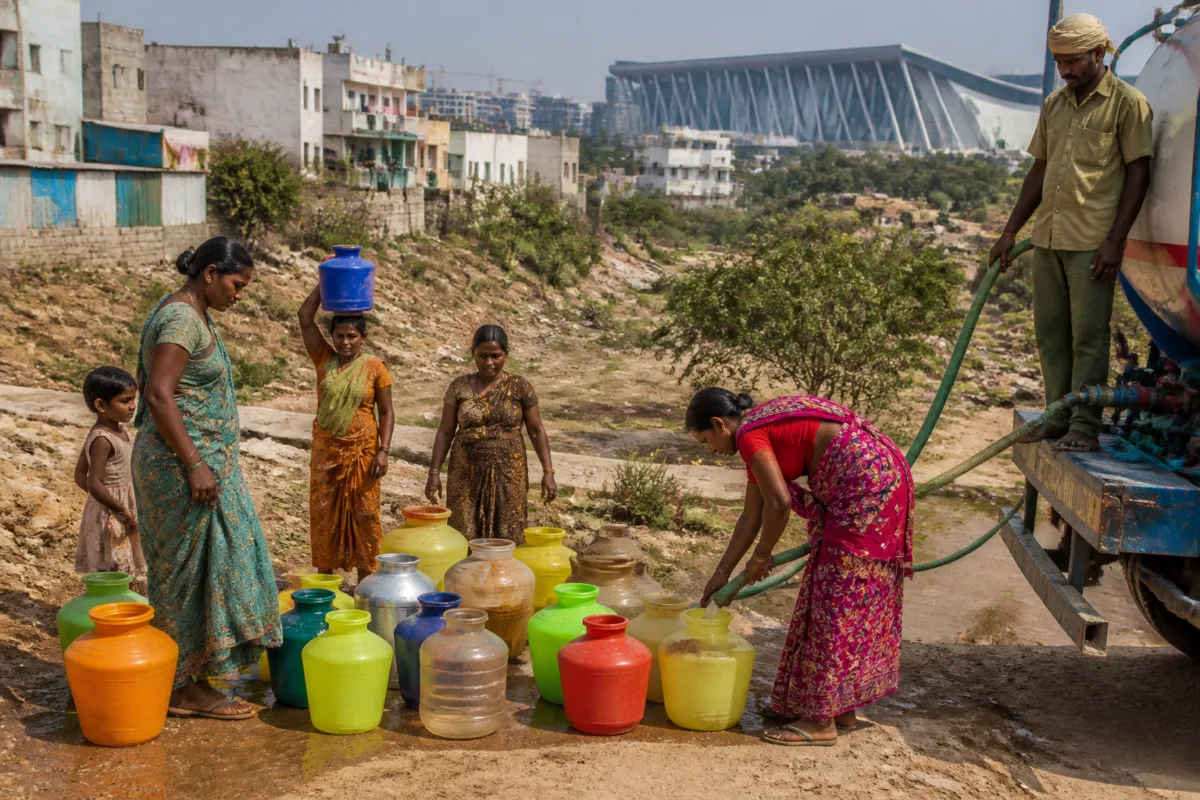
The report also connects the rural drought declaration to conditions inside Hyderabad. The signatories said some parts of the city were receiving only a few litres of water every three to four days. They further claimed that water shortages had led schools and colleges to declare holidays, while several government hostels had sent children home. These details illustrate how a water crisis can quickly become an urban services crisis: it affects education, institutional accommodation, household routines, workforce availability and the continuity of essential services.
The claims about Hyderabad’s supply conditions are presented by the civil society groups and are not accompanied in the supplied report by an independent city-wide assessment or departmental water-supply data. That distinction matters because water stress is rarely distributed evenly across a city. Some neighbourhoods may face intermittent municipal supply, while others may rely on private tankers, borewells or stored water. The report does not establish the extent of the affected areas, the number of households involved or the duration of the reported interruptions. It does, however, show how residents’ organisations are linking everyday supply failures to the state’s decision to host major public events.
The groups also criticised the Bharat Summit, scheduled in Hyderabad from November 12 to 14, arguing that Telangana could not afford another large event during the crisis. The report does not specify whether the two events have the same organisers, venues, budgets or operational arrangements. Their inclusion in the open letter nevertheless indicates that the concern is about a pattern of event-led public expenditure and administrative mobilisation rather than only the Invest Telangana summit.
That distinction is important for understanding the policy question. Telangana has positioned investment summits and similar events as tools for attracting business and promoting the state. The Invest Telangana Global Summit is scheduled to be held at Bharat Future City, a major planned development area near Hyderabad. The supplied report does not state the expected number of delegates, the investment commitments being pursued or the projected economic returns. It also does not state whether postponement would result in contractual costs, lost participation or a change in the proposed programme.
Without those figures, the competing public claims cannot be assessed through a simple comparison of event expenditure and drought relief spending. The groups have argued that financial, administrative and human resources should be redirected to protecting lives and livelihoods. The government’s position on the postponement demand, however, is not included in the report. As a result, the available evidence establishes the demand and the conditions cited by its authors, but not the government’s assessment of the summit’s resource requirements or its justification for proceeding.
The dispute also highlights the institutional complexity of drought response. Water supply, education, hostels, electricity, public health, agriculture and livelihood support are managed through different departments and levels of government. A major event can require coordination across many of the same administrative systems. The question is therefore not merely whether one department has enough money to host a summit. It is whether the state’s overall administrative capacity can handle event preparation while maintaining emergency response across hundreds of mandals and urban neighbourhoods.
The open letter’s reference to officials and administrative attention is particularly relevant. During a crisis, the availability of personnel can be as important as the availability of funds. District administrations and urban agencies must assess needs, identify vulnerable groups, arrange water distribution, maintain essential facilities and communicate with residents. If the same officials are assigned to event coordination, the practical concern raised by the groups is that relief work may receive less attention. The report does not establish that such diversion has occurred, but it identifies the risk as a central reason for postponement.
The case also exposes a recurring tension in urban development: the state’s effort to project growth may collide with the immediate demands of resilience. Bharat Future City is presented in the report as the venue for the proposed summit, but no further details are supplied about its water systems, power arrangements or operational readiness. That absence prevents a conclusion about whether the venue itself would place pressure on existing city networks or rely on separate facilities. It does make the site relevant to the debate because a new urban development area must function within the constraints of the region’s water and energy systems.
The drought declaration attributed to El Niño adds a climate dimension to the controversy. The report does not provide rainfall data, reservoir levels, groundwater measurements or forecasts, so the physical severity and likely duration of the drought cannot be independently assessed from the supplied material. The civil society groups’ warning that conditions could worsen is their stated concern, not an independently established projection in the report. Even so, the reference to climate-linked drought shows why event planning and urban resilience cannot be treated as separate policy tracks.
For Hyderabad, the immediate urban question is service reliability. A city can continue to host investment and business activity only when water, electricity, transport, sanitation and institutional services are dependable. The report says the IT sector was considering work-from-home arrangements because of the shortages, but it does not identify the companies involved or indicate whether any formal decisions had been taken. That claim remains attributed to the signatories. It nevertheless points to the economic consequences of a crisis that begins as a water-supply problem and extends into offices, schools, hostels and commercial activity.
The state now faces a decision with two distinct dimensions. One is operational: whether the summit can be held without weakening drought relief or adding pressure to essential services. The other is political and administrative: whether proceeding with a high-profile investment event during a declared drought would undermine public confidence in the government’s priorities. The supplied report documents the groups’ position but does not include a response from the Chief Minister’s office or the departments responsible for the summit and drought management.
What the evidence confirms is that civil society organisations and resident associations have formally asked for postponement, citing a drought declaration covering 365 mandals in 31 districts and reported water shortages in parts of Hyderabad. What remains unestablished in the supplied material is the summit’s budget, expected attendance, resource demand, contractual exposure and the government’s response. The next significant development will therefore be the state’s decision on the postponement request and any official disclosure of how the event would be conducted without compromising drought relief.

