


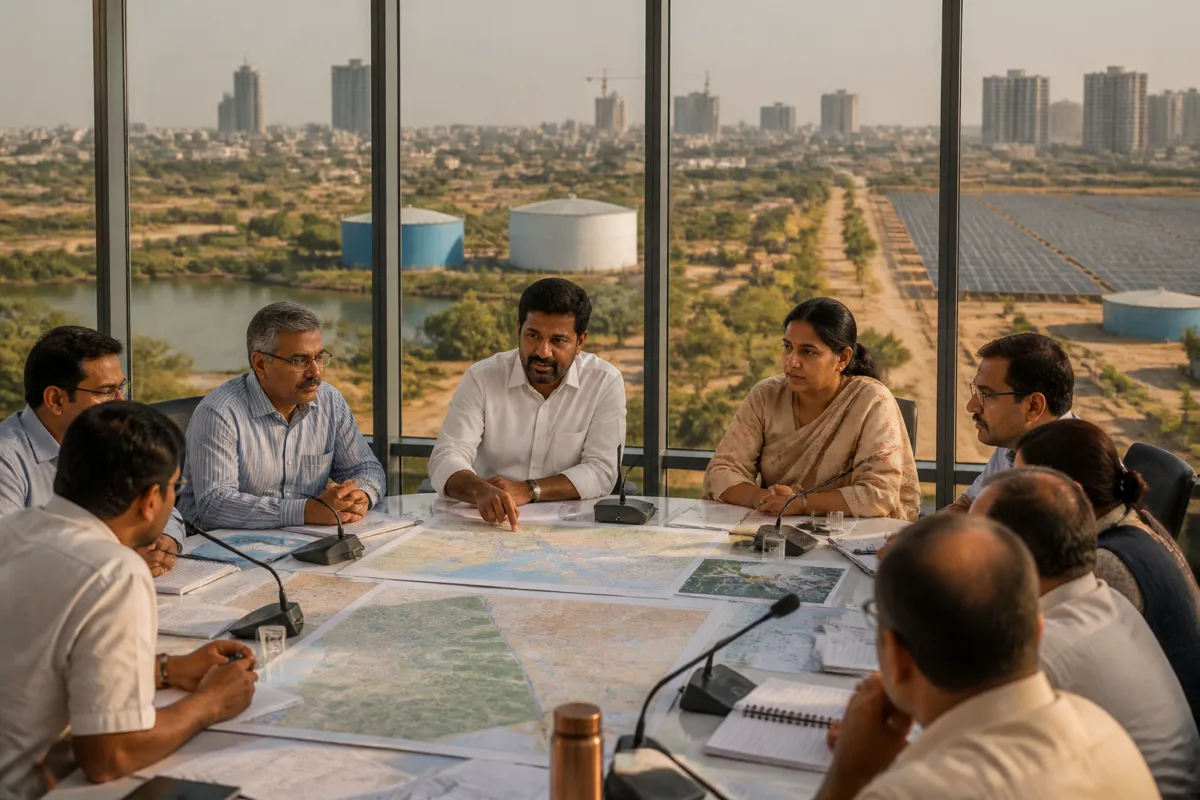
Telangana’s proposed climate conclave is being positioned as more than a conference attached to the Invest Telangana–Global Summit 2026. The state government wants it to bring international visibility, green investment and climate expertise to Hyderabad, but the more consequential test will be whether it can convert concerns over El Nino, water shortages and rising summer demand into practical preparedness for residents, farmers and vulnerable communities.
Irrigation Minister N Uttam Kumar Reddy said the conclave is planned from December 7 as part of the three-day Invest Telangana–Global Summit 2026 at Bharat Future City. The programme is expected to address climate resilience, green investments and El Nino preparedness. A review meeting was held with officials at the Secretariat, where the minister called for a carefully curated conference rather than an overcrowded event.
The proposed format matters because the state’s climate challenge is not confined to a single department or a single season. The issues identified by the minister—drinking water security, agricultural distress, fodder availability, heat, electricity demand and protection of vulnerable communities—span irrigation, municipal administration, agriculture, energy and social protection. A conclave that treats them as separate conference themes may produce discussion; one that links them to operational responsibilities could produce a more useful preparedness framework.
The government’s stated focus is the March-to-May summer period. According to the minister, Telangana must prepare for the possible effects of El Nino, including prolonged dry spells, water shortages, higher temperatures and increased demand for drinking water and electricity. The announcement does not establish the intensity or duration of those impacts, but it identifies the points at which climate variability can become an urban governance problem: reservoirs and local water systems face pressure, households require reliable supply, agriculture needs protection and power demand rises as temperatures increase.
For Hyderabad, water security is particularly important because the city’s requirements are managed through infrastructure and institutions that must function continuously during periods of stress. The supplied account does not provide current reservoir levels, city demand figures or a project-wise assessment of supply capacity. It does, however, show that the state is treating summer preparedness as a matter requiring advance planning rather than only post-event relief.
That distinction is visible in the minister’s reference to Chief Minister A Revanth Reddy’s commitment to mobilise nearly Rs 1,000 crore every month during peak summer months for drought mitigation and relief. The figure signals the scale of public spending being contemplated, although the announcement does not specify the funding route, departments involved, eligible works, release mechanism or criteria for measuring outcomes. Without those details, the commitment remains a financial assurance rather than a fully described implementation plan.
The institutional question is therefore central. Climate resilience depends not only on money or high-profile speakers, but also on how decisions move from the state level to districts, municipalities, utilities and communities. The proposed themes—drought and El Nino preparedness, water security, afforestation, desertification, clean air, renewable energy, climate finance and waste-to-wealth initiatives—cover a wide policy field. The challenge will be to connect each theme to a responsible authority, a defined action and a measurable milestone.
The government has proposed a grassroots consultation on November 28 involving about 100 representatives from different walks of life. This is one of the more significant elements of the plan because it could bring ground-level experience into a summit otherwise designed around institutional and international visibility. The supplied report does not identify the representatives or the consultation’s mandate. Its value will depend on whether it is used to document local risks and implementation barriers, or whether it functions mainly as a pre-event engagement exercise.
The minister has also argued that the success of the conclave should not be judged by the number of sessions or participants. Instead, he identified the stature of speakers, the quality of deliberations, international visibility, investment opportunities and actionable outcomes as the key measures. This is an important shift away from attendance as the primary indicator of a successful summit. It also creates a clear accountability test: the government will need to show what actions emerged, who is responsible for them and when they are expected to be completed.
The proposed invitees reflect the state’s attempt to combine public recognition with expertise. Environmental leaders and experts such as Rajendra Singh, Sunita Narain, Sadhguru and former Norwegian environment minister Erik Solheim are among those mentioned. Actor Dia Mirza has been suggested for the curtain-raiser because of her association with environmental causes. Union ministers, selected ambassadors—particularly from Norway, Denmark and Sweden—and national political and environmental figures are also proposed invitees.
At this stage, the report describes invitations and participation as proposed rather than confirmed. That distinction is important for assessing the event’s likely reach. International visibility can help attract attention to climate finance and green investment, but the presence of recognised personalities cannot by itself establish that the state is better prepared for heat, drought or water stress. The substantive measure will be whether expert participation changes planning, financing or delivery on the ground.
The proposed spending and investment emphasis also raises a question about the relationship between climate finance and public service delivery. Green investments can support renewable energy, waste management and resource efficiency, while resilience spending may be directed towards water security, drought response and protection of vulnerable groups. The supplied material does not specify the sectors, projects or safeguards under consideration. It therefore remains unclear whether the conclave will produce a broad investment pitch or a prioritised pipeline of climate-resilient works.
The conference is expected to be held over two days, although the wider Global Summit is scheduled for December 7, 8 and 9. The minister has favoured fewer, more substantive sessions. That design could help prevent the agenda from becoming a sequence of unrelated panels, particularly because the proposed themes extend from afforestation and desertification to clean air, renewable energy and waste-to-wealth initiatives. A narrower set of linked questions would make it easier to record decisions and assign follow-up responsibilities.
The numbers presently attached to the plan are limited but revealing: the Global Summit is scheduled across three days; the grassroots consultation is expected to involve around 100 representatives; and the state’s peak-summer drought mitigation and relief commitment has been described as nearly Rs 1,000 crore a month. These figures indicate the event’s intended scale, but they do not yet establish the size of the climate risk, the number of affected communities or the infrastructure gap that must be closed.
That missing evidence will matter. A preparedness strategy requires more than identifying possible hazards. It needs a clear account of which areas face water stress, how agricultural and urban demands may compete, what local bodies can deliver, how electricity demand will be managed and which communities require targeted support. None of those operational baselines is included in the announcement. They may be developed through the proposed consultation or the conclave, but that remains to be established.
The proposed event also places Hyderabad within a wider administrative geography. Although the summit is expected to be held at Bharat Future City and is likely to be located in the city, the risks under discussion extend across Telangana. Water security, fodder, farming and drought mitigation cannot be addressed through an urban investment lens alone. Conversely, urban demand for drinking water and electricity can influence how the state allocates resources during a difficult summer. The conference will therefore need to connect the capital’s infrastructure concerns with district-level livelihood and ecological pressures.
The larger urban question is whether climate summits can become instruments of routine governance. Climate risk is experienced through ordinary systems: water supply, electricity, public health, agriculture, transport, housing and municipal services. The announcement is valuable because it places these systems within the official agenda. It also exposes the gap between announcing a climate platform and demonstrating delivery capacity.
Telangana has announced a proposed climate conclave with a broad agenda and an emphasis on actionable outcomes. The evidence currently confirms the event’s proposed timing, themes, consultation plan and stated policy priorities. It does not yet establish the final speaker list, detailed funding architecture, project pipeline or implementation timetable. Those details will determine whether the conclave becomes primarily a visibility and investment event or a framework for measurable climate preparedness before the March-to-May summer period.

