


The reported breakdown of Delhi’s green cracker rules during Diwali was not simply a story about people ignoring restrictions. It exposed a deeper urban governance problem: regulations can be formally strict, publicly announced and backed by the courts, yet still fail when enforcement is weak at the street level. A report by Millennium Post – Delhi described banned fireworks being sold openly in major markets, firecrackers being burst near AIIMS Hospital and air-quality monitoring data becoming unavailable during the worst hours of the night.
The report said the Supreme Court had permitted only approved green firecrackers on November 7 and 8, and only during specified hours. Green crackers are intended to reduce emissions compared with conventional fireworks, but the rule depends on several linked systems working together. Products must be identifiable, sellers must stock only permitted items, police and civic officials must enforce restrictions, hospitals and other sensitive locations must be protected, and monitoring stations must continue providing reliable information. The events described by Millennium Post suggest that each of these links came under strain.
That makes the episode significant beyond one festival night. Delhi’s air pollution problem is often discussed through the lens of seasonal weather, transport, construction dust, industrial emissions and crop burning. Firecrackers are one part of that wider pollution landscape, but they are also an unusually visible test of state capacity. The rules are specific enough to be understood: only approved products, only during designated hours and not near hospitals. When those conditions are openly breached, residents receive a direct signal about whether public restrictions are operational or merely declaratory.
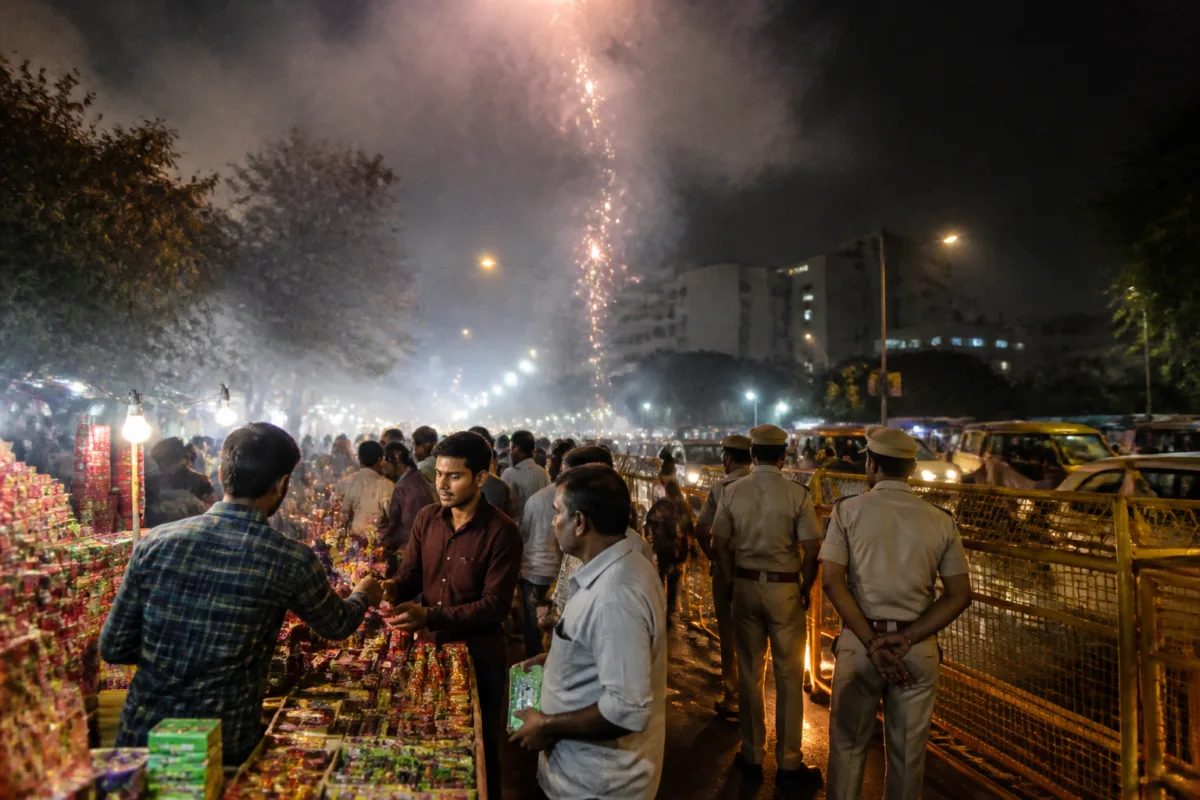
The market-level findings are particularly important. According to the report, sellers in Sadar Bazaar and Lajpat Nagar openly traded banned fireworks instead of approved green crackers. Several products reportedly lacked official safety labels or proper QR codes, while some carried instructions in foreign languages. These details point to a compliance problem that begins before a firecracker reaches the street. If products cannot be reliably identified at the point of sale, enforcement officers and consumers are left with little practical ability to distinguish permitted items from prohibited ones.
This is also an administrative coordination issue. A court order or government restriction does not enforce itself. Market inspections, licensing or seizure action, product verification, police deployment and public communication have to operate as one system. The report described a heavy presence of Delhi Police and security forces but said officers did little to stop illegal sales. If accurate, that gap between visible deployment and effective action is central to understanding what happened. Presence can create an appearance of control without producing compliance.
The reported incidents outside AIIMS Hospital bring the citizen impact into sharper focus. The article said hundreds of poor patients and their families sleep on footpaths near the hospital while waiting for medical treatment, and that loud crackers were set off there late into the night despite restrictions on fireworks near hospitals. This is not an abstract conflict between celebration and pollution. It involves people already facing illness, medical uncertainty and difficult living conditions, with limited ability to avoid exposure or move elsewhere.
Hospitals are among the places where urban rules are expected to be most clearly enforced because the people nearby may be especially vulnerable. A ban on fireworks around such facilities is therefore not only an environmental measure. It is a protection mechanism for patients, caregivers, hospital workers and people living in the surrounding public realm. The report’s account suggests that the problem was not the absence of a rule, but the failure to translate that rule into protection at a specific location.
The timing of the reported pollution spike also matters. Millennium Post said Delhi’s air pollution reached its worst Diwali level in five years by midnight, although the report did not provide the underlying readings or identify the specific metric used for that comparison. That limitation is important. A strong analysis must distinguish between a reported trend and independently presented data. The article supplies the observation that conditions deteriorated sharply, but it does not include the numerical air-quality series needed to test the five-year comparison.
The report also said several official air-quality monitoring stations stopped showing data during the worst hours of the night. This raises a separate governance concern from the pollution itself. Monitoring is essential during an environmental emergency because it allows residents, hospitals and authorities to understand the severity and location of exposure. When data disappears at the moment public interest is highest, uncertainty expands. Residents cannot easily tell whether a station is malfunctioning, disconnected, delayed or recording an extreme reading that has not yet been displayed.
That does not establish that data was deliberately withheld. The supplied report records questions from experts and residents about whether official reporting reflected the full extent of toxic air, but it does not provide a technical explanation for the monitoring interruptions. The distinction matters. A monitoring failure may be an equipment or communications problem; a reporting failure may reflect an administrative weakness; intentional suppression would be a much more serious allegation. The available account establishes concern and a transparency gap, not the cause.
The episode therefore contains two different enforcement tests. The first is physical enforcement: whether authorities stopped prohibited sales and fireworks. The second is informational enforcement: whether residents could access dependable, timely information about the pollution they were experiencing. Both affect behaviour. If sellers expect little intervention, banned products remain available. If residents cannot see reliable air-quality data, the health risk becomes harder to interpret and public accountability becomes weaker.
The reported conduct of enforcement personnel is also significant because it illustrates the difference between rules on paper and administrative incentives on the ground. Millennium Post said some officers were browsing stalls rather than stopping illegal sales. The account is based on the newspaper’s observation and should be understood as a reported scene, not as a finding about every officer or agency involved. Even so, if enforcement officials are present in a market where banned products are openly displayed and no action follows, the credibility of the wider restriction is undermined.
The same problem applies to time-bound restrictions. A rule limited to particular dates and hours requires concentrated preparation and rapid response. Authorities must know where sales are likely to occur, identify legal products before the festival, communicate the permitted window and respond quickly to violations. Once the restricted period passes, preventive enforcement becomes difficult to recover. A late response may record violations without preventing exposure during the hours when residents are most affected.
The report’s account also shows why pollution enforcement cannot be treated as a single-department responsibility. Police may control public-order violations, civic agencies may address markets and local compliance, hospital authorities may report incidents near medical facilities, and air-quality agencies may maintain monitoring systems. Residents experience the combined outcome, not the departmental boundaries. When one part of the chain fails, responsibility can become diffused even though the public impact is immediate.
The larger urban question is whether Delhi’s environmental restrictions are designed only as legal instructions or as functioning delivery systems. A restriction becomes meaningful only when residents can identify what is allowed, sellers face predictable consequences for non-compliance, vulnerable locations receive priority protection and public data remains available. The Millennium Post report suggests that Delhi had the legal framework but struggled with delivery at precisely those points.
At the same time, the available evidence has clear limits. The supplied article does not provide the number of inspections, seizures, arrests or prosecutions; it does not list the monitoring stations that stopped displaying data; and it does not include official responses from Delhi Police, the pollution-control authorities, hospital administration or the government. It also does not provide the air-quality readings behind the five-year comparison. Those missing details prevent a complete assessment of the scale and causes of the reported failure.
What the report does establish is a sharp contrast between formal restrictions and conditions observed on the ground. Banned fireworks were reportedly available in major markets, fireworks were reportedly used near patients at AIIMS, and air-quality information was reportedly unavailable during the most polluted hours. The next stage of accountability lies in documenting how many violations were recorded, what action was taken against sellers and users, why monitoring data became unavailable and whether authorities publish a formal review of the festival enforcement operation.

