


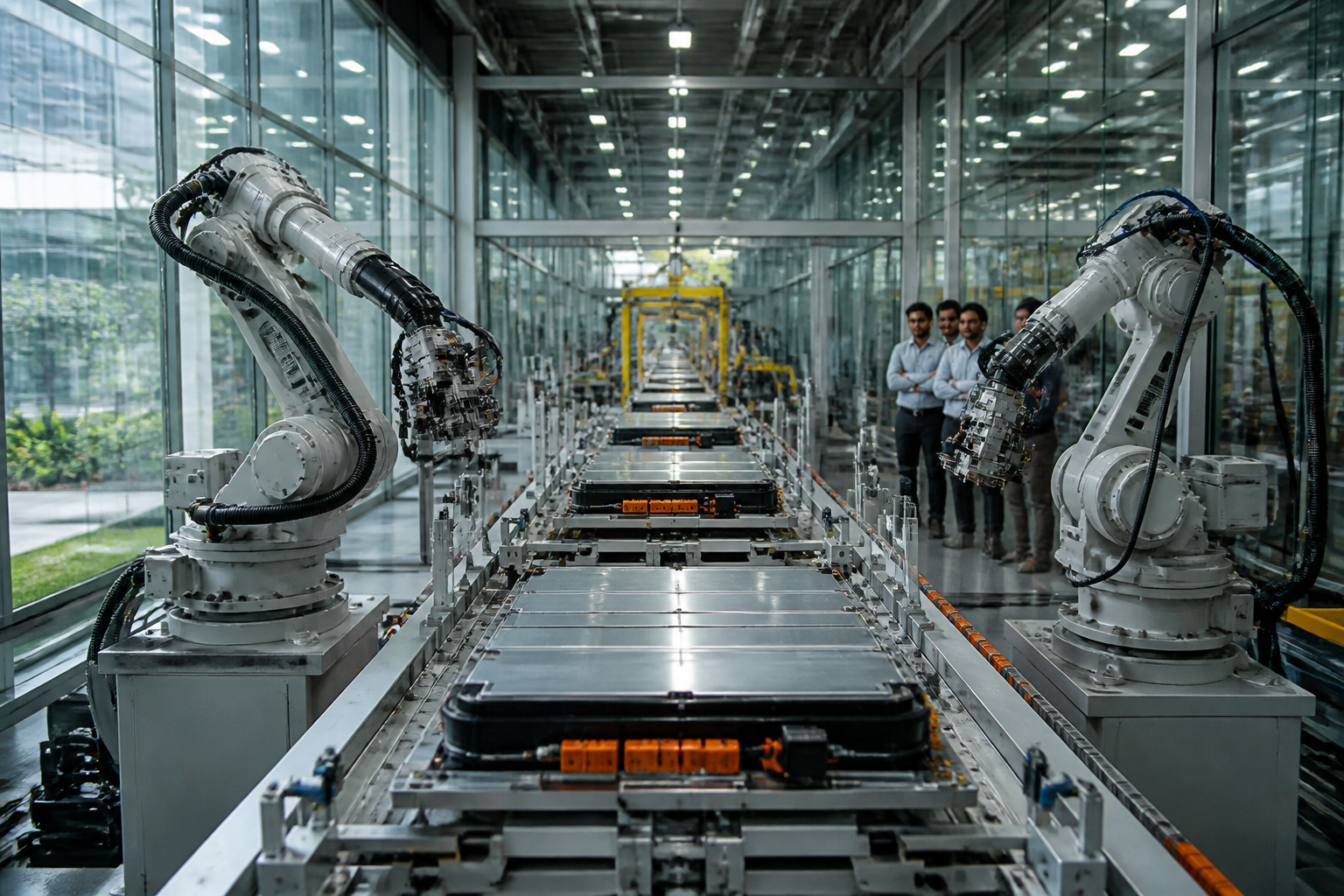
Tata Consultancy Services has opened an Industrial Autonomy & Engineering Lab at its Sahyadri Park campus in Pune, positioning the facility as a test bed for manufacturing systems that can increasingly operate without continuous human intervention. The announcement is significant not because it immediately changes Pune’s industrial landscape, but because it shows how manufacturing infrastructure is being redesigned around artificial intelligence, robotics, digital twins and real-time control systems.
TCS describes the facility as India’s first lights-out factory lab. In manufacturing, the term refers to production environments where autonomous systems operate production lines with minimal human intervention. At the Pune facility, the company has installed a fully robotic battery pack assembly line in a live, multi-stage setup. According to TCS, manufacturers will be able to use the lab to prototype, validate and scale AI-first production systems while reducing deployment risks.
That combination of a physical production line and software-led control is the central development. The facility is not presented merely as a research centre or a demonstration of individual robots. It is designed to simulate how an entire factory could coordinate production, monitoring, quality checks and maintenance through connected systems. The distinction matters for cities such as Pune, where industrial activity is increasingly linked to technology services, engineering, mobility and advanced manufacturing.
The supplied announcement does not provide the lab’s investment value, physical area, workforce size, production capacity or the number of manufacturers expected to use it. It also does not state whether the battery-pack line is intended for commercial production or primarily for testing and validation. Those omissions limit what can be concluded about the facility’s immediate economic impact. What is clear is the direction of the infrastructure: the factory is being built as a controlled environment in which industrial processes can be tested before being deployed at customer sites.
### From automation to industrial autonomy
Traditional factory automation generally focuses on specific tasks: moving components, welding, inspecting products or controlling machinery. The model described by TCS is broader. It combines digital twins, robotics, industrial artificial intelligence, factory control systems and real-time operational intelligence. Together, these systems are intended to create a production environment that can monitor conditions, respond to changes and optimise operations with less manual intervention.
A digital twin allows a physical process or asset to be represented digitally so that performance can be monitored and scenarios can be tested. In the Pune lab, TCS says the technology will be used alongside live production systems. The company’s description suggests that the value of the facility lies in connecting simulation with actual factory operations, rather than treating software and machinery as separate layers.
This also explains why a technology services company is entering the conversation around factory infrastructure. The announcement places software, engineering and operations in the same production system. A factory’s performance is no longer dependent only on machinery, floor space and labour organisation; it is also shaped by the data architecture that links machines, processes and decisions.
TCS’s Sreenivasa Chakravarti, Global Head and Vice President of Industrial Autonomy and Engineering, said the facility advances the company’s vision of engineering AI-first production systems. He described the lab as a tangible demonstration of a “Human + AI model”, in which enterprises move from digitally enabled operations towards increasingly autonomous production systems.
The wording is important. The company is not claiming that people disappear entirely from the production system. Its stated model combines human capabilities with artificial intelligence, while the facility’s use cases include human-machine collaboration. The lights-out description therefore refers to the level of autonomy in the production line, not necessarily to a factory without workers, engineers, supervisors or maintenance personnel.
### What the Pune facility can test
TCS identifies five broad industrial applications for the lab: predictive maintenance, automated quality inspection, real-time process optimisation, human-machine collaboration and autonomous factory operations. Each reflects a different operational problem, although the announcement does not disclose performance results or targets for any of them.
Predictive maintenance uses operational information to identify potential equipment problems before they cause a breakdown. In an industrial setting, the purpose is to reduce unplanned downtime. Automated quality inspection uses cameras, sensors or other systems to identify defects and deviations. Real-time process optimisation seeks to adjust production conditions as operations continue, while autonomous factory operations bring several such functions together under a coordinated control structure.
The battery-pack assembly line provides a concrete industrial setting for these tests. Battery packs require multiple stages of assembly and quality control, making the line suitable for demonstrating the interaction between robotics, inspection, process control and operational data. However, the supplied material does not establish the type of batteries involved, the line’s throughput, the products it will serve or whether the setup represents a particular customer deployment.
The facility’s stated purpose is therefore best understood as validation infrastructure. Manufacturers considering advanced automation face risks when a system is moved directly from a software model or isolated pilot into a working plant. A live, multi-stage laboratory can provide a setting in which the interactions between machines, software and factory controls are observed before a wider deployment. TCS says this is intended to reduce deployment risks, although no independent assessment or measured reduction is included in the announcement.
### The urban meaning of a lights-out factory
For Pune, the immediate urban question is not whether the city will suddenly become a fully automated manufacturing centre. The announcement does not support that conclusion. The more relevant question is how the city’s industrial ecosystem may accommodate facilities where the boundary between an engineering office, a technology laboratory and a production line becomes less distinct.
Pune already functions as a major centre for technology and industrial activity, but the supplied material does not provide data on the city’s manufacturing base, employment or investment patterns. It would therefore be inaccurate to assign a citywide economic effect to one corporate facility. The announcement does, however, offer a specific example of the infrastructure required to test the next generation of manufacturing systems within an urban technology campus.
Such facilities require more than robots. They depend on reliable power, communications, industrial controls, physical safety systems, engineering expertise and access to specialised maintenance and integration capabilities. None of these requirements is quantified in the announcement, but they are implicit in the company’s description of a connected, live, multi-stage setup. The modern factory is consequently both a physical workplace and a digital operating system.
That shift has implications for skills. If factories adopt more autonomous systems, demand may grow for people who can integrate robotics, data systems, industrial controls and engineering processes. At the same time, some routine production tasks may be redesigned or reduced. The supplied announcement does not make employment claims and does not provide a workforce plan, so the effect on jobs cannot be measured from this development alone. It does establish that the company’s stated model includes human-machine collaboration rather than a simple replacement narrative.
### The policy and implementation gap
The Pune lab also highlights a recurring gap between demonstrating industrial technology and deploying it at scale. A controlled facility can show that different systems work together under defined conditions. Commercial factories must deal with variations in equipment, legacy systems, safety requirements, supply chains and operational practices. TCS’s stated ability to help manufacturers prototype, validate and scale systems addresses that transition, but the announcement does not detail how deployments will be financed, regulated or assessed.
There is also no information on the institutional framework governing the lab or on whether public agencies are involved. The facility is located at TCS’s Sahyadri Park campus and has been announced by the company through a regulatory filing. On the evidence available, it is a corporate initiative rather than a government manufacturing programme. Its wider significance will depend on whether the technologies tested there move into factories, how manufacturers measure results and whether the required skills and infrastructure are available.
The announcement similarly does not establish whether the lab will serve only TCS customers, support partnerships with equipment manufacturers or become part of a broader industrial research network. Those are important questions, but they remain unanswered in the supplied material. The next stage of reporting would require details on customer use, deployment outcomes, capital expenditure, workforce requirements and operational performance.
### What the evidence confirms
The evidence confirms that TCS has launched a Pune-based Industrial Autonomy & Engineering Lab; that the lab includes a fully robotic battery-pack assembly line; and that the company intends it to support prototyping, validation and scaling of AI-first production systems. It also confirms the technologies and industrial use cases identified by TCS, including digital twins, robotics, predictive maintenance and autonomous operations.
What the evidence does not confirm is the commercial scale of the facility, the number of jobs it will create or replace, the value of contracts associated with it, or the extent to which manufacturers will adopt the systems tested there. It does not establish that lights-out manufacturing is about to become the dominant model in Pune or India. Those conclusions would require information beyond the announcement.
The larger urban issue is therefore one of transition rather than immediate transformation. Pune’s industrial infrastructure is now the setting for a facility that treats software intelligence, engineering systems and factory operations as one connected problem. Whether that model becomes economically important will be determined not by the launch alone, but by measurable deployments, operational results and the capacity of workers and institutions to support increasingly autonomous production.
For now, the TCS lab is a clear signal of where industrial infrastructure is moving: towards factories that are designed not only to produce goods, but also to sense, analyse and adjust their own operations. The developments that deserve monitoring are the lab’s customer deployments, its reported performance results and the skills and infrastructure required to take its systems beyond the demonstration environment.
