


Tata Trusts’ spending rose 72.5% to Rs 1,556.31 crore in 2025-26, but the more consequential shift lies in where the money is going and how the organisation says it intends to measure results. The Trusts are placing greater emphasis on institutions, healthcare capacity and models that can become enduring public assets rather than judging philanthropy only by the amount disbursed or the number of beneficiaries reached.
The increase, reported in the Trusts’ annual report and cited by the Economic Times, came during Noel Tata’s first full financial year as chairman. Spending stood at Rs 902.32 crore in 2024-25. Of the latest total, institutional grants and direct project spending accounted for Rs 1,353.32 crore, while assistance to individuals amounted to Rs 202.99 crore.
That distinction is important for understanding the Trusts’ operating model. Direct assistance can respond to immediate needs, including medical or education expenses. Institutional spending, by contrast, is intended to build or support systems that continue to function beyond a single grant cycle. The annual report indicates that both forms of support remain part of the portfolio, but the stated strategic direction is towards projects whose effects can be sustained and measured over time.
The largest institutional allocation was Rs 457.62 crore for rural upliftment. Education received Rs 270.26 crore, while cancer care accounted for Rs 178.46 crore. Healthcare received Rs 105.97 crore, followed by water and sanitation at Rs 59.04 crore and nutrition at Rs 57.64 crore. These categories are often treated separately in public policy, but together they describe the basic conditions that determine whether communities can access health, education and essential services.
The figures also show that medical needs remain a major component of individual assistance. Medical assistance accounted for Rs 143.30 crore of the Rs 202.99 crore distributed directly to individuals. Education-related assistance stood at Rs 59.38 crore. This combination of institutional investment and individual support reflects two different gaps in India’s social infrastructure: the need to expand systems and the need to help households navigate systems that remain insufficient or unaffordable.
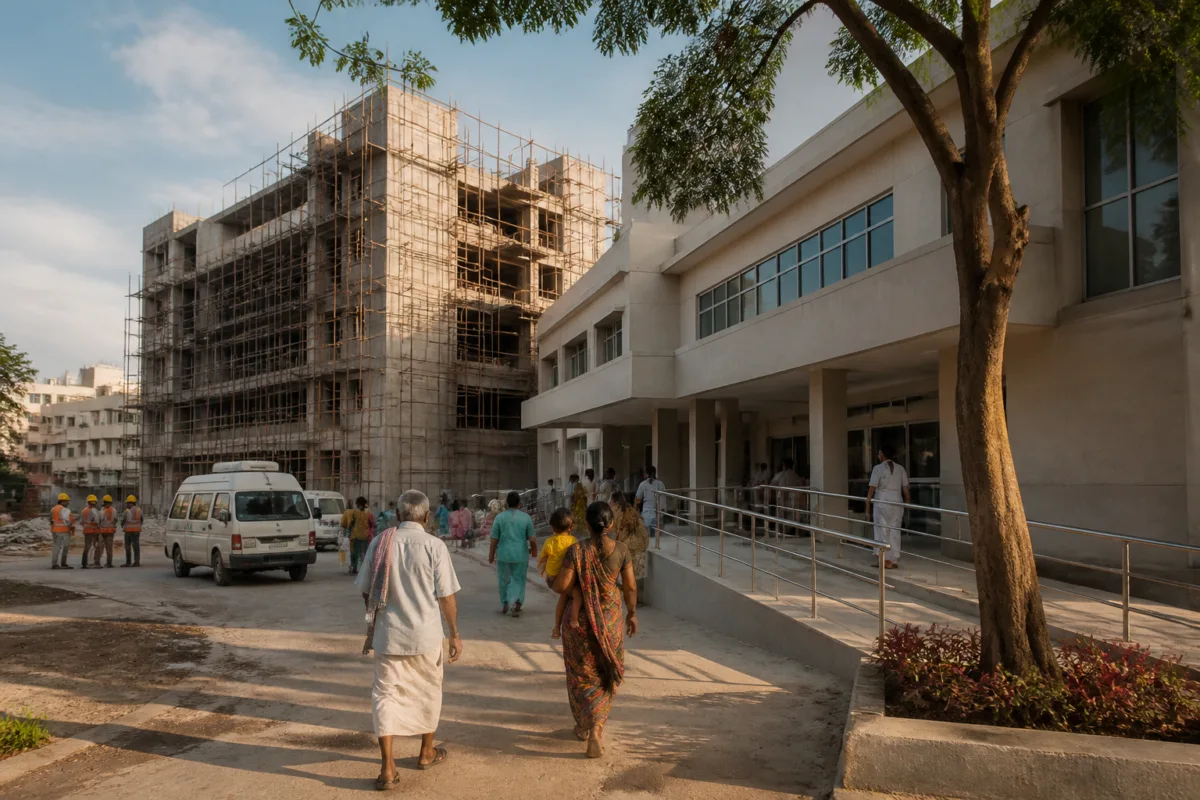
The Trusts’ proposed network of 40-50 not-for-profit general hospitals is the clearest example of the institutional approach outlined in the report. The stated model is intended to make quality treatment accessible to people who cannot afford it. The source material does not provide a construction timetable, locations, capital cost, operating model or details of how the hospitals would be integrated with public health systems. Those unknowns will determine whether the proposal becomes a network of functioning healthcare institutions or remains a long-term philanthropic ambition.
Still, the proposal signals a significant change in the scale at which corporate philanthropy can participate in public-service delivery. Hospitals require land, construction, equipment, trained staff, recurring operating expenditure and governance systems. A not-for-profit structure may reduce the pressure to maximise commercial returns, but it does not remove the practical requirements of maintaining quality and financial viability. The challenge is therefore not only to build facilities, but also to sustain them as reliable public-facing institutions.
Noel Tata’s accompanying message places this question of durability at the centre of the Trusts’ approach. He emphasised that philanthropy should be assessed through lasting, measurable outcomes rather than simply total spending or the number of people reached. That position shifts attention from inputs to institutional performance. A rupee spent on a hospital, school or sanitation project is an input; the longer-term test is whether the asset continues to deliver accessible and effective services.
The same principle applies to rural upliftment, which received the largest allocation. The source does not specify the projects included under that category, so it is not possible to assess their geographic distribution or outcomes from the available material. But its size relative to other categories indicates that the Trusts are treating rural development as a central institutional priority rather than a peripheral grant activity.
Water and sanitation, which received Rs 59.04 crore, also sit at the intersection of infrastructure and public health. These services are less visible than hospitals or schools, yet their availability shapes disease risk, household expenditure and the effectiveness of wider health interventions. The Trusts’ spending figures do not establish the results of these programmes, but they show that basic service delivery remains part of the organisation’s philanthropic portfolio.
The funding structure behind this work is closely tied to the Tata group. Tata Trusts hold about 66% of Tata Sons, the group’s holding company, and rely substantially on dividends to fund philanthropic activities. For 2024-25, Tata Sons recommended a dividend payout of Rs 2,622.91 crore, of which about Rs 1,731 crore was due to the Trusts. This relationship means that the capacity for philanthropy is connected to the financial performance and dividend decisions of the holding company.
That institutional link matters because philanthropic spending cannot be considered entirely separate from corporate governance. The annual report recorded changes to the boards of the Trusts’ principal entities during the year. Mehli Mistry ceased to be a trustee of the Sir Ratan Tata Trust and Sir Dorabji Tata Trust on October 28, 2025. Neville Tata and Bhaskar Bhat joined the Sir Dorabji Tata Trust board on November 12, 2025, when Venu Srinivasan was reappointed. Pramit Jhaveri’s term ended on February 11, 2026.
These changes form part of the governance context in which spending priorities are set and implemented. The available report does not establish that the board changes caused the increase in spending or directly altered any individual programme. It does, however, place the higher outlay within a year of organisational transition and renewed emphasis on institutional models.
The headline figure of Rs 1,556.31 crore is therefore best understood as a measure of expanded activity, not conclusive evidence of expanded impact. The available information confirms a substantial increase in expenditure and identifies the sectors receiving the largest allocations. It does not yet provide outcome metrics for the programmes, details of hospital locations, implementation milestones or evidence on how many new patients, students or households were reached.
That gap is particularly relevant when philanthropic organisations move into infrastructure-heavy fields. A facility can be counted, inaugurated and funded, but its public value depends on access, staffing, affordability, service quality and continuity. The Trusts’ own emphasis on measurable and lasting outcomes creates a framework against which the hospital network and other institutional projects can eventually be assessed.
The larger urban question is how non-state capital contributes to public infrastructure in places where government capacity, household affordability and service demand do not align. Tata Trusts’ spending portfolio covers physical facilities, essential services and direct assistance, linking long-term asset creation with immediate relief. Its next test will be whether the proposed institutions and existing programmes can demonstrate the durability, accessibility and measurable outcomes that the new strategy places at the centre of philanthropy.

