


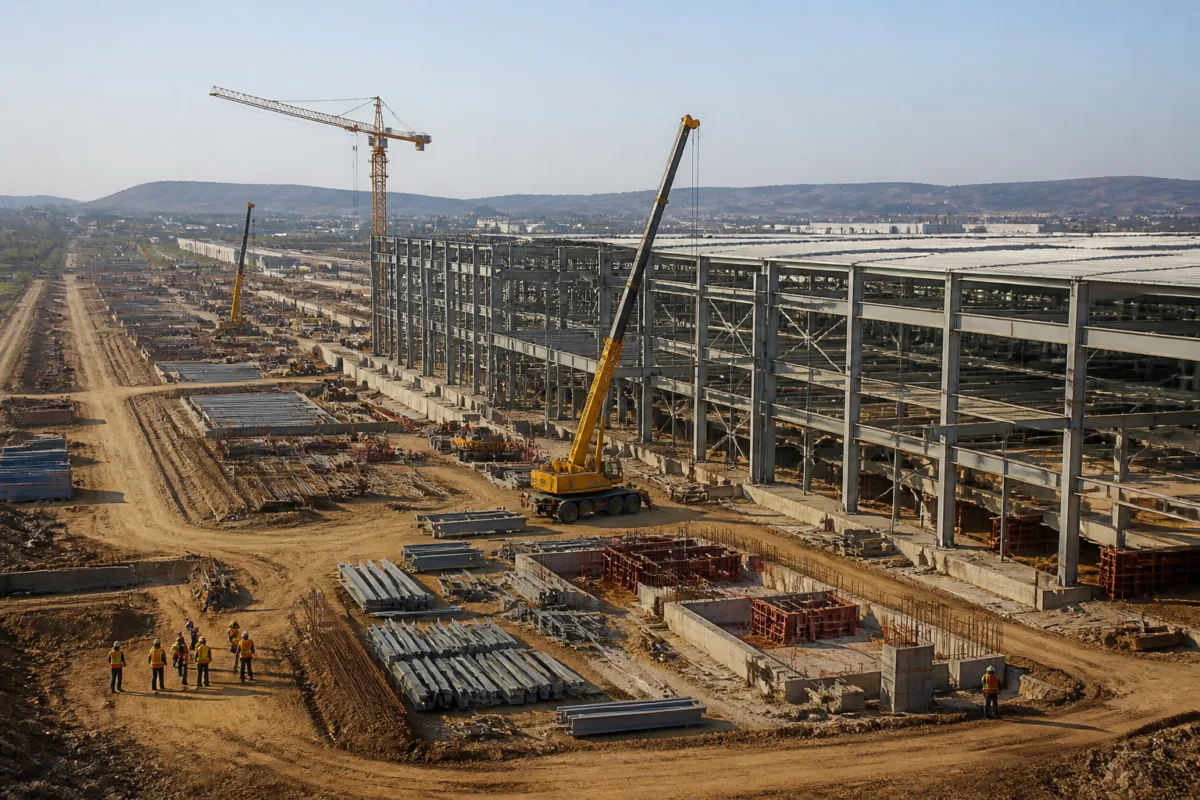
Tata Projects has secured a major contract to develop a greenfield automotive plant in Chhatrapati Sambhajinagar, Maharashtra, covering the facility’s core production buildings, support infrastructure and commissioning, the company said on Tuesday.
The contract has been awarded by a global automotive manufacturer whose identity was not disclosed. Tata Projects said the mandate includes three critical packages: the assembly shop, the press and weld shop, and utility and support buildings.
The scope extends beyond civil construction. According to the company, Tata Projects will undertake civil, structural and architectural works, Mechanical, Electrical and Plumbing systems, utility networks, testing, commissioning and the final handover of the facility.
The project will require coordination across multiple engineering disciplines and construction activities because the production buildings and supporting systems must operate as an integrated industrial facility. Tata Projects said the work would bring together specialist teams, partners and suppliers during execution.
The announcement places Chhatrapati Sambhajinagar at the centre of a new advanced manufacturing project, although the company did not disclose the plant’s investment value, construction schedule, production capacity or expected workforce. It also did not identify the automotive company commissioning the work.
Rajiv Menon, President and Chief Growth and Strategy Officer at Tata Projects, said the company had partnered with a leading global automotive manufacturer to create a facility that would contribute to the sector’s development. He described the mandate as an important step in expanding Tata Projects’ presence in advanced manufacturing.
For Tata Projects, the contract broadens its work in technology-intensive industrial infrastructure. The company said the project builds on capabilities developed through its experience with semiconductor facilities, battery plants, data centres and other complex projects. Its role in the Maharashtra plant will cover the complete execution chain from engineering and construction through testing, commissioning and handover.
The contract also illustrates how large manufacturing projects depend on more than the construction of a single production shed. Assembly, press and weld operations require specialised buildings, while utility networks and support facilities provide the systems needed for industrial operations. Coordinating these elements is part of the execution challenge identified by Tata Projects.
The company did not provide details on the automotive manufacturer’s broader development plans or disclose whether the contract forms part of a phased plant programme. Further information on project timelines, investment, employment and operational capacity was not included in the announcement.

