


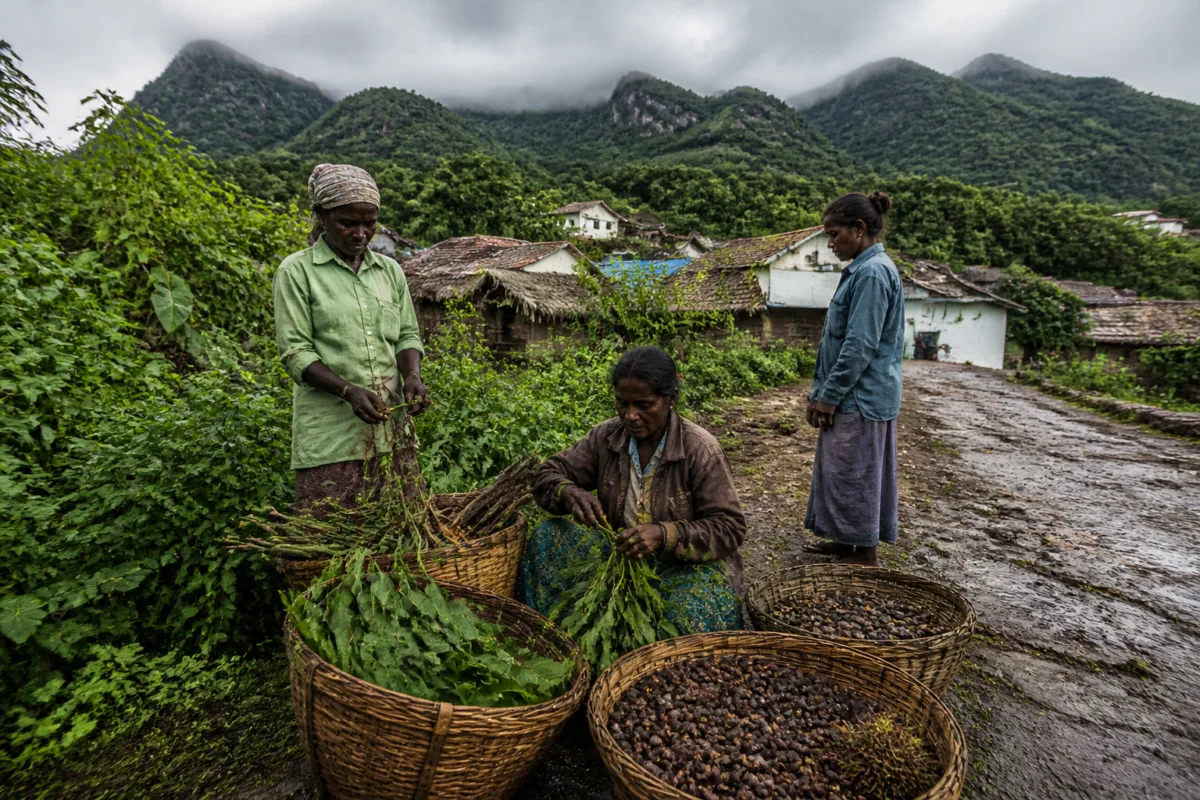
Tamil Nadu’s forest rights system was created to correct historical injustices against forest-dwelling communities, but the evidence presented by two retired Indian Forest Service officers suggests that legal recognition has not translated into control over land, forest produce or local livelihoods. Across settlements in the Eastern and Western Ghats, the gap between rights granted on paper and rights exercised in practice appears to be shaped by administrative classification, market restrictions and the continued influence of forest department structures.
The issue is larger than the delayed delivery of individual land titles. It concerns who is allowed to enter forests, collect minor forest produce, transport it to market and retain its economic value. It also exposes a tension at the heart of forest governance: whether communities are treated as rights-bearing residents with a role in conservation, or as regulated labour operating within a system controlled by officials, committees and traders.
The legal framework at the centre of the dispute is the Scheduled Tribes and Other Traditional Forest Dwellers (Recognition of Forest Rights) Act, 2006, commonly known as the Forest Rights Act. The law was intended to recognise rights that had remained unrecorded during the colonial and post-colonial periods. It also gave gram sabhas a central role in initiating and verifying claims, creating a process that was meant to move decision-making closer to forest-dwelling communities.
According to the article, implementation in Tamil Nadu remains uneven nearly two decades after the law was enacted. In the foothills of Palani in Dindigul district, members of the Paliyar community in settlements including Kuthiraiaru Dam, Puliyampatti and Ponthupuli have allegedly been denied Scheduled Tribe certificates for more than 20 years. The authors say revenue officials classified them as Puliyars, a Scheduled Caste community, even though they are related to Paliyars in Kodaikanal who hold Scheduled Tribe certificates.
That classification has consequences beyond identity documentation. Without the relevant Scheduled Tribe certificate, residents face difficulty claiming rights under the Forest Rights Act. The article says the settlements have nevertheless benefited from Integrated Tribal Development Programme projects implemented by the forest department and are recorded as tribal habitations in government-approved forest working plans. The authors argue that this creates an administrative contradiction: communities can be recognised as tribal habitations for development and planning purposes while their claims under the forest rights framework are rejected.
The dispute also raises questions about the functioning of the committees responsible for processing claims. The article says gram sabhas have recommended claims in these settlements, but that recommendations were rejected by the sub-divisional level committee. If accurate, this would weaken the statutory design of the Act, under which the gram sabha is intended to initiate and verify claims before they move through higher levels of scrutiny. The problem is therefore not only a delay in issuing documents. It is also a conflict between local evidence and bureaucratic interpretation.
The authors describe a second gap between official measures of progress and the economic reality of forest-dependent communities. The tribal welfare department highlights the distribution of individual land titles, they write, but fewer than 20% of forest-dwelling communities have agricultural land. The remaining 80% depend on minor forest produce for their livelihoods, according to the article. This distinction matters because a land title cannot by itself secure an income for households whose economic activity is based on collection, processing and sale of forest products.
Minor forest produce can include leaves, fruits, tubers, flowers and other non-timber products collected from forests. For communities that depend on these products, access to a market is as important as permission to collect them. The article argues that restrictions on transport and sale prevent forest dwellers from exercising the economic rights that the law was meant to protect. It refers to central government directions asking states to ease forest transit rules in line with the Forest Rights Act, while alleging that restrictions continue in Tamil Nadu.
The resulting market structure, as described by the authors, places collectors in a weak bargaining position. They allege that forest officials select or approve traders, locally known as vyaparis, and compel gatherers to hand over produce at low rates. A resident of Manthittu, a settlement of the Malai Malasar community, reportedly told the authors that a trader waited downhill to collect seemar pul, or date palm leaves used to make brooms. The resident said collectors could not sell the material elsewhere.
This account illustrates how a formal right can be undermined without being explicitly removed. A community may possess a forest rights title, but if it cannot transport produce, access competing buyers or negotiate prices, the title may have limited economic value. Control over the route from forest to market can become a substitute for direct denial of the right itself.
The article further alleges that the system has consequences for forest ecology. It cites the harvesting of nux vomica fruits in Javadu, satavari tubers in the Palani hills, gallnuts in the Shervarayan hills, kalpasi in the Melagiri hills and mavaalikizhangu in Pachamalai as examples of extraction taking place with little ecological concern. These claims are presented by the authors as evidence that excluding communities from ownership does not necessarily protect forests. Instead, they argue, it can push collection into informal and less accountable channels controlled by intermediaries.
This is the central institutional question raised by the article. If communities that live in forests are denied a recognised role in managing and selling forest produce, the economic activity does not disappear. It may move into a parallel system in which the people doing the collection have the least influence over prices, records and environmental safeguards. The article’s argument is not that all extraction is sustainable simply because it is community-based. Rather, it challenges the assumption that bureaucratic control automatically produces better conservation outcomes.
Village Forest Committees add another layer to this governance structure. The committees emerged under the joint forest management policy in 1998, but the authors state that they are not statutory authorities under the Forest Rights Act. They allege that forest field staff use these committees to restrict the collection and sale of minor forest produce, including produce to which communities are legally entitled.
The article also raises concerns about financial accountability. It says large quantities of forest produce are reportedly sold through VFC officials, with only a fraction recorded and limited returns deposited into VFC accounts. The authors allege that VFC finances have not been subject to adequate public scrutiny since the committees were established. Accounts are described as being jointly operated by a forest ranger serving as secretary and a tribal representative serving as president. The article claims that presidents are often selected by forest officials, are not given full information about balances and transactions, and may be directed to organise collection and loading for designated traders.
These allegations point to a problem of institutional overlap. The Forest Rights Act establishes one legal pathway for recognising community rights, while older forest management arrangements continue to operate at the local level. Where the older structures control access, records, transport or payments, the newer rights framework can be reduced to documentation without effective authority.
The article alleges that forest dwellers carrying produce on foot or bicycles face restrictions at forest checkposts, while vehicles belonging to traders pass through. It also claims that residents in some areas are required to pay between ₹4,000 and ₹5,000 annually to local forest officials to enter forests and collect produce, even when they hold collection rights. These are serious allegations and would require official records, community testimony and administrative responses for independent assessment. Their significance lies in the type of accountability they demand: not merely whether titles were issued, but whether rights holders can use them without unofficial costs or unequal enforcement.
The administrative chain is equally important. The article calls on officials in the sub-divisional and district-level committees, drawn from the revenue, forest and tribal welfare departments, to improve their understanding of forest rights claims. This reflects the fact that implementation is distributed across departments. Revenue authorities influence community identity and land records; forest officials control access and management practices; and the tribal welfare department serves as the nodal agency for implementing the Forest Rights Act. When these institutions apply different classifications or operate without transparent coordination, communities face the burden of resolving an official contradiction.
Tamil Nadu’s case therefore reflects a wider governance challenge within rights-based conservation. The law attempts to recognise historical occupation and livelihood practices, but implementation depends on departments that have traditionally exercised regulatory control over forests. The transition from a command-and-control model to a rights-based model cannot be completed through titles alone. It requires the institutions controlling access, markets, records and enforcement to accept the authority of the legal framework.
The evidence supplied in the article does not establish the scale of every allegation across Tamil Nadu, nor does it include responses from the state government, forest department, tribal welfare department or the committees named. It does, however, identify a consistent pattern of concern: delayed Scheduled Tribe certificates, rejected gram sabha recommendations, restricted market access, alleged trader-official arrangements, weak financial transparency and continued dependence on non-statutory local structures.
The larger urban and regional question is how the state values the people who sustain economies beyond city limits. Forest produce moves through rural settlements, transport networks and local markets before reaching consumers and businesses. When collection rights are blocked or captured by intermediaries, the impact is felt not only in remote habitations but across the supply chains connecting forests to towns. The issue also demonstrates that conservation, livelihoods and administrative justice cannot be managed as separate policy categories.
What remains to be established is how many claims have been filed and rejected, how many communities possess community forest rights, how VFC accounts are audited, and what enforcement records exist for forest transit restrictions and alleged payments. Those records would allow the state’s stated progress to be assessed against the lived experience described by the authors. Until then, the central finding is clear: recognising forest rights on paper does not guarantee that forest-dwelling communities can exercise them in the places where land, produce and markets intersect.

