


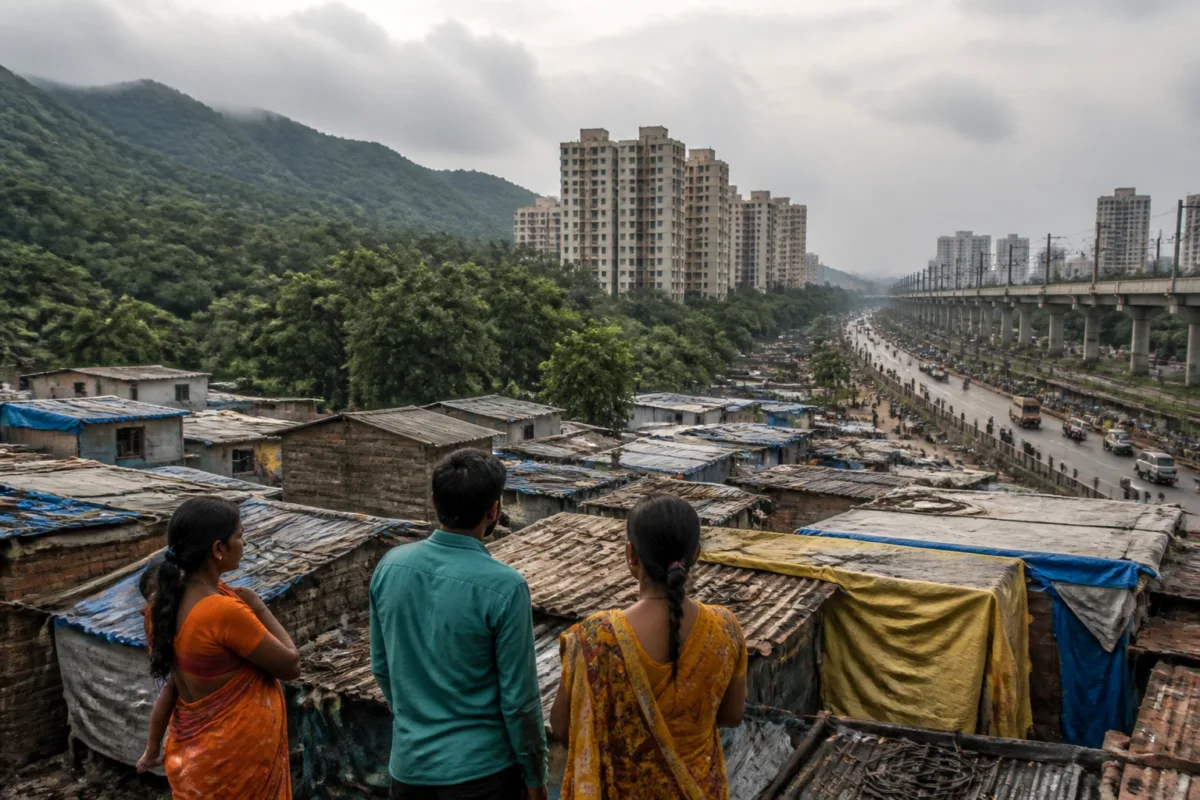
The Sanjay Gandhi National Park relocation plan is moving towards a consent-based model for eligible non-tribal households, but the proposed shift to MHADA flats in Shirdon and Kon in Kalyan has exposed a larger problem: rehabilitation housing can meet a land or conservation objective while making everyday urban life harder for the people being moved.
SGNP authorities are expected to distribute consent forms after Diwali to eligible non-tribal households willing to relocate to the two Kalyan sites, which are more than 50 km from their present locations in Mumbai. Anita Patil, director and chief conservator of forests at SGNP, told the Times of India that only those who sign the forms will be shifted. MHADA has offered 6,300 flats at Shirdon and Kon.
The immediate administrative question is therefore whether households will accept the proposed location. The deeper question is what consent means when the alternative is continued uncertainty, possible eviction or a home in a distant settlement that may be disconnected from employment, schools, healthcare and established social networks. The supplied report does not establish how many households will sign the forms, what support will accompany the move or whether a detailed assessment of household livelihoods has been completed.
The scale of the rehabilitation challenge is substantial. Officials have identified around 12,000 households in the south division of the park, covering areas from Goregaon to Dahisar, and around 5,200 households in the Yeoor region as eligible for rehabilitation. The figures include tribal and non-tribal households. The proposed 6,300 flats, however, cannot be read as a complete solution for all identified households without further clarity on eligibility, allocation, household size and the division between the two categories.
That gap between the number of households identified and the number of flats offered is not simply a housing-supply issue. It is also an administrative sequencing issue. Before relocation can be implemented, authorities have to determine who qualifies, which category each household falls into, where each household will be accommodated and what happens to those who do not accept the offered site. The report records the consent mechanism for non-tribal households but does not provide the complete rehabilitation schedule or the final allocation framework.
The present process is rooted in a long-running legal and institutional history. The Bombay High Court’s 1997 order on relocation and rehabilitation was not fully implemented, according to the report. After a contempt petition was filed, the court took up the matter again and established a high-power committee to oversee the task. The continued involvement of the court indicates that the issue is not a new eviction exercise but an unresolved implementation problem extending across several decades.
The history of the tribal settlements adds a separate layer to the dispute. Government authorities announced that tribals would be rehabilitated on 90 acres in Aarey Colony, but residents opposed being identified as encroachers and said the area was their home even before it was declared a forest. SGNP officials, meanwhile, said the original park tribals had been relocated to Palghar in the late 1970s and early 1980s, but many returned because of a lack of employment opportunities there.
That account demonstrates why relocation cannot be evaluated only through the availability of a constructed dwelling. The earlier movement to Palghar, as described by forest officials, did not permanently resolve the question of where people could live and work. Employment access became a factor in return migration. In the current proposal, the same question has resurfaced in a different geography: whether a flat in Kalyan can support households whose livelihoods remain connected to Mumbai.
The resistance to the Kalyan sites is expressed in practical rather than abstract terms. Some affected residents told the Times of India that the rehabilitation locations are 14 km from Dombivli station and that a one-way journey costs Rs 60. They estimated that daily travel could cost Rs 120 and take five hours. Yogesh Bole, one of those affected, said residents were asking how they would survive under those conditions when their work is in the city.
These claims are the ground-level test of the relocation plan. A dwelling may be formally adequate while the settlement remains economically inaccessible. For a household dependent on daily or frequent work in Mumbai, travel costs reduce disposable income and travel time reduces the hours available for paid work, domestic responsibilities and education. The report does not provide an official travel-time or affordability assessment, but the residents’ accounts identify the indicators that such an assessment would need to examine.
The proposed move also involves the loss of location-specific networks. Manohar Nikam, 55, said he had lived in Malad for 30 years and would find it difficult to start again in a place without employment opportunities. Sukeshni Pawar, 36, said a forest department site visit to Shirdon was cancelled, after which residents visited the location themselves. She said some people had decided to accept the offer to end the uncertainty, while most of those willing to move had arrived in the area after 2000.
Those accounts suggest that the affected population is not uniform. Some households may prioritise a formal flat or an end to prolonged uncertainty. Others may view relocation as a threat to income and community ties. The distinction is important for policy because a single consent form cannot capture the different economic, legal and social circumstances of thousands of households. The report does not state whether the forms will record employment location, household income, travel needs or preferences for alternative sites.
Possible alternatives are already part of the institutional discussion. Former BJP MP Gopal Shetty suggested rehabilitation on a 10-acre BMC plot at Kandarpada in Dahisar. He also said residents wanted the government to pay the difference between the value of their huts and the proposed flats. His account put the comparison at Rs 50 lakh for a hut in Mumbai against Rs 15 lakh for a flat in Kalyan. These figures are attributed to Shetty and are not presented in the report as an independent valuation.
Former NCP MLC Vidya Chavan said there were at least 6,000 flats for project-affected persons in Mumbai that could be considered for the affected households. She said party workers had identified several such flats, including two entire buildings. Forest officials said the Slum Rehabilitation Authority had so far offered 212 project-affected-person flats in the city. The difference between these figures shows that the availability of alternative housing is itself contested or depends on which inventory, eligibility rules and administrative authority are being considered.
The Yeoor region has a further possible route. Thane Municipal Corporation has offered to accommodate households from Yeoor in three cluster redevelopment projects under way. Two are close to SGNP and the third is about 5 km from the national park, according to Pradip Patil, deputy director of the north division of SGNP. This proposal appears more closely connected to the existing geography, but the report does not establish the number of units available, the delivery timeline or the conditions under which households would be admitted.
The institutional map is consequently fragmented. SGNP and the forest department control the conservation context and identify affected households. MHADA is offering flats at Shirdon and Kon. The SRA has offered a smaller number of city-based project-affected-person units. The BMC has been mentioned as a possible land-owning authority for an alternative site. Thane Municipal Corporation has offered accommodation through cluster redevelopment. The high-power committee and the Bombay High Court provide oversight of the wider process.
A fragmented institutional structure does not necessarily prevent rehabilitation, but it makes coordination central to the outcome. Household identification, legal status, housing allocation, transport access and livelihood continuity must be addressed together if relocation is to be more than a transfer of structures from one site to another. The report records several offers and proposals, but it does not identify a single consolidated plan that brings them into one publicly explained framework.
The dispute also reflects the tension between protected-area management and the realities of metropolitan expansion. SGNP is embedded within Mumbai’s urban fabric, while the households discussed in the report are linked to neighbourhoods such as Goregaon, Dahisar, Malad and the wider northern suburbs. Moving them to Kalyan is not only a change of address. It shifts the relationship between residence and work across municipal and regional boundaries, with consequences for transport demand and household expenditure.
The numbers make that relationship visible. Around 17,200 households have been identified as eligible across the south division and Yeoor, while 6,300 MHADA flats have been offered at the two Kalyan sites. Residents have cited a daily transport cost of Rs 120 and a five-hour travel burden. The report also records 212 city-based project-affected-person flats offered by the SRA and three Thane cluster redevelopment projects for Yeoor households. These figures do not provide a final solution, but they show that the central issue is not just whether housing exists; it is where that housing is located and how it functions within the metropolitan economy.
The tribal question further complicates any attempt to treat the park’s population as a single rehabilitation category. Tribal residents have challenged the description of their settlements as encroachments and have demanded implementation of the Forest Rights Act. In January this year, they held large protests, after which the government stayed the eviction of non-tribal and tribal residents who had already been rehabilitated in the first phase. The supplied report does not specify the current legal status of every category, but it makes clear that the process has different legal and political dimensions.
For the non-tribal households now being asked to consider Kalyan, the consent forms will become the next concrete administrative milestone. Yet their significance will depend on the information provided with them and the choices available after refusal. A consent process is meaningful only when residents can understand the location, travel implications, tenure conditions and services attached to the proposed housing, and when alternative options are clearly defined.
The SGNP case therefore reveals a rehabilitation gap that extends beyond the park boundary. Mumbai’s redevelopment and conservation decisions repeatedly bring together land protection, informal housing, court orders, public agencies and the regional labour market. The evidence supplied here confirms that authorities have housing offers and oversight mechanisms, but it does not establish that the proposed relocation sites can preserve livelihoods or that the full population identified for rehabilitation has a settled housing pathway.
The next stage will be the distribution of consent forms after Diwali and the response of eligible non-tribal households. The implementation of the Bombay High Court’s order, the high-power committee’s oversight, the status of city-based alternatives and the terms of the Thane proposals will determine whether the process becomes a workable rehabilitation programme or another partial step in a dispute that has remained unresolved since 1997.

