


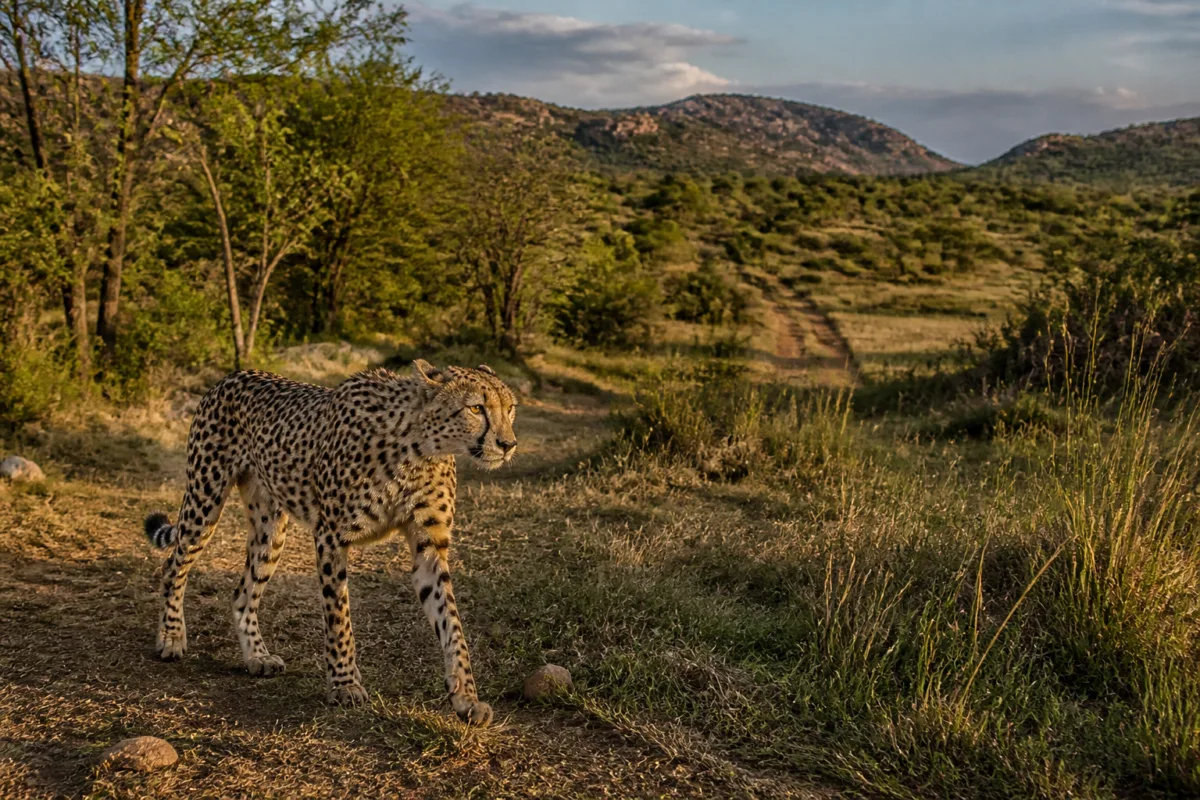
The delay in signing a proposed cheetah corridor agreement between Madhya Pradesh and Rajasthan is no longer an administrative detail. Two cheetahs from Kuno are now moving through Rajasthan’s Karauli forests, while a confrontation between villagers and a tracking team has resulted in an FIR. The developments show how quickly a wildlife reintroduction programme can outgrow the boundaries of the protected area where it began.
The proposed corridor was intended to create a coordinated management landscape across the two states. Nearly two years after the proposal was discussed, however, the memorandum of understanding remains unsigned. The immediate question is not only whether cheetahs can move across state borders, but whether the institutions responsible for managing that movement are ready to work across those borders.
KGP-3 and KOMG-4 are currently moving through the Karanpur forest range in Karauli district. According to the report, KGP-3 travelled beyond Mandrayal before entering the range, while KOMG-4 crossed the Chambal near Gota Ghat on October 10, entered Rajasthan through Maharajpur Naka and reached the same landscape. This is the first recorded instance of two Kuno cheetahs being together in a single forest range in Rajasthan.
Their presence also adds complexity to an already active landscape. The area is frequented by tigers and leopards, meaning that the management challenge is not limited to tracking one reintroduced species. It involves understanding how cheetahs move through a forest system shared with other large carnivores, livestock-owning communities and forest personnel responsible for monitoring them.
The proposed agreement covers approximately 17,000 square kilometres. Of this, 10,500 square kilometres lies in Madhya Pradesh and 6,500 square kilometres in Rajasthan. The proposed landscape connects Kuno National Park and Gandhi Sagar Wildlife Sanctuary in Madhya Pradesh with the wider forest belt extending towards Rajasthan’s Mukundara Hills Tiger Reserve. Eight districts in Madhya Pradesh and seven in Rajasthan fall within the proposed area.
That geography is important because it changes the administrative character of the cheetah project. Kuno may be the programme’s principal site, but the animals’ range is not governed by the park boundary. Once they move through adjoining forests, responsibility is distributed across state forest departments, protected-area administrations, district officials, police agencies, veterinary systems and local communities. A species-reintroduction programme therefore becomes a coordination exercise involving multiple jurisdictions.
The proposal was discussed in 2024 by Madhya Pradesh Chief Minister Mohan Yadav and Rajasthan Chief Minister Bhajan Lal Sharma. In November that year, senior forest officials from both states and experts from the Wildlife Institute of India prepared a roadmap. The draft MoU reportedly includes a joint feasibility study for free-ranging cheetahs, scientific assessment of suitable habitats, grassland development, improvement of prey availability and common monitoring protocols.
It also seeks to establish procedures for emergency capture, recapture or release of cheetahs under the Wildlife (Protection) Act, 1972, as well as protocols laid down by the Centre and the National Tiger Conservation Authority. The agreement is expected to cover situations in which cheetahs enter inhabited areas, including rescue operations, veterinary support and responses to human-wildlife conflict.
These provisions indicate that the pending agreement is not simply a symbolic declaration of cooperation. It is intended to define who does what when an animal crosses a state line, enters a human-used landscape or requires intervention. Without common protocols, field teams may have to rely on ad hoc coordination during incidents in which time, public safety and animal welfare are all at stake.
Madhya Pradesh has deferred the signing several times. The state had placed the MoU on hold while seeking to stabilise and grow its cheetah population, with officials reportedly concerned that animals dispersing from Kuno might not return. The signing was also delayed after Madhya Pradesh sought amendments to the draft.
That hesitation reflects a tension within the project’s management model. A national conservation programme may benefit from landscape-level movement, but the state hosting the core population may also prioritise retaining animals within Kuno until the population is considered stable. The issue is not resolved by declaring either objective correct or incorrect. It requires a formal framework that can accommodate dispersal while establishing measurable responsibilities for monitoring, intervention and conflict management.
The incident in Karauli gives the institutional delay a direct human dimension. Forest personnel tracking a cheetah were allegedly assaulted by villagers following livestock losses, and an FIR has been registered. The report does not establish the full circumstances of the incident or the outcome of the investigation. It does, however, show why the draft agreement’s provisions on inhabited areas, rescue and conflict response are operational requirements rather than peripheral clauses.
For communities living around forests, a cheetah is not an abstract conservation success. Its presence can raise concerns about livestock, movement restrictions, response times and access to officials when an animal is sighted. The effectiveness of a reintroduction programme in such areas depends partly on whether local administrations can provide timely information, veterinary support, compensation or other responses permitted under the applicable framework. The supplied report does not specify the compensation arrangements in Karauli, making that an important unanswered part of the public record.
The corridor proposal also illustrates a wider problem in Indian conservation administration: ecological systems often extend beyond the boundaries within which government departments operate. Forests, rivers and animal ranges do not follow state borders, but budgets, notifications, field commands and political accountability generally do. A corridor MoU can help bridge that gap, but only if it translates broad cooperation into standard operating procedures, communication channels and clearly assigned authority.
The pending document is therefore significant for three reasons. First, it must recognise the actual movement of animals rather than treat Kuno as an isolated enclosure. Second, it must connect scientific habitat planning with field-level management, including grassland and prey availability. Third, it must define the response to conflict before incidents become more frequent or more difficult to control.
The available information does not establish whether the proposed 17,000-square-kilometre landscape has been formally notified as a single administrative conservation area. Nor does it establish the expected signing date, the final text of the MoU or the specific changes sought by Madhya Pradesh. Those details matter because the practical value of the agreement will depend on its legal and administrative status, funding arrangements and implementation mechanism.
What is clear is that the cheetahs’ movement has already created the conditions the agreement was designed to manage. Two animals are using a Rajasthan forest range after crossing from the Kuno landscape, and field-level tensions have surfaced. The next decisive milestone is not another announcement of intent, but the completion of the inter-state agreement and the publication of the protocols that will govern monitoring, emergency action and human-wildlife conflict across the proposed corridor.

