


The Urban Adda 2026 conference in New Delhi has placed a familiar urban contradiction at the centre of the debate: the problems experienced inside a city rarely stop at its administrative boundary. Clean air, safer roads, public transport and water security are usually managed by different departments, agencies and jurisdictions, even though citizens experience them as one connected urban system. The experts assembled at the India Habitat Centre argued that the decisions taken over the next decade will shape the character of Indian cities by 2047. Their central message was that sustainable cities will depend less on isolated projects and more on coordination across transport, environment, water and land-use systems.
The significance of the discussion is not limited to the conference itself. It reflects a structural difficulty faced by expanding metropolitan regions: the geography of urban activity is wider than the geography of governance. People commute across municipal and state borders, pollution travels through shared airsheds, vehicles use road networks managed by multiple authorities, and water systems depend on catchments and groundwater conditions that do not follow administrative maps. A department-by-department approach can therefore produce individual schemes without resolving the combined pressures created by growth.
Amitabh Kant, a former G20 Sherpa and former chief executive officer of NITI Aayog, called for a faster expansion of clean transport. According to the report by Jagran – New Delhi, he said India could electrify vehicles at scale, but that this would require a strong regulatory framework and sustained institutional coordination between states. The point is important because vehicle electrification is not simply a procurement decision. It involves regulation, energy use, fleet planning, charging or operational systems and coordination among the authorities responsible for roads and public transport.
The discussion also moved beyond the idea that air pollution can be controlled within the boundaries of a single city. Rajesh Verma, chairman of the Commission for Air Quality Management, said vehicle pollution needed action across the entire airshed. He called for the identification of high-density transport corridors, a shift towards cleaner vehicle fleets and real-time monitoring to be implemented together. This approach changes the policy question from how one city can reduce emissions to how a wider region can manage the sources and movement of pollution.
That regional framing matters particularly in metropolitan areas where residential districts, employment centres, industrial activity, logistics routes and educational institutions are distributed across several jurisdictions. The report does not provide an emissions inventory or a detailed institutional model for such cooperation. It does, however, identify the operational components that experts believe must be aligned: transport corridors, vehicle fleets and monitoring systems. Without those components working together, an improvement in one location may coexist with continued exposure elsewhere.
The transport discussion at Urban Adda 2026 also included a broader question about what cities are designed to prioritise. Amit Bhatt, India managing director of the International Council on Clean Transportation, said the next decade would determine the direction of equitable public spaces and human-centred transport. This places mobility within the public realm rather than treating it only as a question of vehicle movement. A transport system affects how people reach schools, workplaces, public services and neighbourhood facilities, but the supplied report does not establish a detailed programme for implementing that principle.
The emphasis on schools and pedestrians provided a more grounded dimension to the debate. Sarika Panda Bhatt, co-founder of Raahgiri Foundation and director of Nagarro, called for safer school zones and streets that work for all users. School areas are where transport policy becomes immediately visible to residents: road crossings, traffic speeds, vehicle access and pedestrian space determine whether children can travel safely. The conference report also referred to a report on the health effects of road-transport pollution on schoolchildren in Gurugram. It does not provide the study’s methodology or findings, so the precise scale of those health effects cannot be assessed from the available material. The inclusion of the report nevertheless connects regional air-quality policy with a specific group of urban users.
The same systems perspective appeared in the discussion on water security. The conference released a report on action plans for water-secure cities and presented the Border Security Force campus in Bhondsi, Gurugram, as an example of a water-neutral campus. The site was described as using rainwater harvesting, wastewater treatment and groundwater recharge. These measures address different parts of the urban water cycle: capturing rainfall, treating used water and supporting groundwater replenishment. The example is a campus-scale intervention, not evidence that an entire city has achieved water security. Its relevance lies in showing how water management can combine supply, treatment and recharge rather than relying on a single infrastructure response.
This distinction is essential for understanding the policy challenge. Water security is often discussed through the narrow lens of additional supply, while the measures described at Bhondsi involve managing demand and flows within a defined site. The supplied report does not state the campus’s water consumption, recharge volume or performance period, so no quantitative assessment of the model is possible. What can be established is that the conference used the campus to demonstrate an integrated approach involving rainwater, wastewater and groundwater.
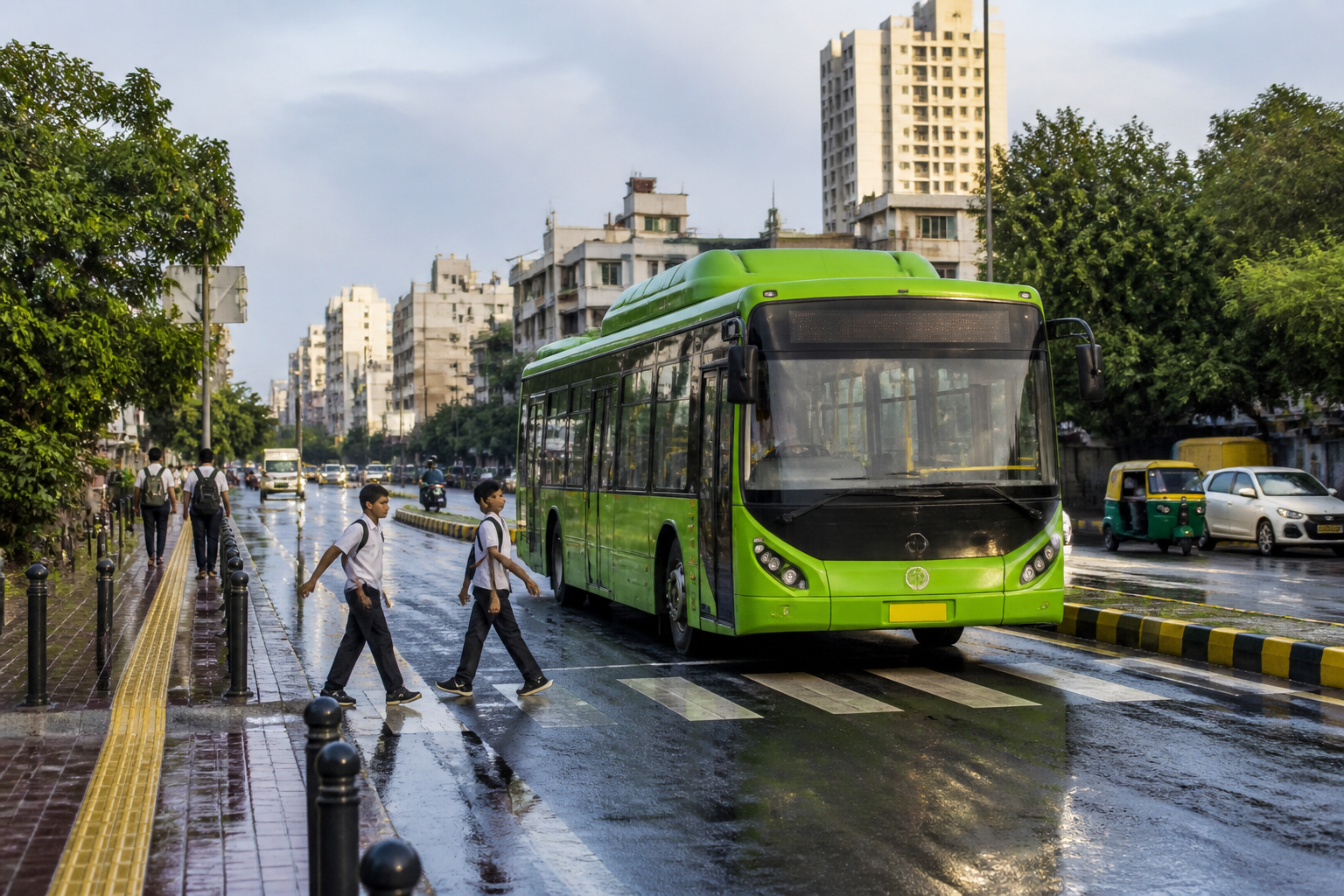
The strongest numerical evidence in the report concerns the energy performance of electric municipal fleets. A study by the International Council on Clean Transportation and Maulana Azad National Institute of Technology found that electric buses used 54 per cent less energy per kilometre, while electric waste-collection trucks used 91 per cent less energy than diesel vehicles. The study also found total cost of ownership to be favourable for electric vehicles in both cases. These figures are significant because they shift the electrification debate from private cars to public and municipal fleets, where vehicles follow regular routes and are operated by institutions capable of making coordinated procurement decisions.
At the same time, the figures should be read within their stated limits. The report does not specify the vehicle models, operating conditions, electricity source, purchase costs, maintenance assumptions or time period used in the study. It therefore cannot establish how the findings would apply to every city or fleet. It does provide a basis for examining electrification as an operational and financial question, rather than presenting it only as an environmental aspiration. The reported energy and total-cost findings support the case for closer evaluation of buses and waste vehicles in urban fleet planning.
The policy landscape described by the conference is consequently distributed across several levels. National and state institutions would be involved in regulation and inter-state coordination. The Commission for Air Quality Management has a regional role in air-quality management. Transport agencies and local authorities would need to identify dense corridors, manage public fleets and operate monitoring systems. Municipal and institutional bodies would be responsible for measures such as water treatment, rainwater harvesting and groundwater recharge within their jurisdictions or campuses. The conference did not announce a new single authority or implementation timetable, and the available report does not establish how responsibilities would be divided in practice.
That institutional gap is one of the most important issues raised indirectly by the event. Calling for integrated policy is easier than creating the mechanisms that make integration routine. A regional airshed approach requires authorities to share information and align action. Cleaner transport requires fleet operators, regulators and energy systems to move in the same direction. Safer school zones require road design, enforcement and pedestrian planning to be connected. Water security requires coordination between buildings, campuses, local systems and groundwater management. Each intervention may be technically familiar; the difficulty lies in making the institutions responsible for them act as one system.
The conference also framed 2047 as a planning horizon. That horizon is useful because urban infrastructure has long lifespans. Roads, bus fleets, drainage systems, public spaces and buildings can lock cities into patterns of energy use and movement for years. Decisions made during the next decade will influence whether cities expand around private-vehicle dependence, fragmented services and reactive pollution control, or whether they build systems that connect public transport, cleaner fleets, safe streets and resource management. The report does not provide projections for 2047, so the future outcome remains open rather than established.
What the evidence confirms is narrower but still substantial. Experts at Urban Adda 2026 identified fragmented governance as a common obstacle across air quality, mobility, road safety and water management. They pointed to regional action for pollution, cleaner and electrified fleets, safer school areas, human-centred streets and integrated water systems. The available energy figures provide an additional operational argument for assessing electric buses and waste-collection vehicles. What remains unclear is how these ideas will be converted into binding coordination, funding arrangements, measurable targets and accountable implementation. Those details will determine whether integrated planning becomes an urban operating model or remains a conference recommendation.
