


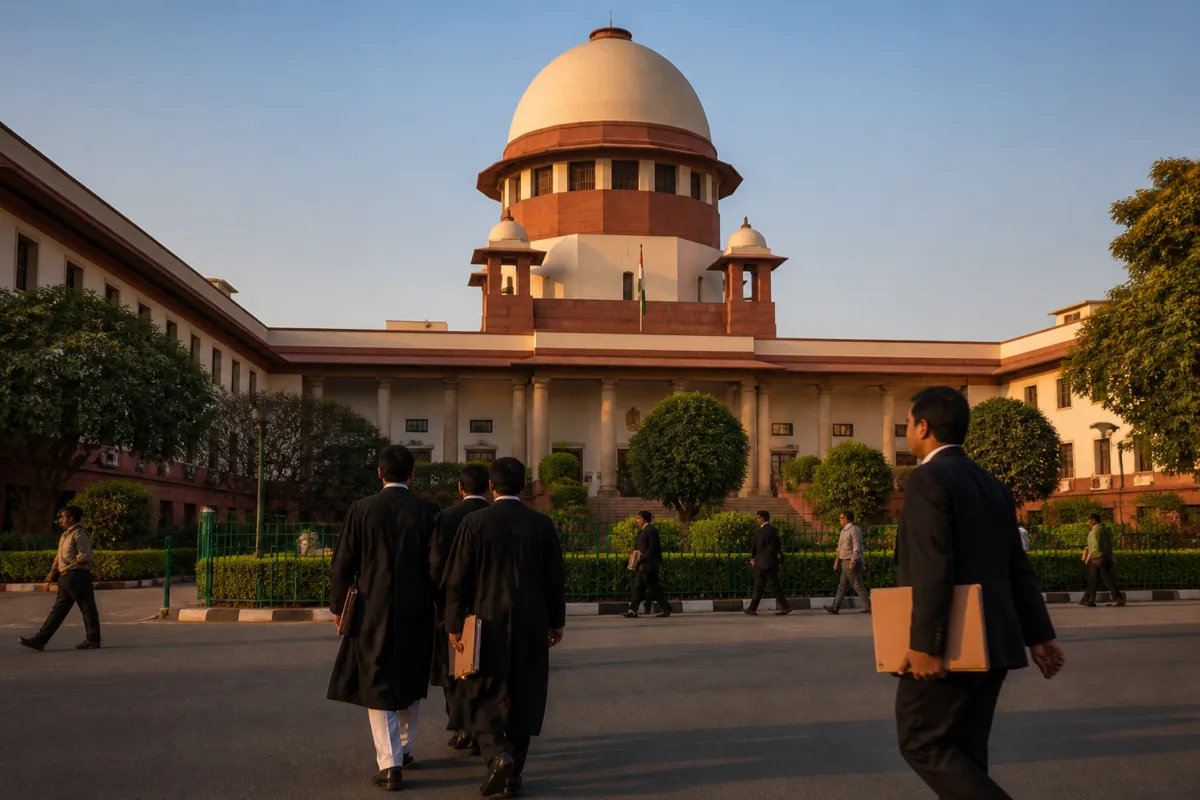
The Supreme Court on Monday questioned the authority and process used by the Bengal government to propose increasing the number of Kolkata Municipal Corporation wards from 144 to 209, placing the proposed civic elections under further legal scrutiny.
A bench comprising Chief Justice of India Surya Kant and Justices J.V. Mohana and Joymalya Bagchi examined the state’s position after Bengal challenged a Calcutta High Court division bench direction preventing the government from issuing a notification to conduct civic polls until a single bench decides a petition against the delimitation exercise.
Justice Bagchi questioned how the state could rely on a recommendation from a corporation whose elected body had ceased to exist. “If you are getting a recommendation from a corporation which does not exist, how will you exercise power?” he asked, according to the report.
The state’s Advocate-General, Tushar Mehta, told the bench that the delimitation exercise had been undertaken by the state government rather than independently by the civic body. He said the urban development and municipal affairs department had notified hearings on objections to the proposal and appointed 10 officers for the process.
Mehta argued that the commissioner was required to act under the state government’s directions while the corporation was dissolved. He referred to Section 17(1)(b), and said the commissioner had expressly recorded that the final recommendations and revised Schedule II were being submitted on the directions of the additional chief secretary.
According to the state’s submissions, government officers conducted the hearings, examined objections and submitted their findings before the government took the decision. Mehta also argued that the increase in the number of wards had not been challenged before the Calcutta High Court, while the demarcation process had been challenged.
Justice Bagchi said the state could amend the number of wards, but added that changing the total would necessarily require the boundaries of the existing wards to be redrawn. He observed that the last two lines of a July 3 communication appeared to reflect a “misconstruction” by the state in seeking a recommendation from an already dissolved corporation. The judge added that the statutory jurisdiction could nevertheless have continued.
The Kolkata Municipal Corporation board was dissolved after the resignation of mayor Firhad Hakim following the Trinamool Congress’s defeat in the Bengal Assembly polls. Smita Pandey, who is also the municipal commissioner, is serving as administrator; her term ends on December 7, according to the report.
The Bengal government has been pressing to hold elections to the Kolkata Municipal Corporation and Howrah Municipal Corporation by December. The report also said Suvendu Adhikari had announced that, if the civic polls could not be held on schedule, the government would appoint coordinators from the BJP to ensure uninterrupted civic amenities for Kolkata residents.
The Supreme Court’s questions place the legal authority behind the ward revision at the centre of the dispute. Until the court proceedings and the related petition are resolved, the proposed boundaries and the timetable for Kolkata’s civic elections remain unsettled.

