


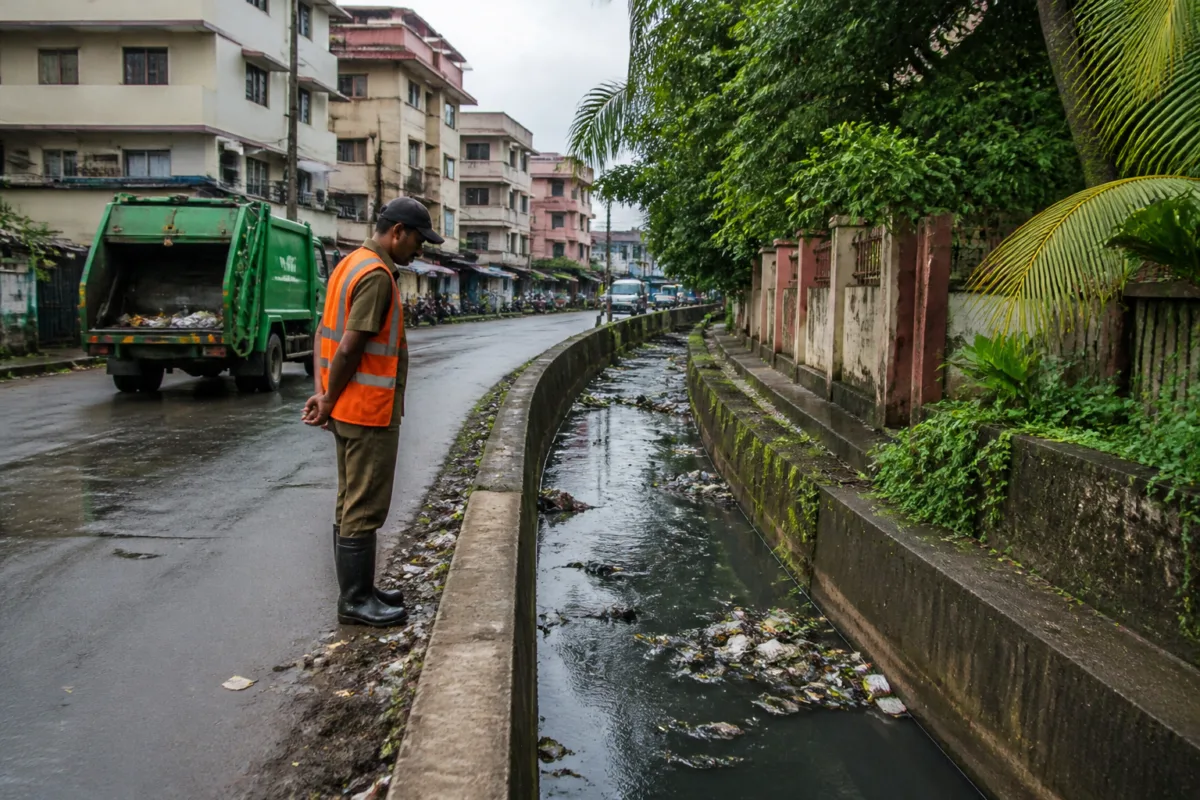
Mangaluru’s decline in national cleanliness rankings reflects a gap between household waste collection and the city’s wider sanitation infrastructure, according to a report by Prajavani. Open storm-water drains, exposed smaller drains, waste black spots and inadequate disposal practices continue to affect the city’s public cleanliness record.
Mangaluru was ranked the country’s third cleanest city among 476 cities in 2016, when sanitation performance from 2013 to 2015 was assessed. The evaluation considered 19 parameters, including solid waste management, sewage management, drinking water quality and the elimination of open defecation. The Mangaluru City Corporation scored 64.74 points, while identifying 339 households without individual toilets.
The city’s position fell to 63rd in 2017 and declined further to 253rd in 2023, the report said. Mysuru secured the top position in Karnataka in the latest assessment referred to by the report.
The ranking decline is significant because it points to weaknesses beyond door-to-door waste collection. Mangaluru is reported to have household-level waste collection and wet-dry segregation systems, supported by awareness programmes and community initiatives. The Ramakrishna Mission, for instance, organises clean-up drives in different parts of the city on the first Sunday of every month.
However, the report identifies open major drains, smaller drains and streams that overflow during the monsoon as persistent weaknesses. It also highlights problems with waste disposal and final processing, even though collection services are considered comparatively strong.
Ranjan Bellarpady, coordinator of Swachh Mangaluru Pratishthana, said the city had expanded without a corresponding increase in sanitation facilities. He said around 10 voluntary organisations and individuals were working on cleanliness, but that there had been no coordinated forum to bring them together with the municipal system.
Bellarpady also said some areas could not be reached by sanitation vehicles, contributing to open dumping. His assessment links the city’s growth and increasing commercial activity with mounting pressure on waste management and plastic-use control.
Nagaraj, head of the Green Brigade organisation, said sanitation facilities were still aligned with the population recorded in the 2011 Census, despite the city’s subsequent growth. He also called for changes in public behaviour and in the working practices of sanitation staff.
The report additionally carries allegations that polluted water and chemically contaminated industrial discharge are reaching the sea and affecting marine biodiversity. It does not provide independent test results or identify specific facilities in connection with those allegations. Similarly, an earlier allegation that sewage contamination had entered drinking water was described in the report as untrue after efforts by the municipal corporation to establish otherwise.
Mangaluru’s experience shows why cleanliness rankings can expose service gaps that are not immediately visible on major roads or in central commercial areas. Regular collection may improve the appearance of neighbourhoods, but open drains, weak final disposal systems and insufficient sanitation capacity can continue to undermine public health and environmental outcomes.
The report’s central challenge for the municipal corporation is therefore not only to improve collection, but also to expand capacity in line with population growth, strengthen drain and sewage management, improve final waste handling and coordinate civic groups working on cleanliness. Without those broader improvements, isolated clean-up campaigns may have limited impact on the city’s overall sanitation performance.

