


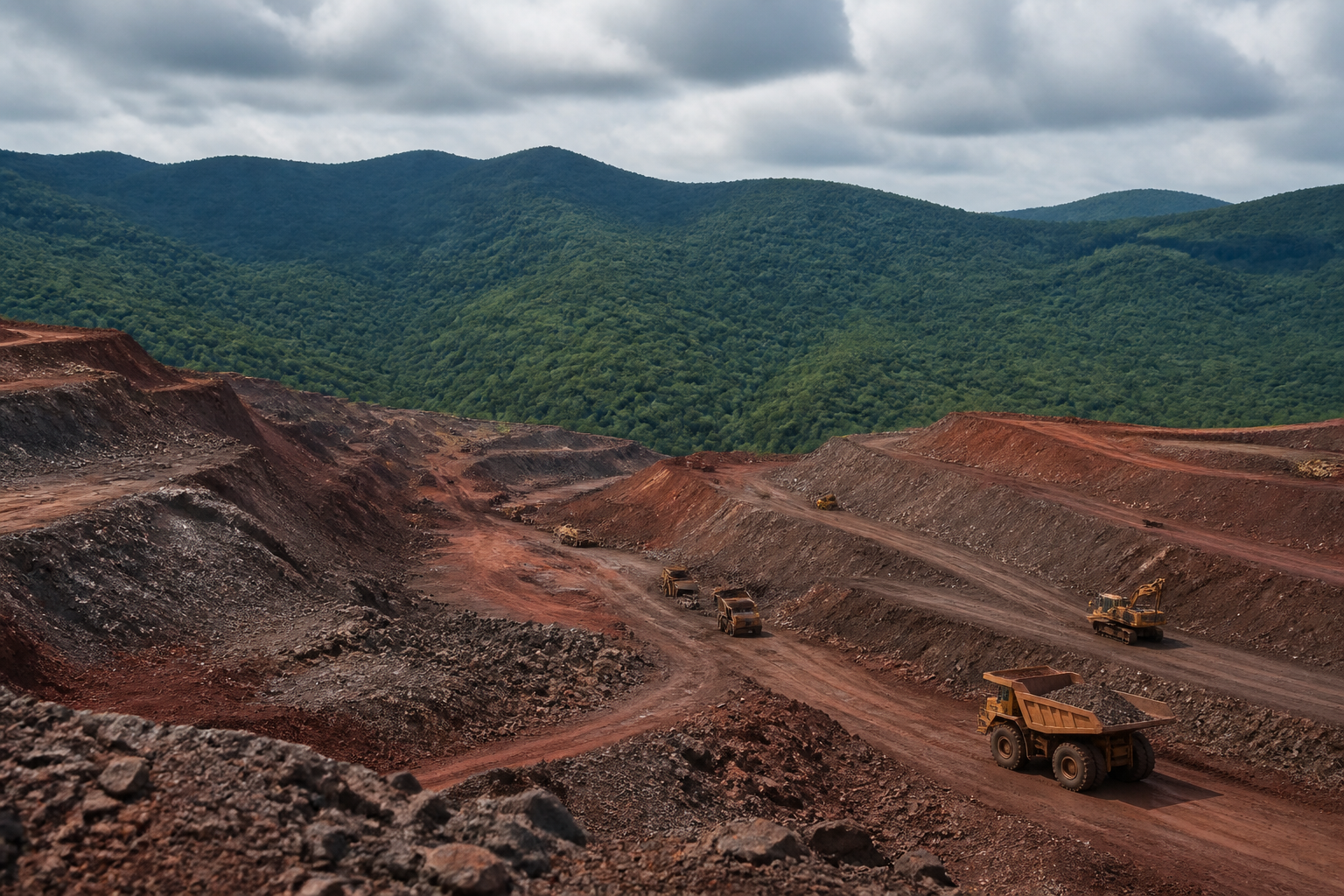
The Supreme Court has allowed Karnataka to combine mining leases from different categories, along with virgin forest land where mining has not previously taken place, into single blocks for auction, while making clear that the merger does not itself authorise mining in forest areas.
A bench comprising Chief Justice of India Suryakant and Justices Joymalya Bagchi and V. Mohana described the consolidation as a measure for “rationalisation of operations”. It said such a merger would be permitted only if it did not compromise the environmental and other safeguards imposed by the court while regulating mining in the state.
The order marks a significant change in the court-supervised system governing iron ore mining in Karnataka for the past decade. The case involved several mining companies and was heard after submissions by senior advocate Shyam Divan, who is serving as amicus curiae.
The court specifically clarified that including virgin forest land in a merged auction block should not be treated as permission to begin mining there. Any mining activity in such forest areas will require prior approval under the Forest (Conservation) Act, 1980. The creation of a composite lease will also not automatically authorise mining in areas where statutory approvals remain pending.
The successful bidder will have to provide a written undertaking that no mining will be carried out in virgin forest areas until all necessary approvals have been obtained. The court also said that existing permissions relating to parts of a block that have already been used or excavated may be transferred to a new leaseholder under Section 8B of the Mines and Minerals (Development and Regulation) Act, 1957.
The ruling came despite opposition from senior advocate Prashant Bhushan, who represented the organisation Samaj Parivartan Samudaya. He argued that combining mining leases with virgin forests could cause serious environmental harm and enable large-scale mining in ecologically sensitive areas.
The court’s order follows the classification of Karnataka’s mining leases in 2013 on the basis of illegal mining and encroachment identified by the Central Empowered Committee and a joint investigation team. Category A mines were found to have no illegalities. Category B mines had operated outside their approved areas by up to 15 per cent, while Category C mines were found to have committed more serious violations, including mining beyond those limits or clear breaches of forest laws.
Those leases were cancelled at the time. Mining in Category A and Category B areas was later allowed to resume under stringent conditions. The latest order permits the operational consolidation of different lease categories, but retains the requirement that environmental safeguards, forest approvals and other statutory permissions must be secured before mining begins in restricted areas.
The next stage will depend on how auction blocks are structured and whether prospective bidders provide the undertakings and obtain the approvals required under the court’s directions and applicable laws.

