


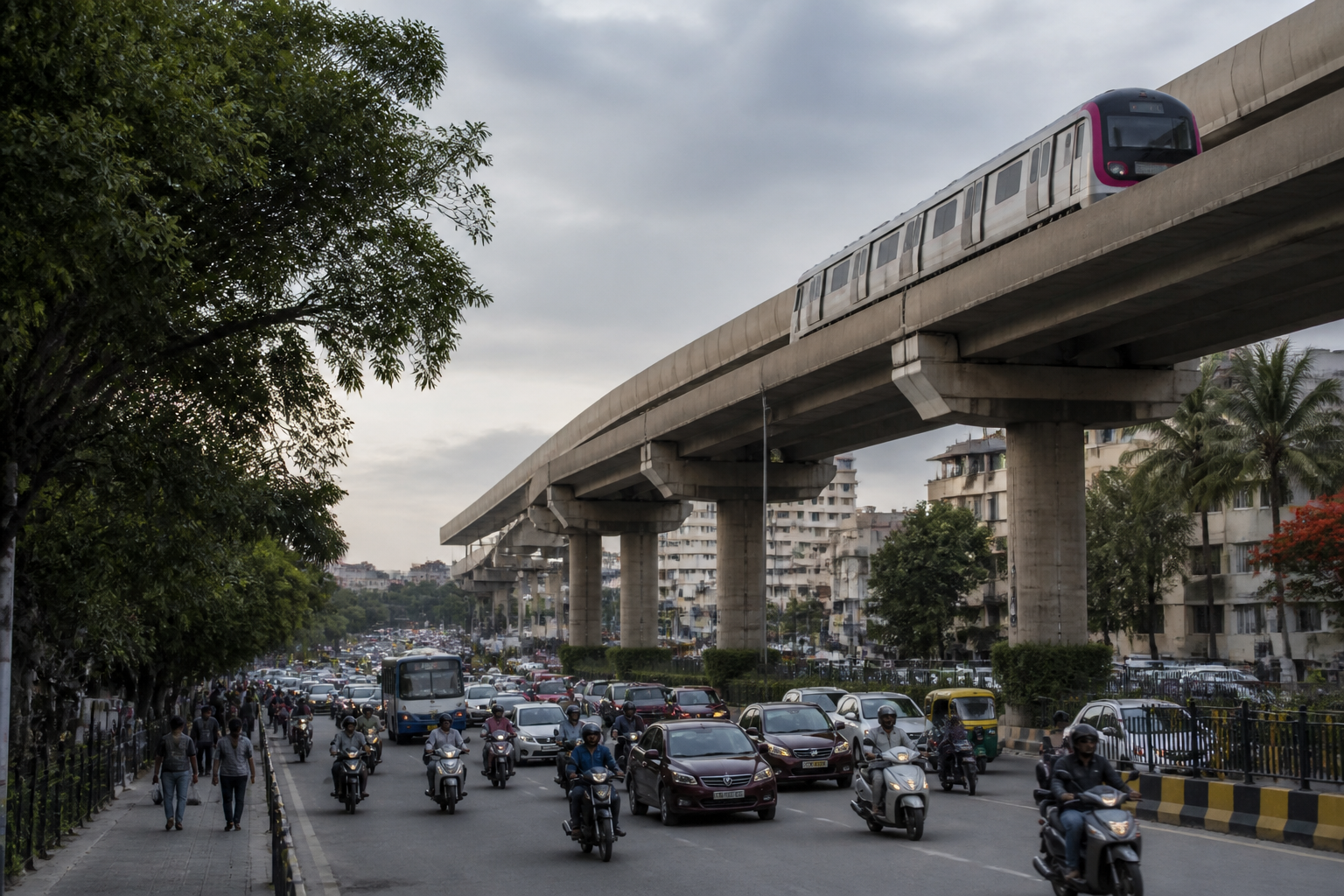
Bengaluru’s proposed Metro double-decker project is facing a delay in approval from the Union Ministry of Housing and Urban Affairs, raising the possibility that the project’s design and existing tender process will have to be changed, according to a report by Vijay Karnataka.
The double-decker structure is part of Bengaluru Metro Phase 3, which covers two corridors: a 32-km route from JP Nagar 4th Phase to Kempapura and a 12-km route from Kadabagere to Hosahalli. Together, the planned network is about 44.65 km long. The Karnataka government approved the Phase 3 proposal in 2022 and sent it to the Centre. The project, estimated at Rs 15,611 crore, received central approval in 2024, according to the report.
Prime Minister Narendra Modi later laid the foundation stone for the project. The state government subsequently submitted a revised proposal for about 37 km of double-decker construction along the two corridors and offered to fund its estimated Rs 9,700 crore cost from its own resources. Approval for this revised double-decker component has not yet been received from the Union housing and urban affairs ministry.
The proposed structure would combine an elevated Metro line with a road corridor along existing alignments. The state government has argued that this approach could improve traffic movement without requiring additional land acquisition. Chief Minister D.K. Shivakumar said the double-decker format was necessary to address Bengaluru’s traffic congestion and expressed disappointment over the lack of central approval during an interaction with editors, the report said.
The Centre’s concerns, as reported, relate to the project’s financial and transport assumptions. One concern is that the parallel road infrastructure could encourage greater use of private vehicles and reduce Metro ridership, affecting the system’s revenue. The proposed double-decker design is also understood to reduce the project’s economic internal rate of return below the minimum benchmark of 14 per cent required for approval.
A change in the project format could significantly reduce the length of the double-decker sections. The approved plan includes around 3 km of double-decker flyovers at two major junctions—1.4 km at the Outer Ring Road-Kanakapura Road junction and 1.6 km at the Kamakya junction. An additional proposal covers about 8 km in high-traffic locations, including Goraguntepalya. The report indicates that the overall double-decker component could be shortened by about 11 km if the Centre approves a modified design.
Bangalore Metro Rail Corporation Limited invited tenders in January for three packages covering the proposed 37-km double-decker structure. Those tenders have not been opened because central approval is still pending. A BMRCL official told Vijay Karnataka that if the design changes, the current tenders could be cancelled and fresh tenders invited.
The delay also affects Bengaluru’s broader Metro expansion pipeline. The report states that the airport Metro corridor from KR Puram to the airport, for which work was launched in 2022, was the last project implemented through BMRCL. It adds that Phase 3 and the proposed Phase 3A corridor between Hebbal and Sarjapur have not received approval, while the revised detailed project report for Phase 3A remains with the Centre. The next step for the double-decker project depends on the Union ministry’s decision on the revised proposal and its impact on the tender process.

