


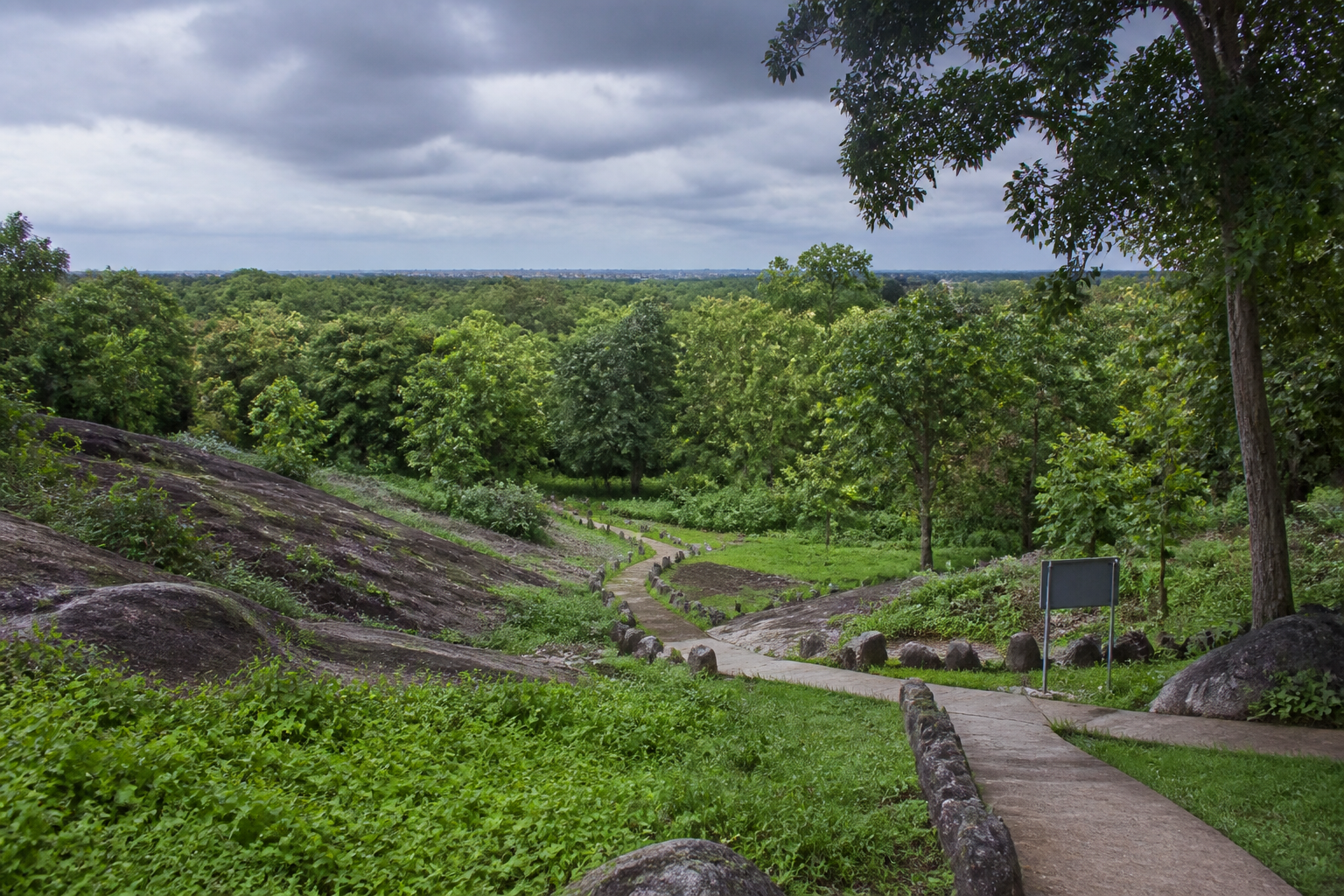
The Karnataka tourism department’s decision to fast-track court-permitted works at the Roerich–Devika Rani Estate in south Bengaluru has brought an unresolved urban question into sharper focus: how can a city open ecologically sensitive land to visitors without treating conservation as a secondary condition? The estate, off Kanakapura Road, is part of a deemed forest and lies next to an elephant corridor. Its development is therefore not simply a tourism project. It is also a test of how government departments interpret forest protection rules, court permissions and the meaning of “sensitive” visitor infrastructure.
The immediate development is a site inspection by tourism minister KJ George, accompanied by officials from the tourism and forest departments and Jungle Lodges and Resorts. During the review, the minister directed officials to complete works permitted by the high court within the stipulated timeline while preserving the property’s ecological, cultural and artistic character. He also called for visitor amenities to be created without compromising the natural landscape.
That instruction captures the project’s central tension. The estate is being presented as an eco-tourism destination, but the physical interventions required to make any site accessible to visitors can alter the conditions that make the site valuable in the first place. Roads, buildings, utilities, visitor facilities and movement within the property can all affect a landscape, even when the stated purpose is conservation. The supplied report does not specify the scale, design or construction status of the permitted works. That absence is important because the environmental effect of a tourism project depends not only on its label, but also on its footprint, access arrangements and operating intensity.
The Roerich–Devika Rani Estate is distinctive because several forms of public interest overlap on the same property. It has cultural and artistic significance associated with the Roerich family and Devika Rani. It is also described as a scenic landscape, part of a deemed forest and adjacent to an elephant corridor. The tourism department’s stated objective is consequently required to serve more than visitor convenience. It must accommodate heritage value, ecological protection and public access within one administrative framework.
The legal issue centres on the Forest (Conservation) Act, 1980. Conservationists pursuing the matter before the high court have argued that the government violated the Act by undertaking work without obtaining prior permission or clearance. Their argument, as reported, rests on the estate’s status as a deemed forest. They contend that the department should have secured the relevant approval before carrying out work on the property.
Forest officials have offered a different interpretation. According to an official who participated in the inspection, clearance is mandatory for non-forestry activities, but the eco-tourism project constitutes forestry activity. The official said the landscape is a deemed forest but ownership rests with the estate’s government owners, and that the tourism department is free to undertake forestry-related work on the property. Clearance would be required, the official said, if development works were taken up outside the estate premises. On the basis of that interpretation, the official said the department had not violated any norms.
This disagreement is not a technical footnote. It determines which authority must approve the work, what kind of work can proceed and how the project’s environmental safeguards are defined. It also shows why ownership and land classification do not automatically answer the question of permissible development. The property may be government-owned, but its classification as a deemed forest creates a separate regulatory issue. The administrative question is not only who controls the land; it is also what activity is being carried out and under which legal category.
The distinction between forestry-related activity and development work is therefore central to the project’s future. The supplied report does not list the works already completed or those permitted by the court. It also does not state the terms of the high court’s permission, the boundaries of the approved area or the conditions attached to the works. Without those details, it is not possible to independently assess whether each intervention falls within the category described by forest officials. What is clear is that the department is proceeding on the basis that the works already permitted can be completed, while subsequent works will require consultation with the departments concerned.
Tourism secretary Ram Prasath Manohar described the department’s approach as a “balanced model” in which conservation remains central and essential visitor facilities are developed sensitively. He said subsequent works, other than those approved by the court, would be taken up in consultation with the relevant departments. That statement establishes an intended sequence: court-permitted works are being advanced, while later interventions are to be subjected to interdepartmental consultation.
The institutional arrangement matters because the project involves at least three distinct responsibilities. The tourism department is driving the visitor-oriented initiative. The forest department is responsible for interpreting the implications of the deemed-forest status and the applicable conservation rules. Jungle Lodges and Resorts is involved in the site review, indicating a role for the state tourism enterprise in implementing or operating the project. The court provides the legal context within which the permitted works are proceeding. The report does not clarify the precise division of execution, monitoring and accountability among these institutions.
That division will influence how the project is judged in practice. A department can describe a project as conservation-led, but the claim becomes meaningful only when the responsible agencies can show what is being protected, which works are allowed, how impacts are monitored and who can halt or modify an intervention. The report records the minister’s direction to preserve the landscape and the secretary’s commitment to consultation, but it does not provide a monitoring plan, ecological assessment or public reporting mechanism.
The site’s location beside an elephant corridor adds another layer of sensitivity. An elephant corridor is not merely an undeveloped patch of land; it is part of the movement landscape used by elephants. The report does not provide details on the corridor’s boundaries, animal movement patterns or the likely interaction between visitors and wildlife. It therefore does not establish the ecological impact of the current works. It does, however, explain why conservationists have continued to raise concerns and why visitor infrastructure cannot be assessed only through the lens of tourism demand.
For Bengaluru, the issue is part of a broader pattern in which urban expansion brings public institutions, recreational projects and infrastructure closer to forests and wildlife movement areas. The Roerich Estate is located in south Bengaluru, an area where the city’s built environment meets larger landscape systems. The report does not claim that the project is responsible for urban expansion or that the works have harmed wildlife. The more precise point is that a tourism decision on the city’s edge has consequences beyond the property boundary, particularly when the site is connected to a forest classification and an elephant corridor.
The project also raises a question about the meaning of eco-tourism in public administration. If eco-tourism means making a natural or heritage landscape accessible, it requires visitor facilities. If conservation remains central, those facilities must be limited by the ecological characteristics of the site. The department’s own language recognises this tension by referring to essential amenities and sensitive development. But the available information does not establish how those principles have been converted into design standards, visitor limits, construction controls or operational rules.
The court’s role is equally significant. The tourism department is not presenting the works as an entirely discretionary project; it is describing them as permitted by the high court and is seeking to complete them within the stipulated timeline. At the same time, conservationists continue to challenge the legal basis of the work. The result is a project moving forward within a contested regulatory context. The report does not state whether the court has issued a final ruling on all disputed questions, nor does it reproduce the order that permits the works. Those details would be necessary to understand the exact legal boundaries of the department’s action.
The available evidence confirms three facts. First, the tourism department is accelerating works that it says have been permitted by the high court. Second, the site has ecological and heritage attributes that make ordinary tourism development unsuitable as a planning model. Third, government officials and conservationists disagree over whether forest clearance requirements apply to the activities being undertaken. The evidence does not confirm the scale of the works, their environmental impact or whether the legal dispute has been conclusively resolved.
The next stage will therefore be defined by implementation rather than announcements. Officials must complete the works that have been permitted, consult other departments before taking up subsequent interventions and maintain the ecological, cultural and artistic character identified by the tourism minister. For the public, the key developments to monitor are the details of the court-approved works, the conditions under which they proceed and the evidence used by authorities to demonstrate that visitor access is not coming at the cost of the landscape the project claims to conserve.
