


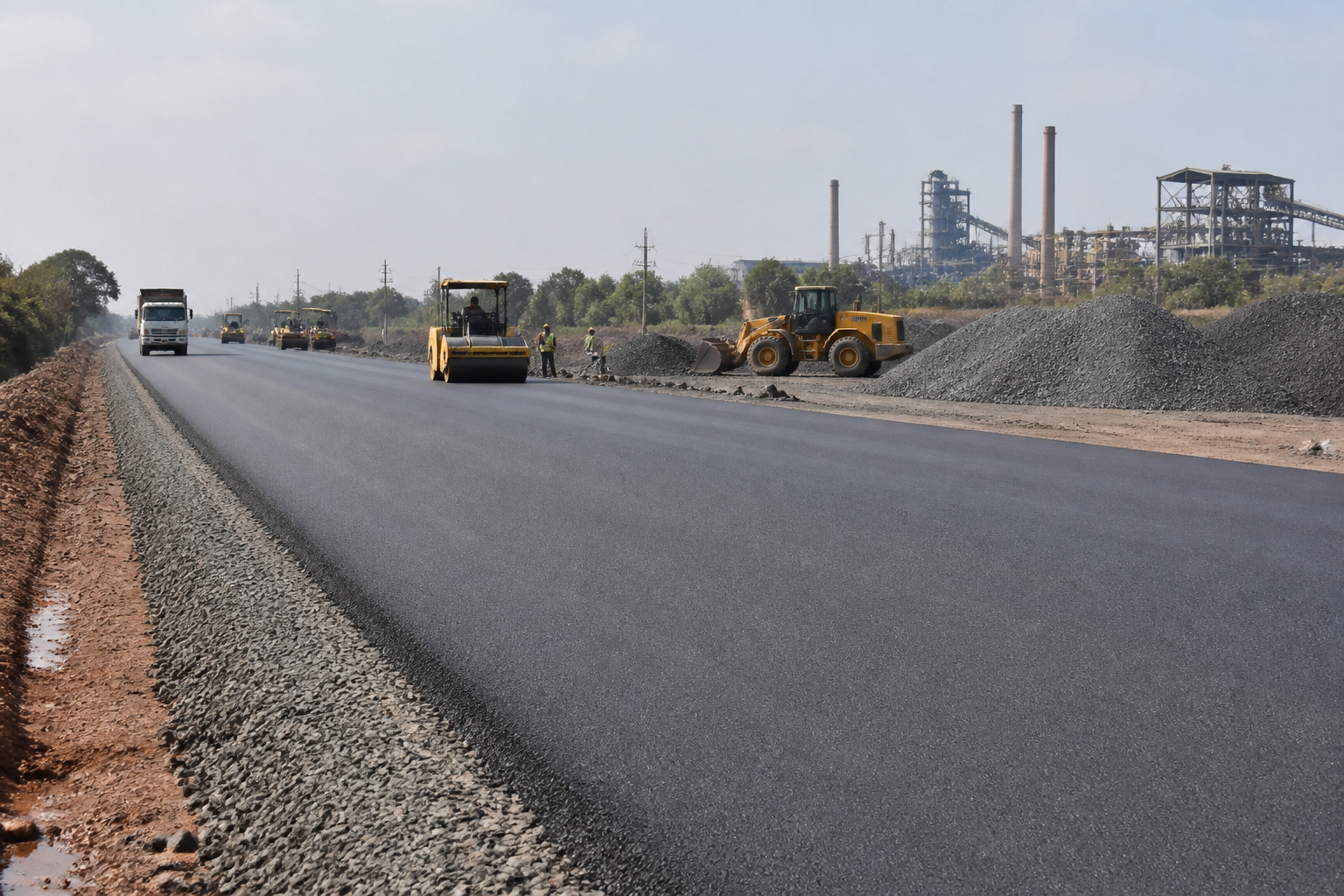
Jindal Steel has received Guinness World Records recognition for constructing a 1.85-km, four-lane road at Raigarh in Chhattisgarh using processed steel slag aggregates, in a project that replaces natural road-building material with an industrial by-product.
The road was built by Jindal Steel Limited in collaboration with the CSIR-Central Road Research Institute (CSIR-CRRI), according to a company statement. Around 2 lakh tonnes of processed steel slag was used for the project. The recognition is for the longest road built exclusively with processed steel slag aggregates, the company said.
Steel slag is a waste by-product generated during the steel manufacturing process. Its use in the Raigarh road is intended to reduce dependence on natural aggregates, which are traditionally sourced through quarrying. The project places industrial waste management within the infrastructure system, linking steel production with road construction and material procurement.
Naveen Jindal, Chairman of Jindal Steel Limited and President of the Indian Steel Association, said the achievement showed how science, technology and industry could convert industrial co-products into resources for nation-building. He said India’s growth needed to be supported by innovation that created economic value while protecting the environment, identifying waste-to-wealth as a focus area for the circular economy.
Jitendra Singh, Minister of Science and Technology, said the road demonstrated India’s ability to translate scientific innovation into practical infrastructure solutions. By converting steel slag into a resource for road construction, the project showed the potential of indigenous technology to address real-world challenges, he said.
The company said scientifically processed steel slag offers performance and cost advantages over traditional construction materials. Steel slag roads are estimated to be 30 to 40 per cent more cost-effective and can last up to three times longer than standard bitumen roads, reducing repair and maintenance requirements. Their strength also makes them suitable for different climatic conditions, ranging from coastal regions to rugged terrain.
The scale of the material challenge is expected to increase as India expands steel production. Steel slag generation is projected to reach 60 million tonnes in the next few years, alongside ongoing capacity expansion aimed at producing 300 million tonnes of steel by 2030-31.
The Union steel ministry is promoting steel slag road technology and collaborating with the Ministry of Science and Technology and the Ministry of Road Transport and Highways to support wider use of the industrial by-product. The Raigarh project is therefore also part of a broader effort to establish processed slag as a usable input for public infrastructure rather than treating it solely as industrial waste.
