


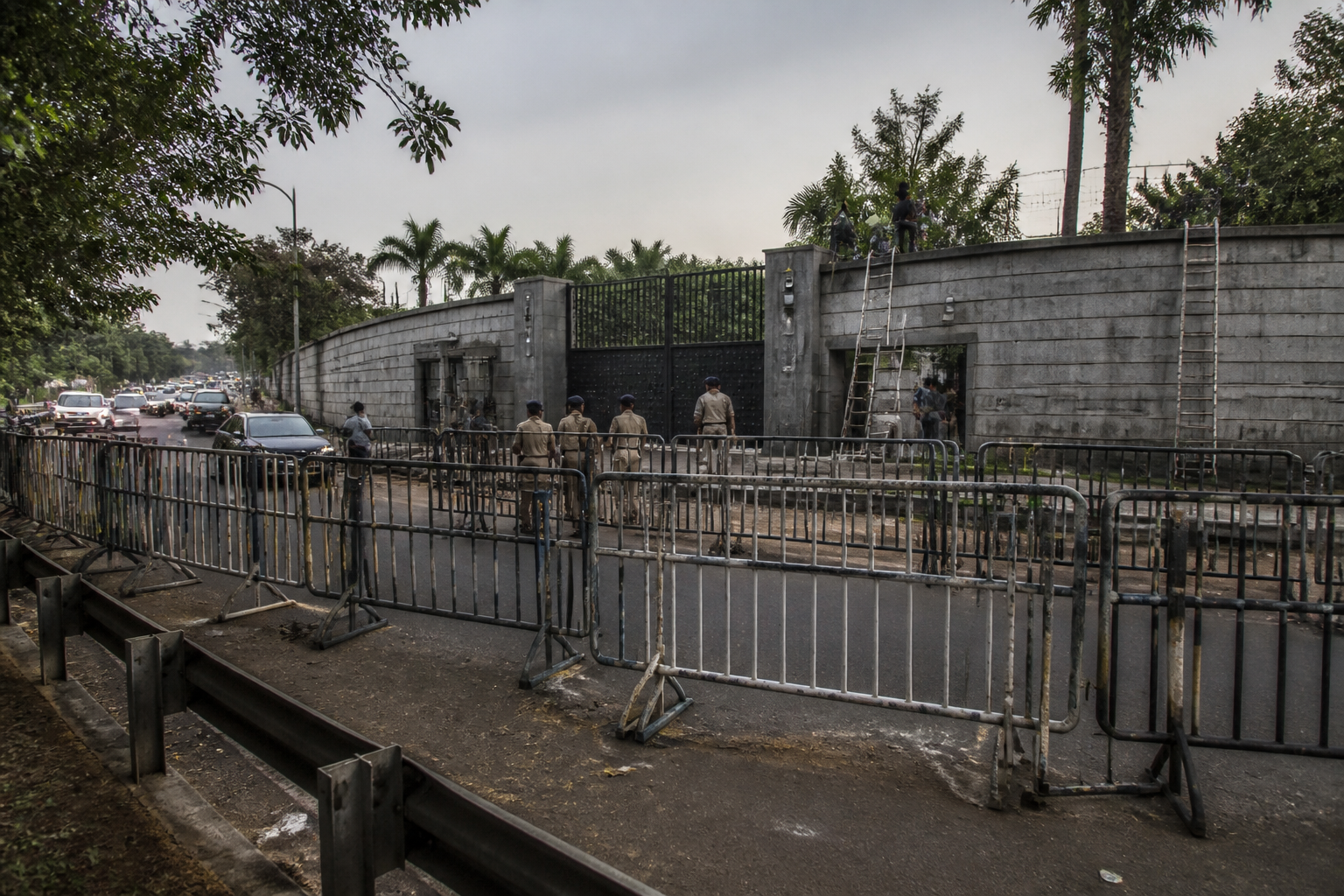
The Satyajit Ray Film and Television Institute in Kolkata has been surrounded by barricades, police personnel and new physical security measures after students were allegedly attacked twice in eight days. The immediate response has secured the perimeter, but it has also exposed a deeper institutional problem: how a public creative campus is governed when political mobilisation, venue use and student safety collide.
The institute’s transformation is visible at its gates and along the roads approaching them. Guardrails and barricades have been placed on the service roads on either side of the campus, as well as along the slip road from the EM Bypass towards the main gate. Police personnel have been stationed at several points outside the campus for what officials describe as “access control”. Work is also under way to raise the height of the main gate, install barbed wire along the boundary walls and fit an iron grille on one side of the gate to prevent people from climbing over it.
These measures followed a request from SRFTI vice-chancellor Santosh Ajmera, according to an institute official cited in the report. They came after two separate incidents involving student protests and alleged attacks. On September 27, students allegedly faced violence from members of the Akhil Bharatiya Grahak Panchayat, an organisation linked in the report to the RSS, after students objected to the use of SRFTI’s main auditorium for a programme. The students’ stated objection was that the organisation had no connection with films.
On October 4, members of the Hindu Jagran Manch allegedly tried to storm the campus gates. The organisation said students had disrespected images of Swami Vivekananda and Bharat Mata while disrupting the September 27 event. The report says the police had not made any arrests in connection with the alleged attacks at the time of publication.
The sequence raises a question that cannot be answered by perimeter security alone: who is responsible for deciding how a publicly funded educational institution’s spaces are used, and what safeguards are expected when that decision creates a dispute? The auditorium booking was the immediate trigger for the first confrontation, while the subsequent fortification became the visible response. The underlying administrative decision, however, remains central to understanding why the campus reached this point.
The issue is not simply that barricades have appeared around a film school. Educational campuses are also public institutions with defined purposes, access rules and internal communities. When a venue meant to support institutional activity is handed over for an external programme, the administration must manage competing claims over access, usage and safety. In this case, the report records criticism from students and faculty that the auditorium should serve SRFTI students and enable them to work independently.
The administration’s response has therefore shifted the focus from the original decision to the control of movement around the campus. Police deployment and new barriers may reduce the possibility of people entering or crossing the boundary, but they also alter the relationship between the institution and its surrounding neighbourhood. The campus is located off the EM Bypass at Ajay Nagar, where service roads and a connecting slip road have become part of the security arrangement. What was previously an ordinary approach to an educational institution is now being treated as a controlled perimeter.
That change has a direct effect on how students experience the campus. One student told the newspaper that the institute had changed within days and said the campus now resembled a fortress, with students appearing to be its inmates. The student argued that a film school should be an open space where people could engage freely without fear. This is not only a comment on aesthetics or atmosphere. It describes the loss of an institutional function: a creative school depends on interaction, discussion and access to shared spaces, even when those spaces must be regulated.
The distinction between security and securitisation is important here. Security measures respond to a defined risk. Securitisation changes the everyday character of a place by treating access, movement and gathering as continuing risks. At SRFTI, the reported measures include temporary barriers, police surveillance and permanent-looking physical changes such as higher gates, barbed wire and grilles. The available account does not establish how long these measures will remain, what criteria will govern their removal or whether the institute has adopted a broader safety protocol for students and staff.
The report also points to a failure of preventive protection. Manas Ghosh, a professor of film studies at Jadavpur University who visited SRFTI, said students had written to the administration on a Saturday seeking protection from a possible attack by the Hindu Jagran Manch. According to Ghosh, no effective action was taken before the subsequent fortification. His account is a criticism of the timing and nature of the institutional response: protection was not adequately provided when students raised a concern, but the campus was heavily secured after violence and threats had already reshaped the situation.
That sequence matters for governance. A campus security system is not limited to guards, cameras or barriers. It also includes the process for assessing threats, responding to written complaints, regulating external bookings and coordinating with the police. The source material does not provide SRFTI’s booking policy, its internal inquiry findings or the police’s account of the incidents. It therefore cannot establish whether the administration breached a specific rule. It does, however, document a clear gap between the students’ reported warnings and the later deployment of visible security.
The controversy also reveals how infrastructure decisions can become political decisions. An auditorium is physical infrastructure, but granting access to it determines who can use institutional space and for what purpose. Once students objected and outside groups allegedly mobilised around the event, the auditorium ceased to be merely a venue. It became the centre of a dispute over institutional identity, cultural authority and the limits of external participation in a national film school.
The comments cited in the report show that the dispute extends beyond the campus. Filmmaker Anand Patwardhan criticised what he described as a broader cultural takeover in Bengal. AISA national president Neha Bora questioned why SRFTI’s main theatre had been handed to an RSS-linked organisation rather than being reserved for students. These are political and cultural interpretations, not independently established findings in the supplied material. Their significance lies in showing how the auditorium decision has been understood by public figures and student organisations beyond the institute itself.
At the same time, the allegations require careful handling. The report attributes the alleged attacks to members of ABGP and Hindu Jagran Manch, records the latter organisation’s explanation for its protest and notes that no arrests had been made when the report was published. The supplied material does not include a police statement, formal complaint, arrest record or court finding. The incidents should therefore remain described as alleged attacks or alleged attempts to storm the campus rather than established criminal findings.
The immediate institutional response has been physical rather than procedural. The campus has gained barriers, surveillance and controlled access, while the public account remains limited on questions such as whether the auditorium booking was reviewed, whether students’ complaints were formally investigated and what accountability measures followed. This imbalance is significant. Physical fortification can protect a boundary, but it cannot by itself resolve the administrative dispute that made the boundary vulnerable.
For Kolkata’s urban governance, the episode is a reminder that public institutions are embedded in surrounding streets and networks. The service roads, the EM Bypass and the slip road near the main gate have become part of the response because a campus security problem affects movement beyond the campus wall. Police deployment at access points can also change how local roads function, even when the intervention is concentrated around one institution. The report does not quantify traffic disruption or public inconvenience, but it establishes that the security response has extended beyond SRFTI’s buildings into its approaches.
The larger question is whether educational campuses should be managed primarily through exclusion after a crisis or through transparent rules before one occurs. SRFTI’s case, as documented, contains both a venue-use dispute and a reported failure to act on a warning. It also shows the consequences of a response that makes the institution look less like an open school and more like a protected compound.
What is established is that SRFTI has intensified security after two alleged incidents, that police are stationed around its access points, that physical fortification is under way and that students and faculty have criticised the administration’s handling of the crisis. What remains unclear from the available account is the outcome of any police investigation, the institute’s formal explanation for the auditorium booking and the timeline for removing or retaining the new security infrastructure. Those steps will determine whether the fortification is a temporary safety measure or the lasting redesign of a public creative campus.
