


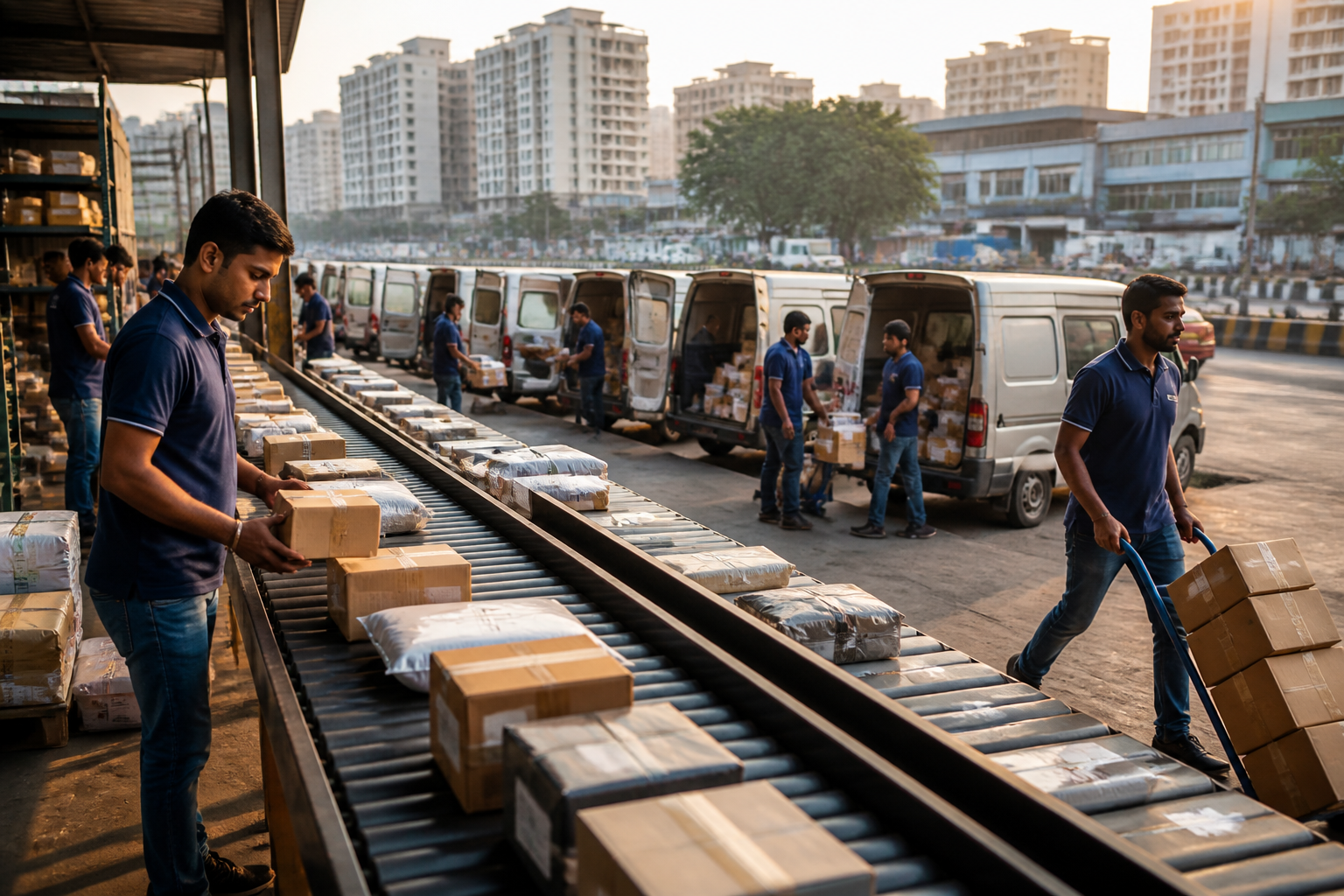
India’s ecommerce map is expanding beyond its largest cities, but the economic weight of that expansion remains concentrated in a smaller group of major urban markets. Data compiled by ecommerce software company Easy Ecom shows that cities outside India’s 96 largest markets generated 57.2% of more than 200 million orders processed in the 12 months to July 2026, yet accounted for only 39.3% of total transaction value. Their average order value was Rs 830, compared with Rs 1,714 in the largest cities.
That gap is the central fact in the latest picture of India’s digital consumption geography. Smaller cities are producing more transactions, but the higher-value commerce that matters to brands, distributors and inventory planners remains concentrated in large urban centres. The pattern suggests that the spread of ecommerce is not the same as a uniform expansion of purchasing power across the urban system.
The data was compiled from transactions processed through marketplaces, brand websites, quick-commerce platforms, distributors and other channels connected to Easy Ecom’s system. The company’s customers include Borosil, Cred, Minimalist and Pilgrim. Because the dataset covers transactions processed through the company’s connected channels rather than the entire ecommerce market, it should be read as an indicator of market structure, not as a complete national census of online shopping.
Even with that limitation, the difference between order share and value share is substantial. Markets beyond the top 96 cities accounted for more than half of the orders but less than two-fifths of transaction value. Their average order value was less than half that of the largest cities. The evidence therefore points to a volume-led expansion outside the biggest urban markets, rather than a convergence in the value of individual purchases.
This distinction matters because ecommerce networks are organised around more than consumer access. Brands must decide where products should be stored, how much inventory should be positioned closer to customers, which delivery routes can support demand and how distribution costs relate to the value of each order. The Easy Ecom data indicates that these decisions cannot be based on order counts alone. A city or state may generate a large number of transactions while contributing comparatively little to total sales value.
The state-level rankings show how sharply the picture can change when transaction value replaces order volume as the measure of market strength. Of the 15 largest states in the dataset, 13 changed position when ranked by value rather than orders. Haryana moved from 11th by order volume to third by transaction value, supported by higher-value transactions in Gurugram and Sonipat. Bihar moved in the opposite direction, falling from 10th by volume to 15th by value.
The difference in average order value between the two states was also wide. Haryana recorded an average order value of Rs 3,804, more than six times Bihar’s Rs 609. The figures do not, on their own, establish why consumers in the two states purchase at different values. They do, however, show that a ranking based only on the number of orders can obscure the economic differences between markets that appear similar in volume.
The city-level data reinforces the same point. Bengaluru was the largest market by order count, with around 11 million orders, 84% more than Mumbai. Gurugram ranked only seventh by volume but second by value, with Rs 1,848 crore in transactions. Its average order value was Rs 6,693, more than four times Delhi’s Rs 1,499.
These comparisons reveal why the geography of ecommerce cannot be understood through a single league table. Bengaluru’s leading position by order count indicates the scale of activity in one of India’s largest digital and employment centres. Gurugram’s position by value indicates a different market characteristic: fewer orders than the leading volume markets, but significantly higher-value transactions. The two measures identify different kinds of urban importance.
The distinction has direct implications for the way businesses interpret smaller-city growth. A rise in orders beyond the largest cities can signal broader participation in digital commerce, but it does not necessarily mean that these markets have reached the same level of purchasing value as major metropolitan areas. For companies, this may create a more complex distribution problem: high-volume, lower-value orders may require broad reach, while high-value markets may justify different inventory and fulfilment priorities.
Easy Ecom’s own transaction growth adds another layer to the picture. The company processed 112.3 million orders between February and July 2026, up 19.3% from 94.1 million in the preceding six months. That increase indicates rapid expansion in the transactions moving through its connected commerce systems. It does not show that all parts of the country are growing at the same rate or generating the same value, but it places the city and state differences within a wider period of ecommerce growth.
The institutional significance lies in the infrastructure required to translate digital demand into completed deliveries. The source data covers marketplaces, brand websites, quick-commerce platforms, distributors and other connected channels, bringing together several forms of commerce that rely on different fulfilment arrangements. The data does not provide a breakdown of delivery costs, warehouse locations, service levels or returns. It therefore cannot establish which operational model is most efficient in smaller cities. It does show, however, that the market is sufficiently dispersed for businesses to track geography and value separately.
For urban economies, this creates a tension between reach and purchasing power. Digital platforms can connect consumers in smaller cities to brands and marketplaces without requiring the same concentration of physical retail as in large cities. But the lower average order value recorded outside the top 96 cities indicates that access to ecommerce is not equivalent to parity with the largest markets. The transaction may be easier to initiate, while the value of the basket remains lower.
The state-level movement also cautions against treating population size or order volume as a complete proxy for commercial strength. Haryana’s rise from 11th by orders to third by value was linked in the report to higher-value transactions in Gurugram and Sonipat. Bihar’s fall from 10th by volume to 15th by value shows how a state can appear stronger when measured by activity than when measured by the economic value of that activity.
The available evidence does not explain whether the gap is driven by differences in income, product mix, brand presence, delivery availability, purchasing frequency or other factors. It also does not establish whether the gap between smaller and larger cities is widening or narrowing over time. Those questions require longer-term, comparable data across cities, categories and channels. The current figures establish the distribution of orders and value in the dataset, but not the causes behind it.
The broader urban question is whether India’s digital economy is integrating its cities economically or merely extending transaction networks across them. The evidence points to both expansion and unevenness: ecommerce orders are spreading beyond the biggest markets, while the value of those orders remains disproportionately concentrated in large cities and selected high-value urban clusters.
For businesses, the immediate lesson is that order volume and transaction value describe different markets. For cities, the figures show how digital commerce is becoming part of the urban economic system without erasing differences between metropolitan centres, fast-growing satellite cities and smaller markets. The next development to watch is whether continued growth outside the top 96 cities begins to lift average order values, or whether expansion remains primarily volume-led.
