


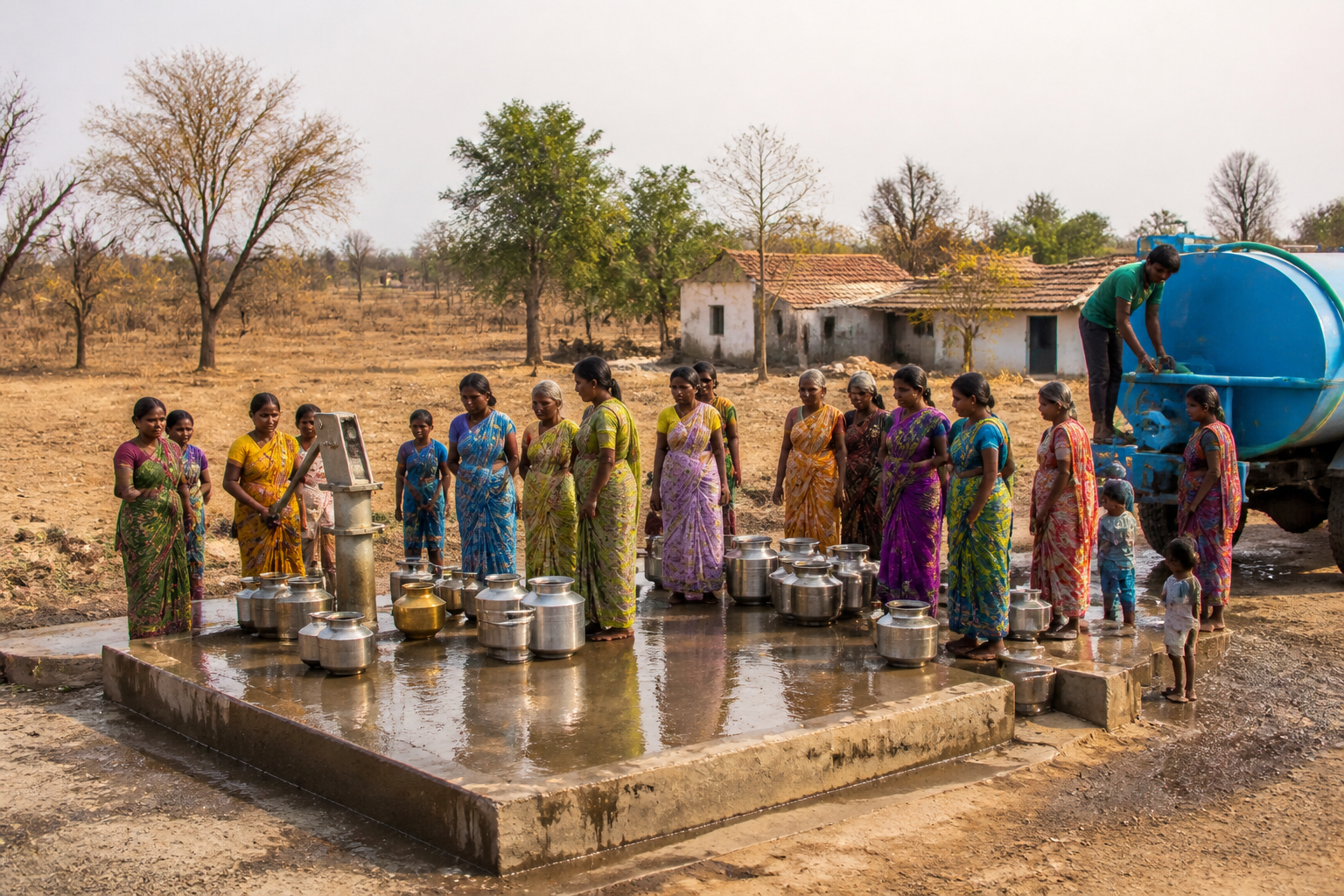
The Karnataka High Court’s order for a comprehensive report on the Sira drinking water crisis has brought an emergency in Tumakuru district into sharper institutional focus. The case concerns both the immediate shortage affecting villages in Sira taluk and allegations that residents are being forced to depend on deep borewells whose groundwater contains excessive fluoride. Together, the claims point to a problem that is larger than a seasonal supply interruption: the state must establish how much water is needed, what is being supplied, whether it is safe and who is responsible for closing the gap.
A division bench headed by Justice Anu Sivaraman heard a public interest petition filed by 28 local residents, including 74-year-old retired engineer R. Jayaramaiah of Chikkabangere village. During the hearing, senior advocate Ravivarma Kumar, appearing for the petitioners, told the court that the drinking water shortage in Sira taluk had become severe. He said residents were relying on borewells deeper than 1,000 feet and alleged that fluoride levels in the groundwater had exceeded permissible limits.
The petitioners’ submissions also included serious claims about the health consequences of the water crisis. According to the report, the petitioners’ counsel said more than five lakh people in the taluk were struggling for water every day and alleged that fluoride had been detected in the breast milk of lactating women consuming contaminated water. These claims were presented to the court by the petitioners’ side; the supplied report does not include an independent laboratory document or a separate health department confirmation establishing them.
That distinction matters because the court’s intervention is centred not only on the existence of scarcity but also on the quality and adequacy of the information available to the administration. The petitioners argued that the government’s existing status report was incomplete and that it had not disclosed even the minimum data on water supplied during the current summer. Without those figures, it becomes difficult to assess whether the emergency is being managed as a short-term shortage, a recurring groundwater failure or a wider public health risk.
The government’s response, as reported by Prajavani, was more limited in scale. Government counsel told the court that 17 villages in Sira taluk were facing water scarcity. To meet immediate requirements, private borewells had been hired in 10 villages, and water from those sources was being supplied after laboratory testing. This establishes that an emergency supply arrangement is operating in at least part of the affected area. It does not, however, answer the larger questions raised in court about total demand, the volume supplied, the reliability of the sources or the long-term safety of groundwater extraction.
The contrast between the two accounts reveals the administrative problem at the centre of the case. The petitioners described an emergency affecting more than five lakh people and involving deep groundwater and fluoride. The government’s response identified 17 affected villages and emergency supply to 10. Both descriptions may refer to different parts of the same crisis, but the supplied report does not explain the difference. The court’s demand for a comprehensive report is therefore significant: it seeks to convert competing descriptions into an accountable record of need, supply and action.
For urban and rural water governance, this is a familiar but consequential fault line. Water administration often responds to scarcity through immediate transport or temporary sourcing, while the underlying system depends on groundwater whose quantity and quality may be deteriorating. Hiring private borewells can provide an emergency source, but it does not by itself demonstrate that the aquifer is secure or that the water is safe over time. In Sira, the court has specifically asked the state to set out the present water requirement and the emergency measures taken to manage it. That requirement pushes the administration beyond a statement that water is being supplied and towards a measurable account of whether supply matches demand.
The groundwater issue is especially important because the petitioners’ account describes dependence on borewells deeper than 1,000 feet. The report does not provide the number of such borewells, their locations, their yield or the fluoride readings from individual sources. It also does not identify the laboratory that tested the water supplied from rented borewells, the frequency of testing or the results. These omissions do not disprove the allegations, but they show precisely why a detailed official report is necessary before the public can understand the full scale of the risk.
The court’s remarks underline the constitutional and administrative character of the dispute. The bench said that supplying drinking water is a basic duty of the government and expressed concern that people should have to approach the court even for such matters. It also said that the court could not supervise every issue. The observation places responsibility on the executive rather than presenting litigation as a substitute for routine water administration. A court can require disclosure, direct corrective steps and monitor compliance at defined stages, but the day-to-day responsibility for identifying shortages, testing water and arranging dependable supply remains with the government system.
The case also highlights the difference between access and safety. A tanker or borewell arrangement may address the immediate absence of water, but safe drinking water requires testing and disclosure. The government’s statement that water supplied through private borewells is being laboratory-tested is an important part of the official response. The supplied report does not provide the test results, however, so it is not possible to determine whether the arrangement is addressing the fluoride concern raised by the petitioners or only the quantity shortage.
That evidence gap is central to the public interest. If the principal problem is insufficient supply, the administration must show the deficit and how emergency sources cover it. If the principal problem is groundwater contamination, supply from unverified or inadequately monitored sources could leave residents exposed even when water reaches their homes. If both conditions exist, the response must track quantity and quality together. The court’s direction for a comprehensive report creates the possibility of such a consolidated record, although the contents of that report are not yet available in the supplied material.
The public interest petition also raises questions about how water emergencies become visible to the state. The court proceedings were initiated after residents approached it, while the bench questioned why citizens had to seek judicial intervention over a basic service. That sequence suggests a possible gap between local experience and administrative recognition. The report does not establish why the earlier government status report was incomplete or whether the authorities had previously received detailed complaints from the affected villages. Those questions would need to be answered through the state’s forthcoming submission and the record of the proceedings.
The immediate policy landscape, as described in the report, consists of emergency sourcing, laboratory testing and a court-directed assessment of requirements. The government has acknowledged scarcity in 17 villages and said private borewells are being used in 10 villages. The next administrative task is to provide the court with complete information on the taluk’s current water requirement and the emergency measures taken. That information should allow the court and residents to assess the geographic reach of the crisis and the adequacy of the response, without relying only on broad descriptions of hardship.
The available numbers show why precision matters. The petitioners’ counsel referred to more than five lakh people facing daily water difficulties, while the government referred to 17 villages and immediate supply arrangements in 10. The report gives no population breakdown for the affected villages, no daily supply volumes, no number of households covered and no fluoride measurements. These are not minor technical details. They are the basic data needed to determine whether the state is meeting a minimum service obligation and whether the water being delivered is safe.
The hearing also places the upcoming court date within a clear administrative timeline. The High Court adjourned the matter to the 23rd and directed the state to submit a comprehensive report before then. Until that report is filed, the extent of the shortage, the quality of the groundwater and the adequacy of emergency supply remain only partly established in the public record. The confirmed development is that the court has required the government to produce a fuller account of both need and response.
Sira’s drinking water crisis therefore matters on two levels. It is an immediate dispute over whether residents have enough safe water, and it is a test of whether public agencies can measure, disclose and manage a water emergency before it reaches the courtroom. The supplied report confirms the court’s concern, the government’s limited emergency response and the absence of several crucial data points. The next substantive evidence will be the state’s comprehensive report and the High Court’s consideration of it on September 23.
