


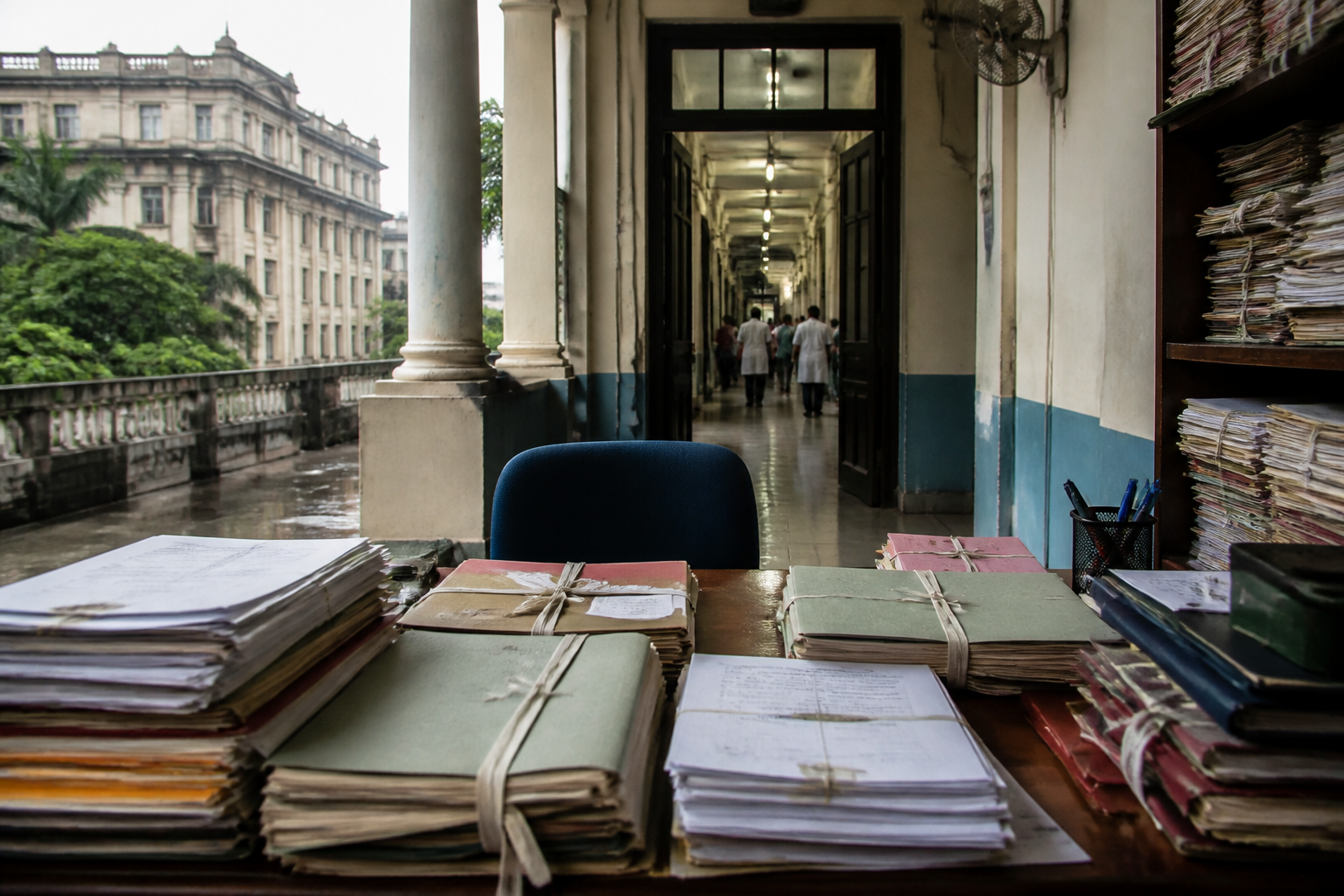
A second investigation into Abhik Dey’s postgraduate admission through West Bengal’s service quota has reportedly recommended action not only against Dey but also against several health department officials, bringing the state’s internal controls for specialist medical training under renewed scrutiny. The report, as described by Anandabazar, raises questions about whether a system designed to reward doctors serving rural and difficult areas was allowed to operate without adequate verification.
The immediate issue is the validity of Dey’s admission to the surgery department at SSKM Hospital. According to the report, the second investigation committee has supported the finding of an earlier committee that his service-quota eligibility was not valid. It has also recommended disciplinary action against those who allegedly helped him obtain the benefit. The health department has yet to decide whether to accept and implement the recommendations.
That distinction matters. The dispute is not limited to one candidate’s eligibility. It concerns how a public health administration certifies rural service, verifies departmental records, authorises postgraduate admissions and detects irregularities before a seat is granted. When those checks fail, the consequences extend beyond an individual admission: they affect the credibility of the quota, the distribution of specialist doctors and the confidence of medical workers who serve in under-resourced areas.
The controversy emerged during the wider political and professional mobilisation around allegations of a “threat culture” in West Bengal’s medical institutions following the RG Kar case. In 2024, the then state government constituted an investigation committee headed by Pীতবরণ Chakraborty, the former principal of NRS Medical College. That committee submitted its report to the health department on 4 October 2024. After the change in government, a second committee was formed to examine the matter again. Its report was submitted on 2 September, according to the report cited by Anandabazar.
The second committee was headed by Parthapratim Pradhan, principal of Sagar Dutta Medical College. Its other members were Manas Bandyopadhyay, principal of RG Kar Medical College; Somnath Das, a doctor in SSKM’s forensic medicine and toxicology department; and Kaushik Mitra, a professor of community medicine at Burdwan Medical College. The committee’s reported conclusion gives institutional weight to the earlier finding that the service-quota admission was not valid, while also widening the focus to the officials involved in processing or supporting the claim.
The service quota exists on the premise that doctors who work in rural and difficult locations should receive an opportunity to pursue postgraduate education. The report says applicants are required to complete three years of service in rural and remote areas. In Dey’s case, Anamay Hospital in Burdwan was presented as the rural workplace, while the Covid period was cited as the difficult-service context.
This is where the documentary questions become central. Medical organisations cited in the report argued that although Anamay Hospital is located within a panchayat area, it does not fit the meaning of a rural health centre. More seriously, the report says there was no record showing that Dey had worked there as a resident medical officer in the radio-diagnosis department. The hospital superintendent, Shakuntala Sarkar, reportedly told the committee that there was no document showing that Dey had joined the hospital.
The committee also reportedly recorded statements from the superintendent, a medical technologist in the radio-diagnosis department and a contractual health worker. According to the report, all said they had not seen Dey working there. These accounts, if accurately reflected in the investigation report, point to a basic administrative failure: the department appears to have relied on a service claim without establishing whether the applicant had actually performed the work required for eligibility.
The record trail adds another layer to the case. A file identified as ME-MISC 1852022 was reportedly created in the health department as evidence of Dey’s service at Anamay. Tanushree Mondal, the doctor responsible for such work at the time, told the committee that she had prepared the file on the instructions of Debashis Bhattacharya, then director of medical education, and the special secretary of the medical education department. The unresolved question is why the file was created without first verifying whether Dey had actually joined or worked at the hospital.
The reported findings also raise questions about the relationship between formal posting orders and actual deployment. Dey is said to have claimed that he began working at Anamay as a resident medical officer and clinical tutor on 31 December 2018. However, the transfer order from Burdwan Medical College to Anamay was dated 2 January 2019. The investigation committee reportedly found that the officials involved could not provide a satisfactory explanation for how service could have begun before the transfer order was issued.
Two principals who were in charge of Burdwan Medical College during the relevant period, Suhrita Pal and Kaustubh Nayak, reportedly told the committee that they were unaware of Dey’s absence from Anamay. Bhattacharya, who was then director of medical education, also reportedly said that he did not know about the absence. If the account is accurate, responsibility becomes difficult to locate because the administrative chain appears to have processed documents while the officials overseeing the institutions said they were unaware of the underlying attendance or deployment position.
A separate control was also reportedly missing. The investigation committee found that Dey did not have approval from the vigilance cell, which was required for the “trainee reserve order” associated with postgraduate study through the service quota. At the time, Aniruddha Niyogi was director of medical education. Anandabazar reported that he did not respond to its questions, although people close to him said that the approval process may have contained errors but that the no-objection certificate allowed cancellation if problems were later found.
That explanation, as reported, highlights the weakness of a system that treats later cancellation as a substitute for prior verification. A conditional approval can protect an institution only if the conditions are checked and records are auditable. If no irregularity is detected until an external controversy or investigation begins, the safeguard operates after the public benefit has already been granted rather than before it.
The case also exposes a division between institutional responsibility and individual accountability. The reported recommendation against Dey addresses the alleged misuse of the quota. Action against health officials would address the administrative pathway through which the benefit was allegedly enabled. Both are necessary to understand how the system functioned, but the source material does not establish what final disciplinary action will be taken or whether the committee’s findings will be accepted in full.
The issue is particularly sensitive because service quotas are built around a public-interest trade-off. The state asks doctors to spend time in rural or difficult settings and, in return, offers an avenue to higher medical training. The arrangement is therefore dependent on trust in records: posting orders, attendance, joining reports, departmental confirmation and vigilance clearance must describe actual service rather than merely formal paperwork. Any gap between the two can disadvantage doctors who genuinely complete rural assignments while weakening the policy’s ability to address specialist shortages.
The institutional structure described in the report is also fragmented. Anamay Hospital falls under Burdwan Medical College, while the postgraduate admission and medical education processes involve the health department, the directorate of medical education and the vigilance cell. Multiple authorities can create checks, but they can also create responsibility gaps if no single office is required to reconcile the complete record before approving a candidate.
The chronology makes that gap visible. The first committee submitted its report in October 2024. A second committee was constituted after the change in government and submitted its findings on 2 September. Yet the central question remains whether the latest recommendations will be implemented. Kaushik Chaki of the West Bengal Doctors’ Forum, quoted by Anandabazar, said that no action had been taken despite the earlier inquiry and asked when action would be taken over an incident that was already three years old.
Health Minister Sharadwat Mukhopadhyay said the file relating to the investigation report had not yet reached him and that he would comment after examining it. That response places the next stage within the department’s formal decision-making process, but it also confirms that the committee’s recommendation is not itself the final disciplinary order.
The evidence currently described supports a serious administrative concern but leaves several matters to be established through the official file and any subsequent orders. These include the precise status of Dey’s admission, the legal basis for cancelling the quota benefit, the responsibility of each official named in the investigation and whether the health department will initiate disciplinary proceedings. Until those steps are documented, the report remains a recommendation rather than a concluded finding by the department.
The larger lesson is that public-sector eligibility systems cannot depend only on certificates generated within the same administrative chain. Rural service quotas require verifiable deployment records, institutional confirmation and timely vigilance checks. In this case, the investigation has reportedly identified failures across each of those stages. The health department’s response will determine whether the inquiry becomes an accountability measure or another document added to a record of delayed action.
